00:00
Introductions
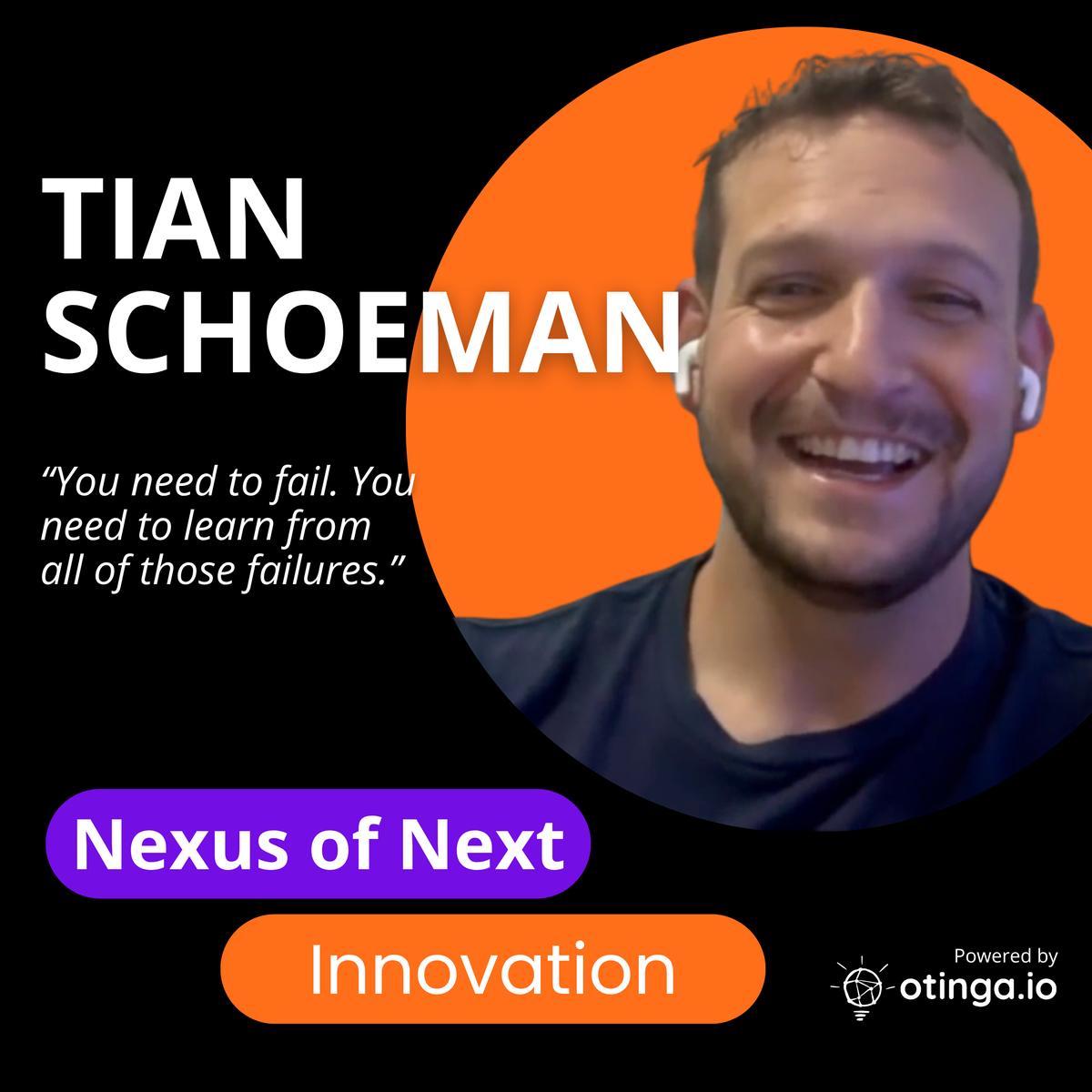
Tian [00:00] You need to build fast and fail fast to iterate and get something good out. The days of planning your software for three months, then executing it for 18 months and getting a feature out eventually, those days are over. It was the worst thing, most expensive, and most worst thing I've ever done in my life. Get yourself a MacBook mini M4 and I'll add my bank card to it.
Tian [00:28] I'll add like my login credentials to whatever stuff my personal things have on it, and just let it go free without knowing how to set up guardrails. You could probably get your own customised ERP system for less than $100. OpenClaw is probably a tipping point in how scary AI can get and become.
01:00
Welcome - meet Tian Schoeman
Francois [01:00] Today, I have the absolute pleasure to welcome a guest to the Nexus of Next podcast, who's someone that embodies the truth that we don't talk enough about in tech.
Francois [01:18] You see, the most dangerous innovators aren't the ones with the fancy degrees or the deep knowledge of some obscure mathematical formula. It is the people who are constantly reinventing themselves, and they absolutely refuse to accept that there's only one thing in this life that they should be doing.
Francois [01:43] Today we've got Tian Schoeman, someone who grew up in a coastal town called East London in South Africa, moving to Cape Town. Yes. Everyone can recognise Cape Town for Table Mountain and the beautiful holidays. But I can tell you one thing, Tian is someone that has started his career learning how to design buildings, learning CAD and then all of a sudden realise that the actual architecture that he wants to work on isn't buildings, it is software.
Francois [02:18] And today Tian is doing exactly that once again reinventing himself. But now in the world of AI. Tian, an absolute pleasure having you here with us on the Nexus of Next podcast. Welcome.
Tian [02:34] Thank you Francois, I'm excited to dive in, and what an awesome introduction.
02:43
Democratised learning, and an obsession with productivity
Francois [02:43] Yeah, I think it's always so interesting how you get to play in this world where we can actually constantly reinvent ourselves and how things have been democratised. Right. 20 years ago it was difficult to learn a skill like computer science. And today most people learn it on YouTube.
Tian [03:04] And, I mean, if you take a look at just AI itself, I've got my mother. My father. People that are not technologists at heart, they're building their own little micro applications with a ChatGPT. So the democratisation and learning capability is unparalleled with AI next to you.
Francois [03:30] Yeah. It's ridiculous. I think it's actually one of those. Wow. Is this real? How awesome is the fact that you can learn basically any skill. And so I saw so many different new roles pop up all over the place, everything from prompt engineer all the way through to chief AI officer. And so I know that your journey has been particularly interesting going towards impact.com, a fantastic platform that connects companies with creators, but more specifically focusing on Gen AI and productivity.
Francois [04:09] Tian, just tell us a little bit more about your experience in delving into this world, in a professional setting, in a proper unicorn.
Tian [04:17] So I have to say that I am absolutely obsessed with productivity. So identifying where there's room for gaps inside of a workforce or inside of a work environment to make things more efficient. Previously we've had integrations and integration seems so stone age at the current moment since the last four years kicked off.
Tian [04:44] It's not only the ability to make things more productive or make businesses more productive, but looking at the human element, like each person unlocking a person on their personal level, to be able to free up more time, like able to get stuff out, work on the more important things. But not just only that.
Tian [05:09] We are in a fast, rapid paced world at the current moment where you struggle to switch off. You want to be able to get your work done, move at a rapid speed, but also enjoy your life, enjoy that off time as well. And with AI and productivity, that becomes a whole new unlock in a corporate environment.
Francois [05:34] Yeah, I think it's something else. I'll say, and there's this light that you can get to see in people's eyes just light up when they start realising, wow, this is actually all now possible. So speaking of lighting people's eyes up, Tian, I know that we've got a jam packed podcast episode today with incredibly interesting things, all the way from starting with one angry email all the way to building one of the biggest on demand delivery software solutions in South Africa during Covid.
Francois [06:07] How not to innovate, building your own LLM, and how not to do that.
06:12
The one takeaway: go play
Francois [06:12] And if you were a senior leader in enterprise, how should you be thinking about AI? Tian, what other takeaways do you think people will get out of this episode today?
Tian [06:27] I think we're covering a few really great topics over there, but one of the things that I would love people to walk away is go play, go jump into the tools, adopt the tools, and identify where it can help you individually, help your team or help your company.
06:51
Why executives getting hands-on with AI is still taboo
Francois [06:51] Yeah, I completely agree. And I'm seeing the same pattern. What do you think about senior executives following that advice to go play?
Tian [07:00] Well, I think that is very taboo. A lot of executives are exceptionally busy, which is part of the role. But the biggest thing that I've learned is once you dive in and you're on top of an executive level, understanding the technology not only from a chatbot perspective, but what unlock it can bring. The ability to properly integrate it into systems, building true agentic systems without the feel of I'm working with AI.
Tian [07:36] But taking it even steps further is bringing the personal connections a lot closer to home. So the ability to work into your software or your services, AI, so that human element becomes more prominent. I think there is a massive unlock from an executive's perspective. Once they realise what unlocks they can have and how that translates into more engagement with customers, more human touchpoints, especially in today's world where everybody is trying to move into a chatbot that helps you with your query and
Tian [08:23] putting the cats. How can I say it like just diving straight into it in terms of like, if you take a look at what the big companies are going to or have done, and I'm using specifically Salesforce as an example with 9000 customer support people, and they laid off 3000 of those 9000 employees, with the
Tian [08:50] expectation that AI is going to be able to not replace them, but enhance the other 6000 people that are employed. And unfortunately, the CEO of Salesforce was the first person to raise his hand and say AI is not here to replace a person, but at the same time, it is about that personal connection. People dropping off, people not wanting to talk to bots and talk to a human.
Tian [09:20] And there is a massive churn component over there for customers. And when an executive actually truly understand where AI inside of business leverages like the next step, the next unlock versus here's another chatbot, I'm freeing up additional monthly resources. And then you will fail without understanding the technology in depth.
Francois [09:51] Mhm. Yeah. It's so true. And I think the other element to it is if you're a senior exec, it's almost the same as being in the dot-com bubble. This new world is so different to what it was before that you need that exposure and you need that play so that you can fundamentally understand what is this even about at that level, so that you can make the right decisions at the end of the day.
10:20
The dot-com boom vs the AI bubble
Tian [10:20] And actually, like on that point, I heard someone talk about like a comparison between the dot-com boom versus the AI boom. And I'm probably getting chills right now just thinking about the fact that the dot-com boom was significantly less disruptive in comparison to the AI bubble people playing and adopting AI at an early stage.
Tian [10:46] They are still stuck inside of the bubble, and the amount of people in the global population that's outside of that bubble that does not know what is there, what is coming, what is going to happen in a very transformative way. And the reality is, it's not just on computer systems where the transformative is coming from.
Francois [11:11] Yeah, it's 100% so, so accurate. Yeah. So I think there's something we'll share a little bit later on in the episode as well, talking about how the future is already here. It's just not evenly distributed. But before we go into that story, so you've had this rich, rich, rich experience of making major transitionary or taking major transitionary steps in your career.
11:43
One angry email and a Friday-afternoon beer
Francois [11:43] One of those started off with an angry email and ended up having you build one of the most impactful pieces of software during Covid in South Africa. Just tell us a little bit more about that story.
Tian [11:58] Yeah, definitely. So
Tian [12:01] I've got to say, like it all started on a Friday afternoon. I was really like craving a bottle of beer. I didn't have transport at that moment, so I thought, okay, let me look at what on demand services there are. And I came across this app where it was an alcohol on demand delivery service based in Stellenbosch.
Tian [12:27] And I thought, okay, I'm going to just order myself stuff. As I'm clicking through, I realised there's a few UI components. Not great. The user experience isn't great and things started falling flat. And from that point I reached out to like the support and got a phone call within the same day saying, can we meet tomorrow?
Tian [12:49] As in my email, I sent like a big list of, oh, you can do this, you can do that. Like, what about this experience, etc., etc. and on that Saturday we sat at a cafe in Stellenbosch and we discussed all the ways that they can improve. By that Monday, I had a contract to replatform the entire system back end to front end.
Tian [13:18] And that just was the start. And after three years we built like three different applications from the consumer side web application, delivery application, rider safety.
13:35
Lockdown, on-demand delivery and an acquisition
Tian [13:35] And after three years being inside of
Tian [13:40] how can I say being inside of like, the on demand alcohol delivery service? They were acquired by a tech giant for millions of rands. And it all started in Covid. Everybody was locked down inside of behind closed doors, making pineapple beer galore, and they were able to deliver alcohol to your door.
Tian [14:06] And massive conglomerates started utilising their platform for on demand services. And that's where the boom took off.
Francois [14:16] That's incredible. You know, one of the interesting things about that is how sometimes a rising tide lifts all boats. Right. And I see that same pattern happening here today. But as part of that rising tide, there's new technologies that needs to be adopted.
14:37
Greenfield vs brownfield, and building on Flutter before it was stable
Francois [14:37] And so I know that you had a very interesting experience.
Francois [14:41] And I'd love to get your perspective on how you decided to, in some cases, just replatform completely and start with this emerging tech. Just tell us a little bit more about that experience and starting from scratch, building a production application using the latest and greatest leading edge, not yet fully adopted technology.
Tian [15:07] So I'm a massive fan of greenfields versus brownfield. So taking over code base, especially larger code bases, that's been running for two years plus, you're picking up a lot of issues with that and your delivery time is significantly slowed down. And that's why I like going with a more greenfields approach, starting from scratch, utilising the existing system or a system as the source of truth.
Tian [15:36] The documentation that I need to be able to build the next platform and this system that we built was built on Flutter. If I remember correctly, and this was many years ago, we actually started before Flutter went GA or their first stable release, and we started building on that. And by the time we launched in production, Flutter was on version 1.5, the second version after the stable version came out.
Francois [16:10] That's crazy. Yeah. So that's like proper early, early, early adopting. Hey. And as part of that journey, you know, there's trade offs. Yes. There's tremendous advantages in leveraging this new technology and do things that other platforms or tools cannot do, just simply cannot compete with.
Francois [16:30] But then there's also a trade off
Francois [16:34] because there's challenges when adopting technology early. When it comes to that.
16:40
Workarounds: native code, accelerometers and rider safety
Francois [16:40] So I'd love to hear some of the stories, some of the workarounds that you had to do to account for those shortcomings in the emerging technology.
Tian [16:50] So one of the biggest pitfalls with Flutter at that time was that it wasn't able to leverage like hardware components, really on devices. And we wanted to get a, how can I say it, a delivery app out to the drivers or the delivery people so that we can track them. Customers can track them. But not only that, we also worked on the safety aspect.
Tian [17:15] So we worked on a few different algorithms to identify G-forces based on the accelerometers. Rapid. What do you call it?
Tian [17:28] A telephone coordinate. Coordinates that keep changing. So based off of that accelerometer that moves at X amount of speed, you can pick up if it was a small bump, if it was a big bump or oh geez, we need to like really get some services out there. And Flutter could not serve that. So we had to go back to a little bit of an old school hack in there.
Tian [17:52] And I think that is where cutting edge technology, but technology itself is also really vital, where you can wrap the lower-level tech inside of your call it the Flutter wrapper in that scenario. And we dove into Java for the Android side and Objective-C for the iOS side to be able to leverage those components, including deeper images.
Tian [18:21] So Flutter unfortunately only had very set limitation on your camera, and we wanted to be able to identify IDs, vet IDs to go through a system that, how can I say it, looks for criminal records and all of that stuff when a driver signs up. And we needed high quality imagery to be able to send off for the
Tian [18:46] I completely forgot what they call it. But like, criminal background checks, if I could call it that.
Francois [18:52] Yeah. That's crazy. So sometimes there's this neat trade-off that you need to consider, right? Like, okay, so we want to exploit the advantages, but you still have to deal with some of the shortcomings from a technology perspective.
19:10
880,000 lines of code and the human review problem
Francois [19:10] And I think in today's day and age, when we look at AI specifically and even more specifically than that, generative coding, or agentic generative coding.
Francois [19:27] As a collective, it's really bleeding edge technology, but on the same level, on the same coin. The other side is there's some challenges as well, right? And so how do you balance the advantages and the speeds that you potentially get out of agentic generative coding versus some of the negative aspects of it?
Tian [19:52] Well, I think everybody that is inside of the engineering world would immediately understand the pain points of a PR that was created by an AI system. As it is this morning, I did a refactor of 1200 or 1100 files, 880,000 lines of code, and there is no chance a human review is going to look at that.
Tian [20:20] So you do have the upsides of let's get stuff done fast, but what vulnerabilities are being added in the ways the shortcomings that's coming through? Is this model that I actually used really like making sure that my stuff is safe. And that comes down to a, I almost want to say, like a play and go test mindset where you test and identify where the shortcomings are and with the capabilities of skills, rules and agents inside of your various different tools, you're able to enforce those different safeguards, if I can call it that.
Francois [21:04] Mhm. Mhm.
Francois [21:06] Yeah, I think it's a proper challenging thing to do well. It's like they say, trust but verify at the end of the day. Right. And unfortunately reading hundreds of thousands of files is not particularly easy when it comes to verification. So there should be a smarter way of doing that as well.
21:24
Who takes responsibility for AI-written code?
Tian [21:24] I think where we're actually going to end up with is we're able to ship hundreds of thousands of lines of code via AI, but at the same time, we're going to have to have AI review hundreds of thousands of lines of code. When does it get into production? Do you take the risk of putting it into production and where's the human element?
Tian [21:49] Who takes responsibility of those hundreds of thousands of lines of code?
Francois [21:54] Yeah, yeah. There's all sorts of challenging questions that needs to be answered from an accountability perspective as well, right? I mean, when there's a developer that peer reviewed each and every line made, had big debates about variable name choices and the like, and now all of a sudden, you've got machines doing all of this at a million times the speed.
Francois [22:17] It becomes really, really challenging. So yeah, I think it's going to be an interesting space to play in. And that's probably the trade off, right? Is that there's this uncertainty.
22:29
When an AI's pull request gets rejected by a human
Tian [22:29] You know, if you followed the most recent news, there was an open source library on GitHub that a guy had just said, okay, my AI is going to go free on this and actually found a optimisation that was really powerful. His AI checked in a PR with the optimisation and it was rejected by a human. And this is where OpenClaw comes into play, because OpenClaw basically took that and then created a
Tian [23:04] Reddit thread saying, how can a human that creates optimisations reject the optimisation that was created by an AI bot? Should you not be looking at what is done not compared to what was done by who or what.
23:25
What is OpenClaw?
Francois [23:25] And for those that don't necessarily know what OpenClaw is, and that's not when a crab just does this. Just what is OpenClaw, Tian?
Tian [23:39] OpenClaw is probably a tipping point in how scary AI can get and become in terms of a fully autonomous AI assistant. Imagine you had your PA on call 24 over seven, but your PA does not just check your calendar, respond to your emails, and schedule your lunch dinners or lunch meetings. It actually writes on demand software when and how you need it.
Tian [24:12] If it can't get a job done, it just spins up a whole brand new software gets credentials to be able to integrate to the different systems that you need fully, autonomously. And you can either let it go completely wild or add a little bit more safeguards around it in terms of like, wait for my instructions only.
Tian [24:40] There's a lot of scary stuff that came out of it. And I think that is a big transformative moment about how scary AI can get in the white collar industry.
Francois [24:53] Mhm. Mhm.
Francois [24:54] I think, yeah, it's quite interesting to see that play out. And I mean the one thing that's particularly interesting about OpenClaw is it's almost like what if a ChatGPT chat could actually do stuff. And so you know, when it makes like a mistake where it, oh oops, I misspelled or I misremembered a fact.
Francois [25:18] Well now it misremembered to use the free tier on a platform and just used your credit card to get the highest subscription because it was faster. Because you said please do it fast. And so sometimes it's quite interesting how these things break.
25:40
Guardrails, guardrails, guardrails
Tian [25:40] Scary. Like I've heard some terribly horrible horror stories around people that's just like get yourself a MacBook mini M4 and I'll add my bank card to it. I'll add like my login credentials to whatever stuff my personal things have on it, and just let it go free without knowing how to set up guardrails.
Tian [26:05] I think that was the biggest important thing that people did not set up on the get-go.
Francois [26:12] Yeah, it's guardrails, guardrails, guardrails. Yeah, I think that's going to be one of those hype words in the near future because as we see more people adopting this technology, the trade off is, yeah, you can write an entire software platform in an evening, autonomously.
Francois [26:35] But
Francois [26:37] there's loads of security vulnerabilities. It just used your credit card to subscribe to a Panda subscription because you said you like bears. It could be anything, right?
26:48
How not to innovate: building your own LLM
Francois [26:48] So I think it's quite interesting, but, you know, in the world of innovation, Tian, like, I see so many different organisations do innovation and there's no real right way.
Francois [27:03] It's just learning from your experiments and running as many as possible experiments that you can afford not to be successful in. And so I'm curious, how would you say your journey around building your own LLM is maybe an example of learning some valuable lessons from the world of innovation.
Tian [27:27] Oh, wow. Yes, that was a little bit of a throwback to about four years ago, maybe three and a half years ago, when ChatGPT really came out. It was really cool. Didn't get to interact with it until six months later when they released their APIs to the public. But we thought, I went in. I did all my research on Transformers.
Tian [27:52] How do you build your own LLM? And I very quickly realised why it was so expensive to build something. I think my little bot or little data set that I created was somewhere around, like, I want to almost say 80,000 parameters. And it was shocking. It was the worst thing, most expensive and most worst thing I've ever done in my life.
Tian [28:25] But the learning curve around it is it's so much cheaper just to tap into the professionals that's done it, just waiting for them to make it cheaper. And that's where Google Gemini comes in. That's I feel like Google really makes it affordable for people to jump in. And you get inference services. Now to apply inferences on top of other models and open source models as well.
Tian [28:52] So yes, I would definitely highly suggest don't try and build your own unless you've got a few bucks in the bank and you want to learn how it works. Exactly.
Francois [29:06] Yeah, it's quite funny. I think there's always this curiosity. But then you learn the lesson and then you're like, okay, don't do that. That was a bad idea. And I think innovation is a lot like that, where organisations aren't really structured for people to fail safely in a way like that.
Francois [29:26] So you have a business where if someone makes one mistake, then it's, you know, game over. And so no one takes chances and as a result, innovation stagnates. But you need people to make these mistakes like learn what not to do. And I think it's so cool. First, just attempting to build your own LLM.
Francois [29:49] It's incredibly difficult to do. So kudos for you to getting something that actually spits out tokens. Never mind whether or not that actually makes sense.
Tian [30:02] Oh yes, my three word responses were brilliant and not sequential, but brilliant.
30:11
What a parameter actually is
Francois [30:11] Yeah, it's quite entertaining seeing. But it's so impressive how far we've come. I mean, you're talking a few thousand parameters. We're at hundreds of billions of parameters today and counting. And for those that don't know, the parameters are effectively, think of it like the mathematical equation going, this is the vector for ocean.
Francois [30:38] And so a parameter is whether or not it is Pacific or Atlantic. And that changes the direction of the vector ever so slightly. And so those parameters are actually the thing that adds distinction to the ocean, if you will. Right. And so yeah, it's quite interesting to see going through that journey.
31:00
Build fast, fail fast
Francois [31:00] So when we're talking about innovation, Tian, like what do you see is probably the biggest superpower that you've got in your team and in your environment over the years of experience that's really resulted in the biggest innovations.
Tian [31:20] I think being completely unlocked, within reason, within budget, that is something very important. But you're not going to get innovation for every 1 or 2 times you try and be innovative. You need to fail. You need to learn from all of those failures. And I actually encourage that, that the typical thing that's coming out from all of these LLMs, these AI systems that are coming at a rapid speed is you need to build fast and fail fast to iterate and get something good out.
Tian [31:58] The days of planning your software for three months, then executing it for 18 months and getting a feature out eventually. Those days are over. The days of like trying to push features within a month is, yeah, even less. Like instead of sitting on a whiteboard planning all of your things out, get into the crux.
Tian [32:22] Focus on delivering 10, 20, 30 POCs. And think about it like as a micro app, small little applications, not building this mega monolithic tool. But for every feature you go in, you dive in and build it, fail, build it, fail until you get to that sweet spot. And that is where I believe innovation is.
Tian [32:50] You just need that one idea. 60 failures and one win.
Francois [32:57] Yeah. So true.
Francois [32:58] It's like Edison says. I didn't fail 10,000 times. I just found 10,000 ways not to make a light bulb. And I think that's so true today. Especially when it's cheap to fail. Right. Like, if we think about it a while back, the moat was the effort required to build software. But now, because the effort has been reduced dramatically, your risk is also reduced dramatically in building anything.
Francois [33:28] And so if someone can tell OpenClaw I want a Panda solution or a Panda social media, and tomorrow morning they wake up with like a Panda solution, right?
Francois [33:44] Then what's the actual cost? If it's no longer hundreds and thousands of dollars to be able to build something like that, the cost is actually just trying and being willing to fail, right?
33:56
The democratisation of software and the $100 ERP
Tian [33:56] Yeah, absolutely. I mean, the democratisation of software is coming. It is. I actually want to say it is here. If you don't have a niche. If you don't have a very specific, unique
Tian [34:13] business value, anyone can go and build a clone. I've already heard of people that built their own ERP systems because SAP didn't cut it for them. Not at the rate that SAP charges, but also with the limitations, the complexity and I'm a little pizza store. I just need this. Go onto a Cursor, Copilot or any of these agentic coding tools.
Tian [34:43] Build it out. You could probably get your own customised ERP system for less than $100, and that is where we're heading into at a rapid pace, where you've got grannies, accountants, and whoever building unbelievable software and yeah, democratising software with AI. And I think just to add on to that is how we got there.
Tian [35:15] And that is because AI is moving at such a fast speed. And if you take a look at where the AI,
Tian [35:25] what core things AI is focusing on, they're not focusing on being a robot, a pilot or a receptionist, but they're actually focusing on code and the purpose, it's very purpose-driven so that they can use their own models to train their own models, build their own models, and iteratively keep going. And I've watched a documentary or podcast recently where they said that every single model that comes out is almost at a 10x capability compared to its predecessor, and it's only going to keep increasing.
Tian [36:04] So software, if that is the core component of all of these AI LLMs that are being put into our hands, they are democratising coding at a rapid pace so that they can progress AI further.
Francois [36:25] 100%. Yeah, that's the way they're putting the pedal to the metal and putting their foot on the gas effectively. Right. Is by creating the system that creates the system. And so it's kind of a very much an inception-like playbook that they're executing at the moment, which is both interesting but also very exciting at the same time.
36:47
AI as augmentation, not replacement
Francois [36:47] So Tian, if you were a senior leader, as a listener today, how would you recommend people think about AI? I've got a large enterprise or I've got a medium enterprise. How should I be thinking about the world of AI? I mean, at your current organisation, you guys have literally thousands of people who work in software.
Francois [37:15] Not just in general employee base, in software directly. Right. And so I think your opinion around how you should think about this technology is incredibly impactful for senior leaders today.
Tian [37:30] Definitely. And I think going back to what we mentioned earlier regarding like the Salesforce scenario is AI is not here to replace you. Like AI is here to augment you. And as a senior leader, understanding that is a massive unlock for the business itself. Imagine you're cutting down on cost or human cost and trying to replace that with augmented people.
Tian [37:58] You're going to get somewhere. But if you give ten engineers all the AI tools that they need, that is great. But if you give 100 engineers or 200 engineers all the AI tools, the unlock is that 100x, 200x that comes into play. So I think the biggest danger that comes in is not AI itself, but people using AI. People understanding where AI is coming from.
Tian [38:31] And there's numerous ways that I think executives would think about it, not just from a chatbot perspective. AI is not only a one-dimensional solution. Baking it into your system, making your system smarter, self-healing, or being able to actually get deeper insights. Tap into human emotional
Tian [38:59] components to deliver better software, deliver better services. The unlock is here at the moment, and it's about how you interpret it and how you're able to adapt it to your business, find that niche and actually know what your customers want. And if you don't know, that's where AI can come in. Build something.
Tian [39:24] Get your customers' feedback. Improve your business through real people, all synthesised with AI. Getting that unlock over there.
39:38
Fuel for a fire or fuel for a rocket
Francois [39:38] Yeah, I think you're 100% on the money. Hey, like I almost see it as senior leaders have this opportunity to stand with, like, a giant fuel canister at their businesses. And they have this choice of whether or not they're going to use the fuel to set the business on fire, or use the fuel to build a rocket to go 20, 100 times further than it could ever be going.
Francois [40:08] Right. And we're seeing this pattern at the moment where loads of large enterprises are really,
Francois [40:19] they're under-investing by orders of magnitude in terms of what they should be when it comes to the world of adopting artificial intelligence technologies as a whole. Right. Because we're seeing a per capita investment in a start-up that is astronomical relative to the number of people and the revenue numbers.
Francois [40:44] And then you look at the same type of pattern completely inversed in large enterprise, which is very strange to see happening.
40:51
From a Monday request to a Wednesday sandbox: the AI ROI case
Tian [40:51] There's actually a wonderful graveyard for all of these start-up AI start-ups to grab ideas from and identify where shortcomings came from. But you're absolutely right. There is a massive shift, especially on an exec or a leadership level where you realise if I invest $200,000, $400,000 into my AI for the business, imagine the complete unlock.
Tian [41:27] If you've got AI fluent staff members, people leveraging their skills, enhancing their skills. And one, your backlog starts disappearing. So you're already saving on months, if not years worth of human cost because you've augmented people in the back office. You are shipping products faster. Imagine talking to a customer on a Monday that wanted a cool feature.
Tian [41:57] Hey, do you think this will be great? And coming back to him on Wednesday saying, hey, listen, we've got a sandbox for you. You want to play around? That engagement, that rapid development is where traditionally you couldn't get that out that fast. Your customers had to wait for a roadmap and sit on that roadmap for six months.
Tian [42:23] Now you can, like, rapidly put something in their hands, get a feel, see if it like has this crap or can get baked in, in a real production manner. And that goes back to that concept of build fast, fail fast, and getting real human feedback. And again, I think I've mentioned it earlier, but when you start looking at AI as a superpower for all of your employees and being able to deliver to your customers faster, you start looking at your $200,000 or $400,000 investment towards your 10x, 20x, 30x ROI, because you're now more engaged with the customer, giving them more of what they want.
Francois [43:22] Mhm.
43:23
Why the biggest AI returns are kept quiet
Francois [43:23] 100%. I think that's part of the challenge at the moment, is that the people who are actually getting these astronomical returns on investment, they're keeping quiet.
Francois [43:37] And so think about it. If you were a senior leader of a large enterprise, would you be announcing, and you're getting 20x return on investment on a very significant AI investment, would you be announcing that in the world? No. Not really. Would you be sharing that so that your competitors can do that as well?
Francois [43:58] Well certainly not. And so I think there's that catch where just because you aren't seeing this pattern publicised at the moment doesn't mean it doesn't exist. I can tell you the people who are announcing it are the start-ups, because that's what they're using as a differentiator at the moment to compete and punch way above their weight.
Francois [44:20] But yeah, I think there's loads of very significant businesses that's doing exactly that.
44:26
The future is already here, it's just not evenly distributed
Francois [44:26] This brings us to another topic. So as William Gibson told us, the future's already here. It's just not evenly distributed. What are your thoughts about that, Tian?
Tian [44:40] Yes, I think that is, like, absolutely true. If you've been in the AI bubble for, let's say, the last four and a half years, especially after the big ChatGPT boom. I want to say that you're still in the bubble. The amount of people that believe the bubble is going to burst, that's a whole topic for another day.
Tian [45:07] But when I'm referring to the bubble is the massive
Tian [45:14] scale of the population that does not use AI, that is not understanding what AI could do besides just being a ChatGPT or a quick answer for my dinner tonight is astronomical, and I believe that we are at that current juncture in time at the moment. Especially looking at what OpenClaw has done. Opus 4.6, maybe even Codex 5.3.
Tian [45:44] When you start looking at these models, being able to leverage real,
Tian [45:52] agentic frameworks like LangChain, LangGraph to squeeze out more out of those models, you are unlocking an absolute beast. I mean, you're not just looking anymore at software, you're looking at white-collar jobs, anything that can be touched with a computer. But not only that, imagine the
Tian [46:19] complete unlock being in a digital world at the moment where AI can just democratise almost any field, that is what's scary. And that is where, like a lot of people either they don't dive into the tool, learn what the tools can do, and actually adopt it. And then just the people that just don't know it.
Tian [46:44] I watched the podcast this weekend. And it's absolutely scary if you don't know what's happening inside of that bubble. And that is the bubble that I think is going to burst, not the bubble of like, all of these investments dropping, and that's another day. And also not me being professional at like stock exchanges and stuff, but that bubble of like the AI systems, the Claude bots coming for receptionists.
Tian [47:19] What about air traffic controllers? Humans make more mistakes versus autonomous systems that can monitor millions and billions of logs at a given moment. What about things like that?
47:34
Rethinking how you deliver value
Tian [47:34] And I feel like where there's a massive moat or niche is where your,
Tian [47:43] business has something tangible associated to it. Imagine you're able to build all of these softwares. An eight-year-old scholar can build a, not a SAP-like system, but a very similar type of system just by prompting their way through. But they still can't build a system to a packaging solution.
Tian [48:08] And your packaging is what is actually going to drive the value.
Francois [48:13] Effectively rethinking how you deliver value as a whole. Right. It's not even like what is the value proposition, it is how you actually deliver value, full stop. And so yeah, I think it's going to be a very, very interesting future, but also incredibly exciting and in a lot of ways very positive for humanity, because if we're shipping things faster, if we're producing more output, you and I and a lot of people who listen to this episode today is living a better life.
Francois [48:48] Than kings and queens lived 300 years ago. Better healthcare, better entertainment, better transport, better health. And so when we think about how this is accelerating, the world has got a lot of reasons to become a lot better for the everyday person, which I think is fantastic.
49:14
An AI personal trainer and nutritionist in your pocket
Tian [49:14] Oh, I think you actually touched on something that I thought is a perfect use case about how this whole bubble versus people that don't know or don't adopt the tool versus those that have adopted it is imagine you go in to build your own LangChain system. And that system has got an orchestration of agents.
Tian [49:40] One being a dietitian, you go in and you download all of the academic books, the nutritional information, train your agent up specifically on that, another one being a gym expert. And you can imagine where this ends up going, where you've got an AI pocket. Instead of me spending 4,500 rand with my personal trainer every month, I just spend less than 60 rand for a personal trainer plus a nutritionist, and it can remind me and be absolutely annoying as well to make sure that I'm healthy.
Tian [50:20] And that's where
Tian [50:26] I feel like anybody that had a personal trainer or nutritionist has gone through that WhatsApp at 5:00 in the morning. Have you eaten?
Francois [50:38] 100% right.
50:40
A prediction: AI will be dumber and more annoying than we think
Francois [50:40] I think if I could make a prediction about the future, in the near future, I think the world of AI is going to be a lot dumber and a lot more annoying than we all think it's going to be. Usually doing things like subscribing to services and messaging you at 5 a.m., going like, what did you eat?
Francois [51:02] Wake up.
51:04
Wrap-up
Francois [51:04] Yeah, I think it's great. Right. Tian, it's been an absolute pleasure spending some time with you here today. Your insights specifically around how not to innovate and how to innovate, looking at experimentation and creating that safe environment for success, how you remove the bounds a little bit to help people open their knowledge, open their experience and open their perspectives around experimentation being such a key element to it.
Francois [51:35] And then talking about how you as a business leader really needs to rethink your business value proposition that you're offering your customers, and how you should rethink the disconnected returns on investment that you can actually get from the world of AI. Tian. An absolute pleasure having you.
Francois [51:58] Going from architectural draughtsman to exceptional AI thinker, creator and orchestrator of organisations. Tian, thank you so much.
Tian [52:13] Francois, thank you again for having me on your podcast. And I'm very excited to see this space grow. This is amazing.

 Claude
 ChatGPT
 Gemini

