00:00
Intro - meet Themba Chakela
Themba [00:00] Leading innovation is a full contact sport and a full body experience.
Themba [00:05] How curiosity can help you go down rabbit holes that actually end up at the pot of gold.
Themba [00:13] So for all intents and purposes, I should have nothing to do with a tech hackathon.
Themba [00:18] I decided to immerse myself fully in the experience.
Francois [00:22] Most large enterprises have got gold on their streets.
Francois [00:26] But that gold just stays there. No one takes the walk, you know.
Themba [00:29] The similarity between all those organisations is that the Excos cared about people.
Themba [00:34] Now, if your exco genuinely cares about people, there's other ways to show that care in the midst of scaling. It is, and it's, the signal is clear.
Themba [00:44] In this business, we make time to help each other.
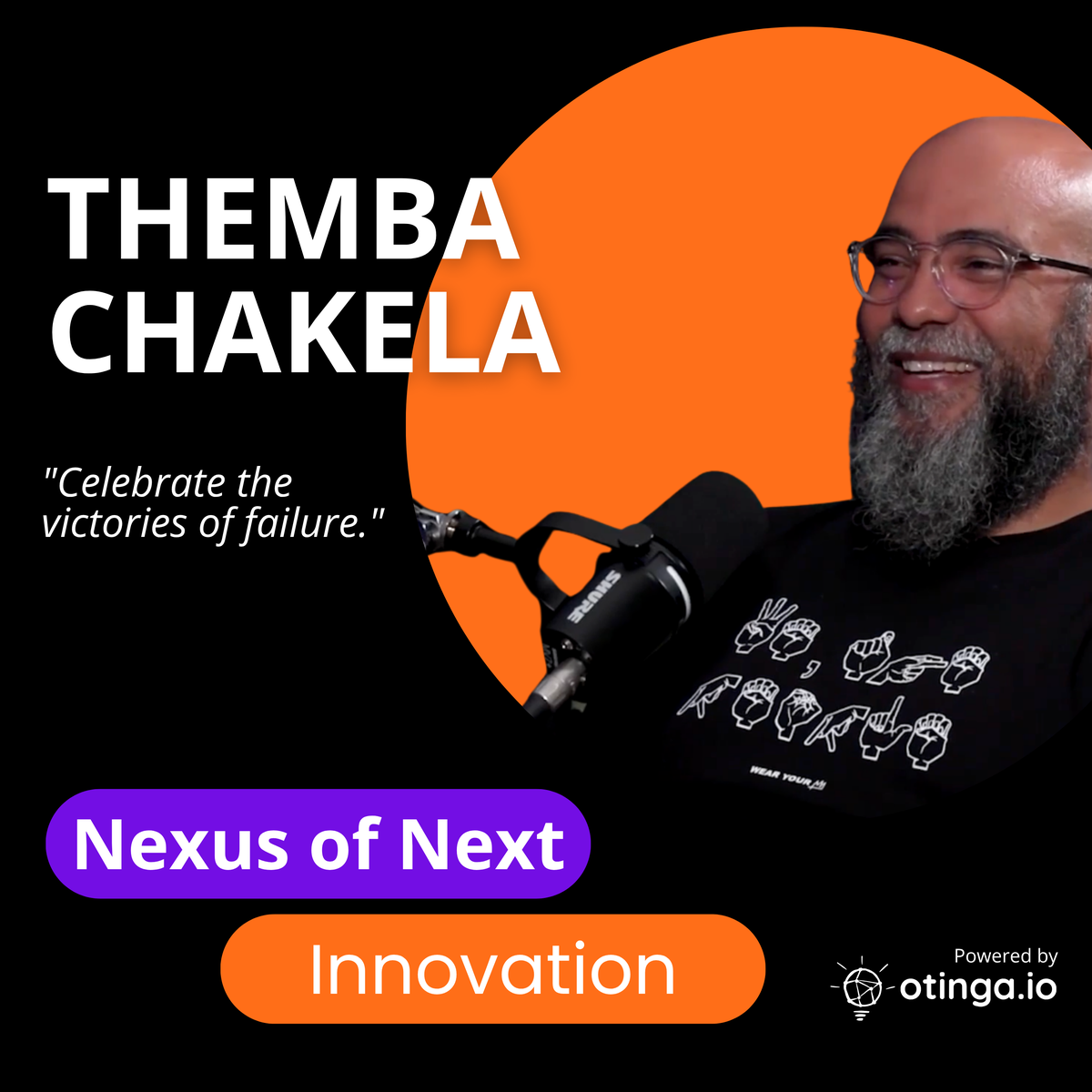
Themba [00:47] Celebrate the victories or failure so that they don't push you away from the opportunities of success. And the higher you rise in organisations, it becomes your job to do that.
Francois [01:09] Hello and welcome everyone to the Nexus of Next Innovation Podcast. Today we have the absolute pleasure of being joined by Themba Chakela. Themba is someone who has been around the block a little bit. He is a senior people, culture and change leader with 22 years of experience in human capital and strategy. He understands organisational structure incredibly well and he has led multiple large-scale changes: people, technology, adoption, and the list goes on. He is currently Head of People, Culture and Change at e-Motion Consulting. Previously he served as Chief People Officer at BlueSky. He has deep knowledge and understanding of consulting firms and how enterprise transformation actually works.
Francois [02:02] Themba, one of the things that always inspires me about how you communicate is that you tell a story, and that story translates into people and culture change. I think it is a skill that a leader has that is absolutely rare. So welcome to the podcast, and I am excited for every single guest that is going to listen to our episode today.
Themba [02:22] Thank you so much for having me, Francois. It has been a long time in the making.
Francois [02:28] Themba and I go way back, and it was really quite interesting having to choose which story we should actually be sharing on the podcast. We had a long list and we started cutting it down. For the listener today, Themba, what do you think they will leave this conversation with once they have listened to the end?
02:51
The three threads: full contact innovation, curiosity, and spectacular failure
Themba [02:52] We spoke about a million and one things, but there are three things for us today. If you hang on to the end: how leading innovation is a full contact sport and a full body experience. How curiosity can help you go down rabbit holes that actually end up at the pot of gold right at the end. And thirdly, what does it take to be spectacular, and is failure part of that spectacular process? How do we build that in if we are completely focused on high performance, optimised success and strategic value? So those three things are the ones we will try to cover today.
03:39
The HR lead who cannonballed into a tech hackathon
Francois [03:39] That is quite interesting. I am sure there are loads of lessons learnt along that journey. But let us start with one of the first experiences you and I had, which was a hackathon that you decided to join. Tell us a little bit more about that experience. And for those who do not know what a hackathon is, it is a scaled innovation event where a bunch of people get together to solve a problem in 48 hours.
Themba [04:14] You and I both grew up in an organisation that, whatever they decided to do, they went full out. They would not do a sentiment and then let it slide. So there was a big focus on innovation, and from the top to the bottom of that organisation it was actually a strategic imperative. We were in a market that was becoming heavily commoditised. Everybody could get the products, and therefore everybody could sell them. So there was a big focus on innovation. And one of the best ways to tease out innovation at scale is to run a hackathon.
Themba [04:53] We had, what was it, 7,000 people in the Africa business. And I am a little bit biased, but I suspect some of the best and brightest people out there. They had a lot of IP and ideas between the ears that had not been codified or documented or industrialised in the business. So they decided to run hackathons.
Themba [05:26] As a disclaimer here, I was an HR guy. So for all intents and purposes I should have had nothing to do with a tech hackathon. But I am a lover of cool things, and the hackathons were cool. They were about high-pressure innovation at scale, and just watching it, even as a concept or as a thing that plays out in the organisational space, was a thing of beauty. And being an HR guy, the H, which we forget often in HR, is human. It was people in these hackathons.
Themba [06:07] So I decided to immerse myself fully in the experience. I could not get on any of the tech teams, but I was at that stage a leader in that business, and the best way to show that you are for this thing is to be there, even if your level of understanding, or your acceptable engagement without showing your gaps in wisdom and skill, would be exposed. But that is what we did. So I jumped in like a cannonball.
Francois [06:42] Cannonball in.
Themba [06:42] We ran those on weekends. My kids were quite young at the time, and I think I might have asked you, Francois, whether you would mind if they came along. And they did. The older one is a little bit more sporty, so he came once. But the six-year-old at the time just thought this was the coolest thing, and was the one who made me go back on the Sunday morning after having been there the whole of Saturday.
07:12
Why leaders get comfortable in their silo, and what innovation costs them
Themba [07:12] As leadership, I think it is very easy to get comfortable in your silo. HR will HR, and finance will finance, and ops will op, and sales will sell, and marketing will market. But if you think about what a hackathon represents, it is the nexus of all of those cool things. If I were the CMO, I would have gone in there and said, where is my best advert for the kind of stuff we are doing in this organisation? As a salesperson, how about understanding something that might become a product next year? And what better way to sell it into an enterprise-wide client than being able to talk to them about the napkin this thing was designed on, and the spaghetti that was used to build the wireframe, and the 24-year-old kids who wrote it.
Francois [08:04] I think that is super inspiring, because in a lot of cases when you look at how large enterprises are structured, there is usually this hierarchical divide where there is leadership and there are the people. Part of the problem is that if you are actively creating that boundary, that comes at a cost, and that cost is usually efficacy of communication.
Francois [08:32] One thing that was particularly interesting is that as I saw you moving around the hackathon, most people were very surprised you were there, because you were way too senior to be at the hackathon. It was like, wow, why is Themba here? Are you not supposed to kick it off and then leave and let the people do the work?
Francois [08:56] That was one of the things that really inspired me: the fact that you actually stayed and voted with your feet. And one of the things that stood out at the end was the contributions you made, because of the oversight of the business that you have, and the knowledge and understanding that is usually only privy to leaders, had now been made accessible to anyone in that hackathon context. That ability to communicate and to vote with your feet really inspired me to think about how leaders should actually be showing up when it comes to innovation. It is going first.
Themba [09:39] It is. And you touched on a very good point.
09:46
What a non-technical exec actually brings to a hackathon: line of sight
Themba [09:46] It sounds really cool when you say it, but think about what I had to offer to the hackathon. Not a coder. I am a tech geek, which means I can use the tech, but I am not in the guts of it. So if I am there and I have been accepted in, and nobody kicked me out, which could have been a reality, and nobody made me feel uncomfortable or said what are you doing here in a way that made me feel I had to leave, it was more genuine curiosity. But what did I have to offer that would not have been in the room if I was not there?
Themba [10:26] It is my perspective and my line of sight. Maybe you are working on something that can slot into this division's strategic ambitions. Or, the guys in that business are working on something similar, here is a phone number, call their CTO and have a chat. Or, the guys in San Francisco spoke about Kubernetes and Schrödinger's cat, and maybe this is how you could apply it here.
Themba [10:57] So bringing what you have, regardless of level, is super important for me.
11:04
"If you're coming to the braai, you have to bring something"
Themba [11:04] I have always been of the view that if you are in the room, or if you are coming to the braai, you have got to bring something. Even if it is just a good joke or a good story. You cannot be quiet, eat the meat, enjoy the chakalaka, and then leave. You need to have added something to the party. And that is in the spirit of hackathons.
Francois [11:31] In a lot of cases it is also quite challenging, because what if people realise that I am incompetent in this field? So there is this healthy sense of vulnerability that you also show up with. I am not a technical person, and that is actually a super strength, because what I have found is that the people who are the strongest and who orchestrate the best value do not worry about their ego. They do not worry about what other people think. It is that outlook you have that is really focused on how do I add value, how do I bring the meat and hold the braai tongs.
12:11
The walk around the block: when the building itself answers your question
Themba [12:11] And the reality, and again I do not want to over-focus on one org, is that the physical architecture, the buildings where we were, meant that if you had a question you could walk a full circle and there was a 99% chance you would not get back to where you started without having it answered. Somewhere in that space was somebody who knew the answer. The cost of getting it was a walk and maybe a coffee. And in fact you were never rejected, I think. That was a cultural thing. The worst response you would get is, sorry, cannot talk now, come back in ten minutes, or tomorrow, let us set up time.
Themba [13:02] That reduces your dependency on having to know it all. And that is a healthy thing to get rid of early in your career, because then you can do what a lot of these self-help books talk about. You can focus on your strengths, so that you are as strong as possible for somebody who has a weakness in your gift space. Because when they do the walk around the block and come to your office and ask you a question and you have the answer, they have done you the same grace that other people have done for you.
Francois [13:38] As I have done many times, coming to knock on your door.
Themba [13:42] And vice versa. And I do not remember ever asking myself whether this was a good idea, because my CEO would do the same thing. He would say, I am not quite sure about this thing, let me walk up and see X in building Y. And every single time he came back unburdened, relieved, and with a quality answer.
14:13
Gold on the streets, and why nobody takes the walk
Francois [14:13] My view is that most large enterprises have got gold on their streets, but that gold just stays there. No one takes the walk. It is a weird thing to think about. We will do our strategic initiatives, we will do our KPIs, and we will do that blindly without actually walking the factory floor and just going to have a look at what is going on on the ground ourselves.
14:37
The Vice President of Office Operations, and giving KPIs to the unmeasured
Themba [14:37] You talk about KPIs and performance. We had a lady who I used to call the Vice President of Office Operations, because nobody deserves to be called tea lady in this century. When we were doing our KPIs for the year, she knocked on my door and said, Themba, what are my KPIs?
Themba [15:06] I said, well, you keep us caffeinated. You are a serious go-to for some of the junior staff who see you as quite a maternal figure, so they speak to you. And she said, yes, but how are you going to measure me for the year?
Themba [15:24] Eventually I said, okay, sit down. And it became a whole thing around stock management: milk, coffee, sugar. It became a thing of being available and accessible. It became about making sure our meeting rooms were up to spec. And a big part of it was being accessible to anybody who looks like they need a helpful hand or someone to talk to.
Themba [15:52] Because she was super connected. If she ran into you and you looked troubled and you said you were worried about this, or you were working on a proposal for that, she would say, oh, so-and-so was working on that last week, why do you not go chat to him, come let me show you where he sits. When everybody is locked in and that mindset is like that, it becomes quite easy to run the people side of an org.
Francois [16:20] Something I have just realised is that when your prerogative is to innovate as a leader, your modality should be: how do I orchestrate value? So when you are talking about enabling someone who for all normal intents and purposes should just stick in their lane and do nothing else, enabling that person gives them the ability to also orchestrate value.
Francois [16:56] That is where a lot of this comes down to. When you join the hackathon, when you lead with your physical presence, that is all part of that orchestration of value throughout the organisation, especially when it is a big business. If it is 100 people, that is safely within Dunbar's number, and most people know most people depending on how long you have been at the office. But the moment you start exceeding that 150, 300, 500-person organisation, the dynamic completely changes. Then you need to do these things that scale, which is enablement.
Francois [17:32] I can tell you that the most powerful person in the office is almost never the CEO. It is the person who handles the kitchen, the vacuum cleaner.
Francois [17:45] The amount of times that person has given me the valuable tea, if you will, to know what to do in the business has been quite interesting. Highlighting problems you would never have thought about.
Francois [17:59] So we talked a little bit about those walks between the different buildings.
18:05
The basement walk that led to the cybersecurity hub
Francois [18:05] But you had a different type of walk, where you went down to the basement out of curiosity and crashed a bit of a party down there at the cybersecurity innovation hub. Tell us a bit more about that story.
Themba [18:24] The joke is that HR is the function that is located the same way you grow mushrooms.
Themba [18:36] We had connected basements, and I found this out in about year seven. It is crazy. Walking between buildings in the rain, you do not have to get wet. I would always be surprised. I would walk up to a meeting and people had come from different buildings and they were all dry, and I have got water on my glasses. Eventually somebody said, no man, all of these buildings are interconnected, you just have to walk through the underground parking. So I started using those tunnels to get around, even when it was not raining, because it is just cool. And nobody saw you. You get to pop up somewhere.
Themba [19:21] There was a workspace in one of the buildings housed down there, and they had cybersecurity teams. If you ever want to scratch the dark underbelly of the human condition online or in tech, spend some time with those guys. At some stage I was like, heuristically you should not be allowed to be in this role for more than two years, or you run the risk of having this thing colour your frame of reference.
Themba [19:58] Eventually I ended up looking after cybersecurity at a top level across the globe. And your cybersecurity guys in Australia are the same as in South Africa. Low tech, because they do not trust it. If you ever travel with them, you get through the airport faster than they do. Our cybersecurity guys were good and well known, and I am pretty sure that as they landed at various airports the flag would go off, and you have to answer a lot of questions about what you are doing here. So, not quite the rock star experience.
Francois [20:47] The reverse rock star.
Themba [20:48] No notoriety. But again, it was that same curiosity as with the hackathons. Walked in, did not get kicked out. What are you guys busy with?
Themba [21:02] And if I ever felt I was stuck in run-of-the-mill stuff in the office, I would walk down there and do penetration testing, reverse-slapping some hackers who did the wrong things in a client we were involved in.
Themba [21:17] But just seeing that at the heart of all of this was, again, this deep sense of care and protection.
21:28
The hotel room, the camera light, and "I don't want to be good, I want to be protected"
Themba [21:28] I was in another country in a hotel. I had just finished working on my laptop. I left it open, I was sitting in my bed watching a movie, and my camera light went on.
Francois [21:44] That is creepy.
Themba [21:46] Camera light went on. Luckily I was watching good movies and I was fully clothed. But I quietly walked up to my laptop, disconnected from the hotel wifi, and closed the lid. Then when I went about my day and came back, I went to the guys in the basement and said, this is what happened.
Themba [22:13] The guy said, oh really? Oh yes, somebody was in there. They switched on your camera. I do not think they did anything else. You are good. I said, I do not want to be good. I want to be protected. What do I do now?
Themba [22:27] And they said, look, the protocols in that country are very different. They sort of have reverse POPIA. You are not supposed to be able to have full privacy.
Francois [22:47] And that all started with the basement walk. How crazy is that.
Francois [22:56] When we consider the nuances of an organisation of that size, people is one of the highest-leverage things you can focus on. A lot of us think it is about optimising your capital strategy, or your market positioning. But at the end of the day, all of those depend on people. That is where a lot of people get it wrong. They do not focus on the people first.
Francois [23:32] And in conjunction with that, you cannot really be a people and culture leader without understanding the people. I can tell you, you are probably the first HR guy I have seen down in the basement in the last ten years.
Themba [23:49] Maybe during the hiring process. When they are being asked questions like, tell me about a time when.
Francois [23:55] Okay, let us just tick off that evidence-based interviewing question. Now we are done, now you guys can go do the technical interview.
24:10
Why scale only breaks what you never built properly
Themba [24:10] You touched on it a little earlier: at scale, things become harder. I think they become infinitely harder if you do not do the right things when you are small. If you have done all the scaffolding and the foundational work leading up to hitting that 100 and 150 magic number, then by the time you start scaling beyond 150, for a long time you will still have a majority coalition of employees who understand what you are about.
Themba [24:46] So by the time you hit 300, those 150 will have gone viral and infected people as they come in. If you keep doing that, you can actually maintain your culture by having it auto-renew almost, as people join. If you have not done the work and new joiners join and the scaffolding is not there, and there is not something for them to hold on to or understand how work is done around here, or leaders are not modelling how those things should happen, then it becomes tricky.
25:25
Systems of record at 100 people vs 1,500: how early shortcuts compound
Themba [25:25] That cuts through your systems, process, people and data piece as well. When you talk about your HR systems, it is really easy to maintain a system of record for 100 people. But if you can do it for 100 people and you have industrialised those disciplines, it should be equally easy for 1,500 people, because you are capturing the same information. Now if you are stuffing up ID numbers and gender in your 100-person base, those issues will just carry through. What ends up happening is embarrassing things like the CEO calling Francois to say happy 50th birthday, and Francois goes, I am actually 45, but I will keep this in mind.
Themba [26:07] I will keep this in my back pocket for five years.
Themba [26:13] And you realise it was a finger error, or somebody just did not apply care at inception. That stuff filters through.
Themba [26:24] Some of the biggest organisations I have worked for felt really intimate, because there would be a point where you address people by their first name. You introduce yourself to somebody who you think you might not have met. Nobody gets upset about a second introduction. Somebody takes it really personally if you just walk past them and you have met before. So rather do them the awkward, oh, but we have met.
Themba [26:55] Or, you know, nice to see you.
Themba [26:57] He was so nice the first time, what happened now? So keeping that connective tissue is also super important from a people perspective in orgs.
27:11
What actually scales is care, not intimacy
Francois [27:11] The other thing that is quite interesting is that you spoke about the natural progression of an HR organisation within a scaling business, transcending that threshold of 150 people, Dunbar's number. At that point it is still very easy, because the HR organisation has a firm handle on who is actually in the company, and they almost have a personal connection to them.
Francois [27:37] But then when you scale that business, you start running into this contention ratio problem, because you need to unlock economies of scale, so you are centralising that service. Now you have got a contention ratio of one to a thousand employees in people and wellness. What then happens is that the role shifts dramatically. In a small organisation it is very personal and human-centric, and the person's own EQ scales incredibly well. But the moment you move into that large organisation, it is now a data science problem.
Themba [28:21] Your answer is in your question. The thing that scales is not the human stuff. The thing that scales is all the stuff that might take away from you continuing to be human. So if you are going to try to maintain the same intimate posture with a thousand people as you did with 100, you are going to wear yourself out. You are going to be dog tired, and it might not be possible.
28:48
The headmaster who capped his school at the names he could remember
Themba [28:48] I had a headmaster growing up, I went to a really good school in Lesotho, and he was always oversubscribed. So they asked him, Doctor Wilkinson, when will you not take any more students? He said, I will not take any more students when I do not know every single student by first name and surname and who their parents are. If I do not know you, and I do not know your mom and I do not know your dad, then I have too many kids in the school.
Francois [29:24] That is crazy.
Themba [29:25] I cannot remember how many students there were, I was not focused on those things when I was in high school, but it always felt like we were the same size for the six years I was there. The same high touch. A teacher seeing you getting up to nonsense would stand on the staff room balcony and not call you by surname, because there were a lot of siblings in the school. No doubt about who is messing around. Make your way up here, and there are stairs and the walk of shame and the rest.
Themba [30:05] It is the same thing in orgs. When you reach saturation point in terms of your brain's ability to remember names, the thing that carries you through is genuine care.
30:18
The tough lunch that redefined his target market
Themba [30:18] I had an interesting last 20 months transitioning into the world I am doing now, which is 80% client-facing and 20% behind the scenes. I had a tough lunch with one of my mentors, and we were looking at the year in review, where it succeeded and where it failed. He looks at me and says, so who is your target market? And I said, well, I succeeded over here and I failed over there. He said, you are answering the wrong question. I am asking you straight: tell me who your target market is, describe it. I gave him an MBA answer. He said, Themba, you are giving me an MBA answer and I do not want the MBA answer, give me direct. I said, I cannot. He said, but I can. I said, okay, well you do it then.
Themba [31:13] Enlighten me. Let me eat my steak and listen to you.
Themba [31:17] And he says, your target market is an organisation of between 101 and 952 people.
Themba [31:31] That is a random employee number.
Themba [31:33] He said, yes, the employee number is random, because that is not where the value sits. You have been successful in the last year with organisations of that size. The similarity between all those organisations is that the Exco cared about people. And he used slightly more flowery English than that.
Francois [31:53] Which you would use over a steak dinner.
Themba [31:56] So then he makes your point. Beyond a thousand people, technically I cannot remember the names of everybody in the org. It is just not possible. And what usually happens when companies hit that size is that their Exco has worked so hard to get there that they have not been focused on knowing that your kid is graduating, or this has happened, or that has happened. And they just continue that way from that point onwards.
Themba [32:26] Then you hear people in organisations talking about how we have become more corporate, we do not feel like family now. But if your Exco genuinely cares about people, there are other ways to show that care in the midst of scaling. It is anecdotal stories. It is seeing a senior developer fob off a grad and say, look, go away, I am busy. And the CEO is walking through the open plan and sees this and says, hey, we do not talk to each other like that here.
Themba [33:05] Not only are you like that, but everybody else is too. And the signal is clear: in this business, we make time to help each other. That is something you would have experienced often if you were in the 100-person org.
33:22
One pizza, six pizzas, buffet: how orgs lose their social contract
Themba [33:22] In fact, before the 100-person org comes the org that can be fed with one pizza. If you have ever eaten pizza with six people, there are social dynamics at play, because there is an uneven number of slices and the way you reach over, you figure those things out.
Themba [33:46] If you look at herd boys, or shepherds where I am from, they pool their food and eat. If you join that meal and you do not know the rules, you are going to come out disadvantaged. You will not get meat, because while you are busy with the pap and the veggies and you want to save the meat for last, somebody has eaten your meat and he is looking at your pap.
Themba [34:12] There is a dynamic there because you are so tight. By the time you have eaten, all those things you have figured out in that meal speak to how you are going to manage the combined herd that you are looking after. Same thing with an Exco. You figure all of these things out when you are tight, and that is how you run the org. It is very difficult, I guess, if you have not had that meal, to know how the org runs. It goes from one pizza, to six pizzas, to buffet, to catering. And by the time you bring in people for catering, it is trestle tables and queues.
35:01
"Care scales better than personal knowledge"
Francois [34:57] You would have a lot of people going first and eating the meat.
Themba [35:01] So that care scales better than personal knowledge, or, I do not know what the right word is, maybe physical intimacy. But that will carry you through. If we think about the way you and I work together, it never felt impersonal. And sometimes to a fault. Sometimes it felt overly personal. It is that trade-off.
35:30
Family or high-performing team? When care becomes investment
Francois [35:30] It is a good balance between the two. Some organisations structure as teams and some organisations structure as families. I have found that it is difficult to get rid of your drunk uncle at the family braai. But in a team, everyone is focused on that particular goal. And you get this dynamic of incredibly high-care teams as well. That is where the magic can actually happen, where we are all here for a very deliberate purpose, but at the end of the day we are a team. We need to play to each other's strengths. And, hey, we do not speak to people like that. You cannot do that with your drunk uncle.
Themba [36:17] I think the distinction there, because I have always worked in environments where somebody will say we are no longer family, we are now corporate, this is not a family business, it is not your father's house.
Themba [36:35] Words for me have become super important. That care you speak about is super appropriate in a family environment. High-performance teams are invested in each other's success. So care becomes investment. And if I am going to invest in you, there had better be a return. Let it be a valuable relationship. That is what happens in high-performing teams. We care differently for each other depending on those contexts.
Themba [37:04] But if I had to choose one in the corporate space, I would like to be able to fully invest in my colleagues and teammates, and for them to do the same, because that gets us to where we want to be. That might play out and turn into care where I have a death in the family, and without it being said, my whole team is at the funeral. In fact, they are not just at the funeral. They brought scones to the evening prayers, and the ladies on my team rocked up with aprons and vegetable knives, because they are not guests here. This is a family event. They are here to work, and this thing must go well. And they arrive two days before.
Francois [37:55] That is also the distinction. If you are in a high-performing team where it is high care, that person's wellbeing in that moment is incredibly important for the success of everyone. There is a team dynamic with high care, but it is very self-interested, and I think that is where a lot of these teams actually fail. There is a level of depth and understanding, where you can walk a 20-year journey with someone and understand them 100%. It is like what you see in the movies with a professional restaurant kitchen. It is almost like a dance. But these people have been working together for many, many years. They have been at each other's parents' funerals. They have seen everything. Because of that, they can dance around a pulled pork dish like nobody is watching.
Themba [38:58] I am passing you the spices you need before you have asked for it.
Francois [39:04] Anticipating each other's needs, because it serves the end goal.
Themba [39:08] Somebody spends time washing the knife halfway through the process, and nobody is asking why they are focusing on that, because they know the last step needs the paring knife.
39:22
Curiosity is the root of care
Themba [39:22] And this thing circulates. We have ranged quite far, but at the bottom of this lies that Lincoln-like curiosity. There is a quote attributed to Abraham Lincoln where he says, I do not like that man, I must get to know him better. It is that thing that turns an experience into care.
Themba [39:55] Look, I have also walked into meetings I never want to be in again. Some of them happened to be in finance, but that is just because I am not a numbers guy and I do not get up for that stuff. But that curiosity leads to insight, because you cannot care about something unless you at least understand it. And understanding, whether you like it or not, is a big part of the process. And then if you do not like it, can you respect it? And if you can respect it, then you can live with it.
Francois [40:29] That is an important EQ lesson that people and organisations can really take home, because that accelerates high-care performing teams, working with people, respecting each other. Those are the raw ingredients to create an organisation and an engine that has the ability to innovate at scale. And that is the key.
40:53
Failure, Edison, and the game-winning kick
Francois [40:53] So we talked a little at the beginning about failure, and how the world of innovation actually has a lot of failure in it as well. What is your view about that?
Themba [41:04] It probably has more failure than success. What was it, Edison's ten million light bulbs? And then one worked, and that is the one we screw into our houses.
Themba [41:18] But you have to be able to deal with that as a human being, as an individual. You have to be able, if you are fortunate, to work in a team that allows for it, and then in organisations that maybe even celebrate the failures, understanding what the upside of the successes are.
Themba [41:45] As a human being it is tough. How do you snap back? Luckily, your twenties are built for that. Fail, and get back up.
Francois [41:56] Spectacularly, almost.
Themba [41:56] Almost. And the bigger the failure, the bigger the thing you are probably chasing. If you fail small, then the thing you would have succeeded at would not have been a big issue. But if you are going to take the game-winning kick in a tied game with half a second to go, and the leading kicker is on the team and you push him aside and say, I have got this, and you have never kicked in your life but you feel it in your bones that this is your day. If it goes over, you are the hero. You win the championship. If you miss it, you are going back to the locker room with the rest of the team, and it is going to be a tough conversation.
Themba [42:52] Now, if you are on the team tomorrow, then you are probably on a good squad. And if you have the humility to not take the next game-winning kick and let the kicker do it, then you have learned the lesson.
43:12
The three letters that meant "we believe in you"
Themba [43:12] It is the same in organisations. The guys who put people in positions to succeed on things outside of their comfort zone, or maybe even a little bit beyond their capability. There will be a few people who watch this podcast who worked in the same organisation where I grew up, and there was an acronym. They would give you something to do, and you would be really honoured, because it was a real pat on the back and a testament to what they thought you were able to do. And as you were walking away from that conversation, they would say three letters. D.F.U. The last word is "up."
Themba [44:05] The second is "do not". And that is all they would say. And the weight of that statement is: we believe in you. Everything up to this point in time has shown us that you could deliver on this thing. Do not mess it up.
Themba [44:22] And I had that, and I messed it up. I thought I was going to get fired.
Themba [44:29] We had a rule: bad news quickly via telephone, good news by email or when we meet in person. So I did the quickly via telephone. Very clinical questions. What did you do? What happened? What are the consequences? Lessons learnt? I am on my way to help.
Francois [44:49] That is the answer you would want.
Themba [44:52] Then the help arrives. They help sort out your issue. Issue sorted. Now, Themba, I am about to give it to you properly now. You are going to hear how I really feel. And if you take it, then we will never talk about this again, as long as this does not happen again.
45:16
Optimised to eliminate failure, asked to innovate anyway
Francois [45:16] It is also that safety. When it comes to failure in large enterprises, you are optimised to reduce the failure rate, because you want to be industrialised. You want to do something at scale, quickly and reliably. And now you are introducing a different dynamic, which is that for you to be innovative, you need to fail. It is the price of the ticket to the game where you will be taking your shot.
45:54
The Mabena Award: celebrating spectacular failure
Francois [45:54] The big challenge I have personally seen, and I would love to get your view on this, is that there is a way to fail where that failure is incredibly valuable to the organisation. And there is a way that that same failure can be handled where it is probably the most damaging thing ever. I would like to get your perspective on how you see the two being different.
Themba [46:24] There was a YouTube clip, I think before TikTok blew up, of South African military personnel doing exercises, different things like climbing the high wall. And there is just this one guy who kept messing up. All you hear in these clips is the guy putting them through their paces going, hayi, Mabena. Everybody else is lifting their partner, carrying dead weight, and Mabena flicks his partner over his shoulder, but flicks him all the way, so it ends up being a wrestling move. Not a helpful move.
Themba [47:17] So colloquially, anybody who has a spectacular problem became known as a Mabena. And in an org I worked for, we had a Mabena Award.
Francois [47:34] Oh, wow.
Themba [47:35] We would do all the standard awards, and then we would do the Mabena Award. Now, the thing about Mabena is that if he was not there, everybody else who is doing it properly would never understand what it looks like for this thing to be done wrong. So all these guys are going, I just do not want to do it like Mabena. Which made them maybe a little bit more focused and a little bit more successful at their tasks. Luckily, I never saw a clip where he got the same thing wrong twice. So clearly he learned.
Themba [48:10] But it is that same thing, because the spectacular failure in corporate might have been an inch short of a game-changing technology, or a revenue-generating thing of note.
48:28
2008, the deleted retrenchment plans, and the deal nobody believed in
Themba [48:30] 2008 was a bad year for tech all around. We had conversations about doing the HR-istic things that you do when you are going through a hard time. So we are pulling bonus provisions and looking at optimising headcount and the rest of that. We do some business with the public sector, and public sector sales cycles are notoriously long.
Francois [48:56] About five minutes, right?
Themba [48:59] If you stretch it, Einstein-esque, and curve it around space, that kind of five minutes. One of our sales guys had been knocking on this door, and actually his feedback at Exco about this particular client had become a running joke. Just tell us how much further they have kicked the can down the road. Should we move it back from 80% certainty this month so you have some pipeline coverage to play with?
Themba [49:32] And we are sitting in Exco. We were making some tough decisions. And the guy knocks on the door and says, guys, we won that piece of work.
Francois [49:43] Crazy.
Themba [49:43] If I had been doing those plans on paper, I would have picked them up and ripped them. But I literally deleted documents I had created, because we thought we were going to embark on a certain exercise the following Monday. This guy pops his head in and says, guys, we won. That day changed from hardcore planning to lunch with Exco celebrating this guy. We never doubted you.
Themba [50:13] And that project almost single-handedly pulled us through the bubble. Delivered with great people. But imagine if he had said, okay guys, I hear you, I am going to focus my energy somewhere else. I would have been handing out impacted and affected letters. And that is something I do not like doing at all.
Francois [50:36] It is the toughest thing ever.
Themba [50:38] So that grit and resilience. Celebrate the victories of failure so that they do not push you away from the opportunities of success. And the higher you rise in organisations, it becomes your job to do that.
Themba [50:58] And then you have kids and you are like, okay, so this corporate stuff, how do I allow my kids to be spectacularly unsuccessful at something? Those tolerances get tested. It is not the same thing, but they might be kissing cousins. It is important in both. Kids who experiment grow up to be confident, accept that not everything is going to work out, and continue going. Whereas if you are raised to be a perfectionist, as soon as something goes wrong you tilt, and somebody needs to build you back up.
Themba [51:41] Look, you do not want anybody burning down the organisation.
Francois [51:44] Please do not.
Themba [51:45] Or introducing a patch in a banking environment that they thought would work, but then.
Francois [51:52] It works on my machine.
Themba [51:54] And I realise we have COBOL in the basement. You do not vibe-code that. But again, that freedom within the framework is super important. And in that freedom, you have to have the freedom to succeed, to innovate, and to fail.
Francois [52:14] That is almost like this story about failure being the laughing stock of the Exco, and then becoming the only Hail Mary that stopped the worst outcome in an enterprise.
Themba [52:29] And we will not name them, but there are business units that we incubated that ran at zero profit for three years. The running joke at the bus parade was, stand up and tell us how much of zero you are going to make this year. And the guy stands up and actually does a presentation on zero. It shows zero. You guys, I know you thought the last slide would show profit. Not this year. And now that business is flying.
Francois [53:05] It is crazy how that can happen. But it also comes down to that failure tolerance, and embracing failure, and never letting a mistake actually go to waste.
53:15
People and culture is a power science, not a soft one
Francois [53:15] So interesting to see how people and culture is not just an organisation that approves leave. It is actually the highest-leverage thing you can do in a business.
Themba [53:30] I was at a strategy session yesterday and we were focused very much on this people offering we have. I looked around the room and there were a few of us who get stressed out when we have to talk about this soft space in rigorous terms. A lot of us do, myself included. If you want me to start thinking deeply about my answers, ask me quantitative questions about this qualitative space we work in.
Themba [54:06] One of the people in the room was quite stressed out, and I said, hold on guys, do you realise we will always be in business as long as businesses have people in them doing business? That is it. Until we have orgs run top to bottom by bots. And even then, who is programming the bots, or who is cleaning them? Those are people. The fact that we will be reduced to programmers and cleaners of bots scares me.
Themba [54:36] But this thing that we do is not a soft science. It is a hard science. I would posit that it is even a power science, because when you get it right, it amplifies everything else. Somebody was saying there is a stat that says if you get your people, culture and change piece right in your org, you can get 32% back on every salary you pay, in effort.
Francois [55:11] That is crazy.
Themba [55:12] If you do these things properly, someone can give you a day and a half more.
Francois [55:18] It is ridiculous if you think about it that way. That is effectively increasing your capacity by a crazy amount with net zero cost, and people enjoy it.
55:38
Recognition vs remuneration: why 4% and 15% both landed
Francois [55:38] I read somewhere, it was in a scientific journal about behavioural sciences, that on average a truly authentic compliment results in about 15% worth of return in terms of effort. Now, if we talk about the hardcore Excel-based mechanics of commercial models, where do you put that compliment?
Themba [56:13] You put it here. My love language is recognition. Somebody else with a high commercial orientation, their love language is a high salary.
Themba [56:26] I worked in a retail business, and as I was leaving that business my soon-to-be-ex boss sat me down. It was not an acrimonious departure. I was actually going to go do what I really loved outside of retail. Retail has a special place in my heart, but I was never going to be a retailer. I was always going to be doing something in the people space.
Themba [56:52] So she sat me down and said, look, let me just help you with your next couple of job transitions. You know your colleague, how he is about career progression, promotion and increases. He said, yes. She said, he was very lucky that he had you, that you and he worked on the same team. I am thinking, she is saying I am awesome. She goes, no, no, no, I am not saying you are awesome, but you are. Your love language is thank you and good job.
Themba [57:25] So in order for me to keep him happy, I had to consistently give him increases. In order to keep you happy, I would just say good job, and hold you up as an example of what great is. And I could get away with giving you a 4% increase when I could have given you ten. But what it allowed me to do was to give him 15. And both of you were extremely happy. You have never come to me and complained about being underpaid. He came and complained every day. But he was technically sound. So he is not a bad person, it is just what drives him.
Themba [58:12] And she said, I have made a saving of X by just saying thank you when you have done something good. And I said, sorry, so you have been underpaying me all of these years? And she said, it would have been underpaying you if you could not pay your bills. We paid you well. But a 2% does not make a difference to you. And that might be a better or worse place to be in life, but it is just a thing, and I am mad.
Themba [58:42] And she said this: I manage my people for who they are, not what I wanted them to be. There were 15 very different personalities on the team.
Themba [58:52] And we all know it is like your favourite grandma, when you realise at the funeral, when they call the favourite grandkid to come up and speak, and ten people get up. Everyone looking at each other, but I am the favourite, but I am the favourite. And you realise that that love has just been spread so evenly that it was not even a competition. But it is that, I am going to give you five rand now, but do not tell your brother, because this is just between me and you.
Themba [59:26] It comes from a place of great intent. So discretionary effort, and the cynics will say that is what babies do in their nappies. It is not the same thing. It is super important, and sometimes makes the difference between being a normal business and one that can push the envelope.
59:44
The coming purposeless pandemic
Francois [59:44] I completely agree. I also think that when we look at people who are solely motivated by commercial gains, almost always it is because there is an inability for the organisation to satisfy the true need, and that just becomes the proxy.
Francois [60:02] What I have seen happening quite a lot, and this is going to be a problem soon, is that we are going to have a purposeless pandemic. The reason I am saying this is because when your ability to contribute value is being taken away slightly by machines, what does it mean to be human? So I think more and more people will be leveraging the focus on commercial value exchange. And eventually what is going to happen is that direct motivation for monetary gain, because of the disconnected inputs and outputs and the net value available to everyone, is going to result in people actually chasing purpose first.
Themba [60:52] I used to be firmly in that camp. And maybe it is because I am getting old now and my views are softening. I cannot wait for the stage where I have no location in the world, it is just a blank canvas. But none of this stuff is binary.
Francois [61:12] It is not binary.
Themba [61:15] Somebody who is made happy, whatever happy is, by money, is made happy by money. I do not understand that person, because that is not who I am. The guy who lives in a one-bedroom flat but drives a Ferrari. I live in a house that is cheaper than the Ferrari, but it is slightly bigger, and I drive not a Ferrari. I do not understand the thinking, but are both of us happy? When I see this guy in his Ferrari, smiling. So it is not binary.
61:55
Passion, purpose and pay should not be mutually exclusive
Themba [61:55] One of the things I have lived by in the last year and a bit since I left my corporate role is that passion, purpose and pay should not be mutually exclusive. Because on this consulting journey, my kids cannot eat passion and purpose. But if I am passionate and purposeful, I will do work that gets the third one sorted out, and then I can feed my kids. So it should not be either-or. For me it has become increasingly about both-and. And that is sometimes infinitely more complex to think about, but it is more fun than taking a binary approach and saying the robots are going to steal our purpose, boom.
Themba [62:48] We might find new purpose. You might have more fathers in the home now that machines are doing work. So you get more kids growing up with present fathers. That cannot be a bad thing. But if the father spends the newly found spare time gambling online, then you have a problem. So it is systemic and it is interconnected. But purpose is fulfilled at the individual level, and those are often not the same. Sometimes the people you meet who share the same worldview, values and purpose as you do are the ones who become your best friends.
63:35
Hiring at the edges of culture fit, not the centre
Themba [63:35] I think Niven Postma posted this week a thought-provoking piece about how we hire for culture fit. Hiring people who are too far from a culture can disrupt. Hiring people who are absolutely fit for your culture means your culture does not grow. So she talks about why do you not find the overlaps, or the edges where they come in. They are fit enough to feel comfortable, but they do not dovetail in completely, so they grow your culture and you become more expansive.
Francois [64:15] That is super true. You and I could probably have an entire extra episode just on this topic, but today has been incredibly impactful. Just speaking a little bit about how curiosity can help people really accelerate innovation, how people and culture is so key in understanding how you can orchestrate value in an organisation, and finally how failure can be that spectacular superpower that wins that final kick at the game.
Themba [64:54] I think we killed the three-headed dragon.
Francois [64:57] Exactly.
Themba [64:58] We did the innovation, which was super important, and it has to be led and modelled.
65:06
Curiosity belongs in a Gartner quadrant, top right
Themba [65:06] So full contact, full body experience. Curiosity, which I think should be in a Gartner quadrant somewhere, top right, as a power skill, for the direct upside it gives. And then the ability to fail so that you can succeed, or at least try to succeed, because we are all making it through this journey trying to do our best. Sometimes we get it right, sometimes we get it wrong, and grace is important.
65:39
Closing thoughts
Francois [65:39] I could not have said it better myself. Folks, there you have it. If you are still listening right now, I feel like this is really where the most value comes: tying everything in that nice bow and really helping us understand how people and culture can actually be the true accelerant to any business.
Francois [66:00] Themba, thank you so much. It has been such a pleasure spending time with you and listening to how you perceive the world and how you have learned these valuable lessons. Is there somewhere people can find you, maybe LinkedIn?
Themba [66:16] I am not hard to find. I go by the only names I have ever been given in most places. LinkedIn is probably the easiest place to connect. Thank you for having me. It is not often you get invited to share your views with somebody who has a network as expansive as yours. Some days you are working, other days you are podcasting. True polymath. And again, thank you for making me feel at home at that first hackathon, and inviting me back for the second one.
Francois [66:56] Such a cool experience. Thank you once again. And folks, thank you for watching. If this stuff is interesting to you, please consider following us.
Themba [67:04] Thanks.

 Claude
 ChatGPT
 Gemini
