00:00
Introductions
S'onqoba [00:00] Like you think of how powerful artificial intelligence is, and then you think about how we're just using it for creating fancy professional pictures on LinkedIn. We assume that all the innovative ideas sit in the top boardroom, on the top floor of the building, right? When, to be honest, for the most part, the people in that boardroom, with all due respect, have probably not experienced half of the problems that the customer base of that corporate actually, and we got stuck in the lift and we were stuck in the lift for over an hour and this live stream event on the fourth floor that the ex-president has now made it down for, he's sitting there waiting, thinking, what on earth is going on? I've worked in spaces and even in some of the stuff I do now, it's like you get a million rand and you get a year. I'd argue kind of the era for Titanics is mostly done. And we're actually very much in a farm of speedboats reality where if you're going to survive, especially as a large corporate or organization that's been around for decades or hundreds of years, those are the guys kind of dying out at the moment.
01:14
Welcome - meet S'onqoba Vuba
Francois [01:14] It's my absolute pleasure here to welcome S'onqoba to the podcast. She's an absolute powerhouse, to be honest. Looking at what you've managed to achieve in such a short period of time is truly inspirational. And I think there's a lot of people that can look to what you're doing as an example. Starting out as studying actuarial science and then using that as a springboard to get yourself to actually start making an impact at one of our very, very large banks here in South Africa, First National Bank, as a head of the innovators division and then kind of taking a shift into, into the, some would say, the real world, uh, trying to solve a problem around education and entrepreneurship with Future-Proof South Africa and using education as the superpower and the differentiator for the next generation. I think that's truly inspirational. And then today, all the way to today at NEXT176, you being the Chief Partnerships Officer, where you use innovation and partnerships as a way to differentiate how the market is being impacted by the work that you guys are doing. I think that's quite an interesting jumping off point, if you will, into S'onqoba.
S'onqoba [02:43] Yeah. Thank you. It's always creepy hearing your profile played back. I always say, like, I'm in the room and I hear the intro and I'm also looking around, like, who's coming up on stage? So thank you. Yeah, I think, thank you so much for having me. I'm super excited about this conversation because I'm super passionate about the topic and super passionate just about making it relevant and, like you say, getting more people to see it as real and kind of see what's possible, what's the art of the possible and how much, how empowered we are as individuals to, like, make stuff appear out of nothing because of the tools and the innovation and technology that's around us. So thank you for having me. Super excited about the conversation, provided you don't ask me a lot of stuff about actuarial science.
Francois [03:33] Yeah, I think that's really cool. You know, whenever we look at the stuff you've done before and people talk about it, it's not like you see those pictures flashing in front of your eyes. It's like a past person you used to be and now you're a completely different person reinventing yourself every day.
S'onqoba [03:52] Sure, so true.
Francois [03:54] I always think about how each of us are driven by something unique. I'm personally driven by a few things. Some of them are completely crazy and others are completely understandable and normal.
04:09
The golden threads: future-fit solutions built for Africa
Francois [04:09] But I think what you've shared with me was really interesting is how you were talking about future fit solutions. Tell me a little bit more about that.
S'onqoba [04:19] Yeah. So, I mean, I had to figure this out when I kept getting questions about my career, right? So it's like, you studied actuarial science, you went into banking, you quit banking and went into a startup. And then you went to another startup and you did your own, like, startup and then you're on boards. And it's like, you've been in financial services and education. Like, what are you doing? Like, you know, and I know while it may sound a little chaotic on paper, I think there's always been golden threads for me. And that's what I was saying to you about, like, for me, the golden threads are purely around, I truly love this country and this continent. It makes it very hard to leave. So the first key golden thread for me is around the African continent and what's possible on this continent. And I really do believe that, like, we need to find future fit models and solutions for the problems we face on this continent. And I also, like, gung-ho about technology and, like, innovation because I do believe that if we build solutions using those things, then it makes the solutions sustainable and it makes them scalable. And the scale doesn't have to take 50 years. So for me, those are, like, the golden threads. It's around this continent, this country, the potential, the inherent potential here. It's about, like, solutions for the challenges that we have and making sure that those solutions are going to be sustainable, scalable and don't take forever, which is technology and is innovation. So wherever I've gone, it's always been a mix of those things in financial services and education. It was about, we have problems in financial inclusion. We have problems in quality education. We have problems in small business development. How do we do those things in future-fit business models and future-fit solutions so that the problem is solved for good? But it's also solved in a way that doesn't mean that we're copying and pasting and being consumers of technology or innovation from somewhere else for a problem that doesn't exist somewhere else. So for me, that's always the purpose. That's always the golden thread. And the host of things I'm involved in or have been involved in at some fundamental level speaks to those three key things.
06:36
Why innovation starts with problem discovery, not a white coat
Francois [06:36] So interesting that you mention this unique focus on African problems, but more specifically problems. I think that when we talk about the topic of innovation, a lot of us idolize this, you know, mad scientist with a white coat coming up with these new technologies and all of that. But in reality, innovations are a lot more about problems.
S'onqoba [07:03] Yeah.
Francois [07:04] And finding problems to solve.
S'onqoba [07:07] True.
Francois [07:08] And then most importantly, figuring out how to solve them in the most efficient way.
S'onqoba [07:13] So true.
Francois [07:14] What's your view around like the problem discovery process? Because a lot of us talk about the creative process of innovating, but in reality, it starts with problem discovery.
S'onqoba [07:26] True. So, I mean, you'd know I sit in a lot of sessions like hearing awesome pitches from like startup founders, right? And sometimes coach and mentor them as well. And like when you put together that pitch of like why you should invest in this business or why this business is the next big thing, I really believe like slide one is like empathy for someone who's experiencing a problem. And if you don't grip someone in that first like minute on this is the problem, this is the person experiencing the problem, and these are the ramifications of the problem, I'm not really invested in your solution, like all the fancy sexy, you know, technology you've built. So yeah, exactly, exactly. And I think also if we do it that way, I found we avoid the future problem of product-market fit. Because if you started by talking to the person who has the problem and that led to a discovery process that led to you designing your solution, when you're now ready with an MVP, hey, you have a base of people because you already spoke to them. So you go to them. And as you iterate to improve that solution, you're going back to the same people. And as you launch your product and you're proving product-market fit, you should have a database already. Whereas I find sometimes it's like you say, we, we glorify the creative process, which is important and it has its place, so much that we forget about the person who's actually going to benefit and actually keen to see the solution exist. And then when we get to product-market fit, we all wonder why can't we prove product-market fit, why is no one willing to pay for the solution, why is no one adopting it. So I really do think it starts with the problem first. And if you're not clear on the problem you're solving for, and to even take it a step further, if you're not clear on the person you're solving it for, then kind of it's a solution that you've kind of just created for yourself to feel good about yourself. And you need more than just yourself to be the customer of the solution for it to be successful. So I think it's paramount. I feel like if people paused on the registering the company, building the website, and just spend time with the person that they're solving for, a lot of businesses would be a lot more successful. Yeah, that's very interesting.
09:48
Solutions in search of a problem: the blockchain task team that fizzled out
Francois [09:48] It reminds me of the, I can't remember who from the Y Combinator crew said this, but it's the CISP, the solution in search of a problem.
S'onqoba [09:58] Yes.
Francois [09:59] And that focus on, we've got the shiny thing. Let's see how we can fit this round peg into all of these square holes. And sometimes you do find a square hole but it doesn't always fit just right.
S'onqoba [10:13] Just right. You actually, you remind me, back in my banking days when I was at First National Bank, and at the time, I mean, this must have been the early days of blockchain, yeah, and it was like blockchain, cryptocurrency, and this was like this awesome thing. This was probably 2012, you know, 2011, 2012. And it was like, we're setting up a work group at the highest level of the organization focused on blockchain, and we're going to like explore this technology and we're going to find applications for it. And was like, okay cool, but what's the pain point, right? So like, no, we're gonna find it, right? But we're first gonna get to know the technology, which was like amazing for the techie guys because they could explore and learn more about it, but then the techie guys weren't close enough to the pain in the bank on where we had problems, yeah, like in selling properties and registering a title deed as an example, which is a use case for blockchain, right? So it was one of those where it was this awesome task team, awesome smart people, absolutely passionate about the technology, but they never really found the problem for this fancy solution, Rolls-Royce of a solution. And in the end, the task team kind of fizzled out and got disbanded. Not because there weren't problems, but because where it had started was very much the sexy technology, searching for the problem, which I think sometimes the excited people forgot to search for the problem. Yeah. And then it kind of just went nowhere. Yeah.
Francois [11:44] It's quite interesting when you start breaking up these incredibly sexy technologies into something a little bit more straightforward, like blockchain being an auditable distributed database. Correct. And you ask the question without using the sexy word, well, how is an audited or auditable distributed database really going to solve this particular problem? Then it forces us to think without the sexy solution and start thinking about the actual problem. So true. And then it becomes a little bit easier to identify the places where this wouldn't be a solution, but also a little bit more difficult in using the sexy tool to solve your toast's darkness or your coffee roast or whatever it is with blockchain.
12:35
The AI hype curve: we're only scratching the surface
Francois [12:35] And I think we're in that same hype curve, if you will, the Gartner hype curve of AI.
S'onqoba [12:43] Yep. Oh, Lord. Yeah, definitely. Definitely. My goodness. Definitely. I can't wait for that one to be over.
Francois [12:50] Yeah, I mean, your bottled water has probably got a little bit of AI in it already. You know that, right?
S'onqoba [12:57] It's also like just what you see AI being used for, right? So it's, I know we've got to go through the hump, you know, we've got to get through the hump to actually nail down that these are the use cases. But it's like you think of how powerful artificial intelligence is. And then you think about how we're just using it for creating fancy professional pictures on LinkedIn. Like, you know, like we're creating a really cool post on Instagram with an AI influencer. And I think we're just scratching the surface really, right? So it's kind of like that painful hump we've got to get through. It's fun, it gives volume, it gives a lot of people testing the data, testing the information, testing the technology without knowing that they're testing. But I can't wait for like the good part. I really am excited to see the good part on AI and the real big applicable problems that AI can actually help us solve. And I know that big problem is not getting my latest professional photo for LinkedIn. It's nice, but that's not the big one we're chasing.
13:59
AI's double edge, and ethics as guardrails on a bullet train
Francois [13:59] It's quite interesting how you've got such a positive outlook on artificial intelligence in the future. And I can definitely echo that. I think that with every great technology there has been, there's been a double edged sword. Always. To it, right? Yeah. And so there's the edge that's cutting and there's the edge that's facing you, right?
S'onqoba [14:22] Always.
Francois [14:23] And so in a lot of cases with AI specifically, I think there's a lot of people that's rightly so focused on some of the negative attributes of AI. Sure. But on the flip side, imagine you have 10, 20, or even 100x the intelligent, capable power to use to have a positive impact.
S'onqoba [14:51] Correct.
Francois [14:52] I think that's something that's easily underestimatable because we're 8 billion people now.
S'onqoba [14:57] Yep, yep, yep.
Francois [14:58] But what if it was 8 billion people, but with the intelligence capability of 80 billion?
S'onqoba [15:06] Correct. Correct.
Francois [15:08] 800 billion.
S'onqoba [15:09] Correct. So true. I mean, I'm super excited about it. And I'm also glad for like the AI ethics movement as well. Because like you say, it is a double edged sword. I kind of see it as like AI is this like fast moving highway. Right. It's like this faster than Formula One, right? Fast moving highway. And I see the conversations around AI ethics as like the guardrails. It's like in Formula One, the built up sides of the track to make sure that the cars stay on the track. So I think both are important. Exploring the speed of that car, that F1 car, plus doing it within boundaries. so that you're not kind of off into the road and hitting a pedestrian or whatever. I do think both are important. And I think sometimes we either or in our debates about technology. And the reality is like, are you going to stop a bullet train, right? You actually can't. And actually this notion of building guardrails is how you direct it. You're not going to be able to put anything in front of it and stop it from moving forward. What you can do is start to put guidelines on, okay, can't go this way, can't go this way, so you have to go that way. And I think that for me is what excites me. So I generally do try not to see stuff as like blatantly good or blatantly bad
16:31
Technology has no ethics - the people coding it do
S'onqoba [16:31] in the technology space. And AI is a great example of this. And I also think like the more of us play with it, the more of us become creators in AI. I mean, I always say like technology doesn't have ethics. It's just, it doesn't have a sense of right and wrong. It's a bunch of statements. Exactly. The person coding the if statements is a person, and they're the ones kind of overlaying their right and wrong as they code the technology. And I think the big challenge for us is to make sure that more people are creators of technology than a small select elite few that code technology for everyone to consume. and I really do believe that that's part of the solution which starts with us not being afraid of technology but actually trying it out because how on earth am I going to become an AI algorithm coder if I'm not even willing to pick up anything with AI on it because I'm so afraid so I think it's that fine balance but I'm super excited about it super excited about lots of bits of technology and kind of end up being like a first adopter just to see how it goes So I've got like a personal assistant on my phone, which is purely gen AI powered. That little thing knows a lot about me because I can be talking about home life, advice for marriage, advice for work, down to, oh, tell me the latest about electric vehicles. And it's just such a conversational, personal way to get information that I could probably get on the internet too. But just makes it a very different type of engagement. And I still think that's still a low form version of using AI. but it's just try it and kind of test it out and help scale this technology into something amazing, which is exciting. For me, it's exciting. I think it's super cool.
Francois [18:16] Like having that superpower of being able to wield these tools so early on is usually first and foremost with an early adopter attitude, you'll always be a little bit further ahead of the curve than the larger cohorts, right?
S'onqoba [18:35] True.
Francois [18:36] But in reality, I think with people who like to live in the future, this is just one step a little bit closer to that future you want to live in.
18:46
Start-ups waste a day, enterprises waste a year
S'onqoba [18:45] So true.
Francois [18:46] But when we think about, you know, like large businesses, and you've seen large businesses, you've seen small businesses, you've seen non-existent businesses, you've seen them all, right? And it's interesting to me to always understand these themes around innovation. and how it's really a problem discovery challenge rather than a solution utilization challenge.
S'onqoba [19:12] True.
Francois [19:13] And when we look at larger businesses, because this is where we once again run into this double-edged sword type of scenario where we've got all of these resources and capabilities on the one side. Yeah. But then when you're making these mistakes of either using solution in search of a problem methodology and those types of things, the impact is a lot bigger. And so in a small startup, you can waste a day or waste two days and it'll be fine. But in a large enterprise, sometimes a whole year gets utilized in chasing a dream that shouldn't have been chased. What is your perspective around some of the big mistakes that's made in enterprise today in your perspective?
S'onqoba [19:56] Yeah, I mean, it's a funny but sad story, right? So like you said, and I think it's important how you put it, that for a startup, maybe they waste a day. You know, they maybe waste a bit of time because they have limited resources, right? They've got to call it at some point. They're not going to kick the can down the road for a year. They won't exist in a year. And I think the challenge, it's a double-edged sword again of large corporates, is there is a limitation on resources, but it's abundant resources from a people perspective, from a money and capital perspective, from a time perspective. And I'm not saying it's unlimited. It is still bound. But if you compare the limits in a corporate versus the limits in a startup, it's fundamentally different.
Francois [20:49] I mean, it probably feels unlimited to someone from a startup.
S'onqoba [20:52] So if I, yeah, right. I'd kill for one year worth of runway for a failing project. So I do think number one, taking in the fact that it's limited, but also realizing the privilege of being in a large organization is important context.
21:08
The answers don't only sit in the boardroom
S'onqoba [21:08] Then I think also sometimes the challenges and the mistakes happen because we assume that the answers only sit at one level of the organization, right? We assume that all the innovative ideas sit in the top boardroom on the top floor of the building, right? When to be honest, for the most part, the people in that boardroom, with all due respect, have probably not experienced half of the problems that the customer base of that corporate actually experiences. And flip it a different way, and I saw this when I was at FNB at first round, it was like the problems that employees are experiencing at a branch around the inefficiencies of a, I don't know, financial recon process is something that is not really on the boardroom agenda, you know, for that board meeting. And it's not really going to be a problem that gets solved by people in the room. So I think it's weird, but I think there's an abundance of solutions because there's an abundance of problems. But sometimes we don't match the people with the problem to come up with the solution and we don't empower them to do it. Right. So I think for me, that's the first piece.
22:18
Innovation is also a science: agree the kill criteria upfront
S'onqoba [22:18] And then kind of then also, like you say, the decisioning on how far to kick this can down the road. It's an innovation. Yes, it is sexy. It is creative. But for the most part, it also is a science. And I think figuring out kind of what's the framework and making data-led decisions on whether this thing should go any further. And it's not even yes or no. It's upfront. You say, these are the KPIs. This is the hypothesis. These are the metrics we're going to measure. If it doesn't hit this threshold, we've got to kill it. And you do that before you even come up with the sexy idea so that you're not yet attached to the idea. But then when you've run the hypothesis, you've run the pilot, you've run the whatever, and it hasn't hit requirements, yes, it may be painful. Yes, we may have gotten attached. But then we need to call it because we agreed a framework up front. And there's actually so much science about innovation on kind of best practice and this is how you should do it and all of that. And we take it with a pinch of salt and we kind of get more married to the unstructured part of innovation and the let's see what happens and we're going to salvage it later. And then the salvage is actually a write-off of millions where it could have been a write-off of a couple hundred thousand rand. So I think that's important. And I think it's different personalities. The personality who brings the framework and holds people accountable is sometimes a fundamentally different personality to the person who's excited about the idea, builds the idea, and actually gives it a real shot. And I think that division of power, division of skill set is a good balance to have in an organization.
Francois [23:59] Yeah, it's kind of that dualistic nature of both having the scientists and the artists in the same room, you know.
24:07
Top-down vs bottom-up innovation: why you need both
Francois [24:07] Yeah. When we look at the challenges of being close to the problem and discovering these problems and then marrying that with a solution. Now, I definitely echo the sentiment around that perspective within the hierarchical model of an enterprise being, you know, one degree, two degrees, six degrees of separation away from the actual problem. And so when we talk innovation, most organizations out there are going to answer you and say, yes, we are, we are innovative. We're innovative. But it's usually top down.
S'onqoba [24:49] Yeah.
Francois [24:50] And it's usually based on hypotheses without the knowledge that it is hypotheses. And so in a lot of cases, what we see is we see a form of experimentation without the knowledge of the assumptions that actually supports that hypothesis. And so when you're talking about bottom-up innovation and how that could potentially serve as not only like a cultural driver, but also as a vehicle to actually solve the problems that matters on the ground. Yeah. And I'm like, what is your perspective around leadership, you know, balancing that top down versus bottom up innovation? How do you do that?
S'onqoba [25:33] It's, you're so spot on. So I think for me and what I've seen, you need both because you could have the most innovative employees in an organization. And if they're going to hit a ceiling because their supervisor, the junior management, the middle management, the senior management, let alone the top management, let alone the board leadership isn't innovative, you will frustrate and lose those people, you will kill, or you'll kill good ideas not because they were bad ideas, just because the antibodies of the organization have spit out, you know, what was not born here. So I think that both pieces are important. I think the bottom up is important from the context of the problems and pain points of the organization, missed opportunities, the, um, you know, validation from who is the person experiencing the problem, both at the customer level and the staff level. And I think top down is important so that innovation is part of the strategy and innovation is not this cute side hustle that gets forgotten about when we talk about bottom line. So you really need top leadership to buy the fact that innovation is an accelerator or a lever to achieve the strategy and the top line growth and all those things that we report on when we do analyst presentations. If they believe it and they back it and they can put a number to the innovation, I know sometimes we don't want to put a rand value on innovation, but if you're able to translate the creative, innovative thinking into this is what it adds to bottom line. You have top-down leadership that then creates the space and empowers employees to innovate and holds them accountable to innovation that's actually helping drive the success of the organization, not seen as this leaking bucket on the side where money's going but no return comes. And therefore, whenever we start needing to tighten our belts as an organization, that's the first place we cut. So I do think it takes both. I think you need to unleash the ideas, solutioning and finding the right solution to a problem from the bottom up. And you need the cover, the backing, the sponsorship, the like prioritization from top down. And I think sometimes we get our roles mixed up, where at the top level where you're supposed to be creating cover, you're trying to come up with the solution for the problem you haven't been close to in more than 10 years. And at the bottom, we're trying to like create cover for innovation when actually we should be focused on the problems that we feel every day and how we solve them. So yet again, not an either or for me, I think the harmony and the magic is when the two actually coexist and coincide. And I think that was really one of the amazing lessons I learned from, you know, like being in charge of an innovation program for employees, the power was empowering employees to do what they wanted to do, provided they could show and link it back to the strategy. The most powerful part of leadership was knowing that leadership had this as an agenda, had this as a priority, put money behind it, protected it, and took days out of their schedule to actually hear the ideas and propose solutions of staff and found a way to scale it. That was what made it work.
29:04
Putting a number on innovation
Francois [29:04] It's very interesting. We had this conversation around the artist and the scientist, and it's very convenient to be able to create a structure within a business that enables these artists to really do what's necessary. But then at the end of the day, attaching a monetary value to innovation, because let's be honest, when we're looking at our budget, there's line items and it's never a nice conversation to have or a nice experience to go through. But the reality is that unless there's a mechanism for a line item to earn its right and its place on that budget, then it shouldn't be there. And so when we look at innovation and the challenges that most leaders have with innovation, we always run into this problem where there isn't really a direct value attached to this line item. And as a result, it becomes easy to cut, right?
S'onqoba [30:07] Yep, very true.
Francois [30:08] Bear in mind that this business or this enterprise wouldn't have existed if it wasn't for innovation to begin with, right? And so what you're mentioning about creating that structure that really surfaces not only the idea and the problem, but also the value that goes all the way up to go and justify that line item in the budget. And then it becomes a lot easier because it's systemic and it's scientific.
S'onqoba [30:37] Yep.
Francois [30:38] And it's not a distraction. It's a part of our KPIs for next quarter. It's core to business and core to our strategy. I truly believe that.
30:51
The deathly 3-to-5-year cycle of corporate innovation
S'onqoba [30:47] And I mean, yeah, I truly believe it. And that's when I've seen it work.
S'onqoba [30:51] If you look at a lot of corporates who are doing innovation, I mean, I always say there's the deathly three to five year cycle where you'll have aha moment in the boardroom. We're going to create an innovation function, you know, and we're going to put some money aside for this innovation function. We go set it up. And then we tell the innovation function, we're not really expecting like short-term results from you because like this is a long play, right? So in the medium to long-term, we're going to look for results from you. And then like if you haven't started showing results in year two, which is hella short-term when you're originally told medium-term, the reality is that the pressures of business and capital allocation come up. And like you said, the CFO is looking at that list and this is where the money is going and we're not making enough. Then that thing that's not showing any results yet and it's just a cost center is normally the first to be cut. So you often see it in corporates where set up an innovation function around the two year mark, there'll be a bit of noise. Three-year mark, it's really proper debates like fighting to get more capital allocated. And normally around the four, five-year mark, you see restructures, you see the centralized unit is now decentralized into the different business units or the decentralized innovation function is being centralized or it's just being canned because the numbers are shifting to be a less lower headcount, right? And then five years later, you know, this innovation thing is a really good, we should so do it. So it's just, it's the reality and it's the nature of the beast, and unless you use the gap you're given in that first two years to secure your right, secure the value you add to
32:37
Projects get cut, business cases rarely do
S'onqoba [32:37] the business, you're not going to exist more often than not. And like you said, it's like initially the hypothesis and so on, but you also want to see an income number coming in exactly against the cost line. And it's like any good startup, you start as a project and you're trying to become a going business case, right? You started trying to be an idea that becomes a business, and we've got to do the same within corporate where it's like, we have this project, we have this hypothesis, there's a certain amount of time where we then must know whether this thing has a business case behind it, and then we're scaling a business case, not an idea, not a project. No, because projects get cut. Business cases with a real scalable business opportunity hardly ever gets cut. And you've got a small window to convert yourself from the project to the full business case.
Francois [33:23] It's very interesting. And I think that from listening to what you're saying, the problem is that there's no cliff that the innovation functions within businesses are hurtling towards. And as a result, there's this passiveness almost. Yes, it affords you a little bit more flexibility and a little bit more ambition to go and look for the longer term moonshots, if you will. But on the other side, when we look at any successful business out there, it started with a business case, like you're saying.
S'onqoba [33:59] Agreed.
Francois [34:02] And so when we look at enterprise innovation, it should release value very, very quickly and it should be reported on and it should be at least a slide in the ExCo deck.
S'onqoba [34:14] Yep. At least. And the slide is not, this is the sexy stuff we're building. It's a slide of, this is how much you spent and this is how much we made.
Francois [34:22] Correct. Right. Correct. Or even saved.
34:29
The fork in the lift
S'onqoba [34:25] Yeah, or saved.
Francois [34:26] Or even saved. Yeah. It's very interesting.
Francois [34:29] But when we're talking about these challenges around enterprise innovation, priorities becomes a challenge as well. Everyone's got their own idea. And sometimes it's because you're emotionally married to a project or whatever it is. And you shared the story with me about a fork and an elevator.
S'onqoba [34:48] Yeah.
Francois [34:50] And I'd love to hear a little bit more about the fork and the elevator and the burning problems.
S'onqoba [34:57] The quintessential case for fourth industrial revolution. So a few years ago, I was at a Heavy Chef event. So shout out to Fred, who's the founder of Heavy Chef and such a strange company name. But then he talks about how he's teaching entrepreneurs to be the chef of entrepreneurship, like the skills to become an entrepreneur. And myself and like Sam Paddock were at an event. We're supposed to be speaking on 4IR in education. And the previous president of the country, Thabo Mbeki, was also going to be a speaker. This event was going to be like live streamed on YouTube and there were over 100 people in attendance. So if you've ever been around an ex-president or a statesperson, there's normally lots of security. So we were told on arrival the fourth floor is where the event is taking place, but you need to go up to the eighth floor in order to enter the briefing room where we're just going to introduce the speakers, brief you guys and make sure you guys are aligned. Then we're all going to go back down. So we all went up to the floor, did the whole briefing. And when we're done with the briefing, we're ready to get back into the lift to go back down to the fourth floor where the event was. But presidents with their security don't end up in the same lift as you. So he went in another lift and myself, Fred, the founder of Heavy Chef, who was also supposed to be the emcee for the night, Sam Paddock, who was the other speaker, a member of the Thabo Mbeki Foundation, who was basically the sponsor or partner for this event, and the guy who'd been taking photos upstairs at the briefing room all ended up in a lift in this building. I won't name the building. And we got stuck in the lift and we were stuck in the lift for over an hour. And this live stream event on the fourth floor that the ex-president has now made it down for, he's sitting there waiting, thinking what on earth is going on? Because I'm supposed to speak at this time.
Francois [36:57] Guys get lost on the way.
S'onqoba [36:58] Yeah, exactly. We all were upstairs. And the guy who was supposed to be doing the introduction to introduce the MC has now gone ad lib to buy time because we are stuck in a lift. So we're pressing the emergency button. We're talking to the technicians of the lift company and we're trying to get out. We're stuck between floors, which is good or bad, not quite sure. And the technicians, okay, we'll send someone out because it's not people on site. Will send people out. And I was saying to you like the craziest thing, you're there to speak about 4IR technology and education, and you're stuck in a lift. And at some point after more than an hour of trying and waiting for technicians, we heard two of the security guards on the one split floor say, oh, this happens all the time. We know exactly how to open this lift. And us sitting in the lift, all we saw was like just a cracking open of the door and a fork appear. So these guys literally put the fork between the two blades of steel of the lift door, used that to pry it open. And then their two sets of hands kind of followed the fork and opened the lift. And that's how we got out of the lift. And then Sam and I were supposed to now speak about 4IR in education and it was just like, well, 4IR may be as simple as a fork opening a faulty lift, and it's not all the fancy contraptions that the technicians would have brought to reset, rewire, reboot and whatever else they were going to do to that lift, and it was just like a reminder that like there's a problem, people are going to find a solution but it may not be the sexiest, may not be the most technologically advanced, they're going to look around for what they have and they had a fork, you know, and they had their bare hands. And sometimes we don't start because we're waiting for the technicians to arrive, we're waiting for the fancy technology, we're waiting for AI to figure itself out, but we have stuff available to us now which could be the technology that we're chasing. So like, so crazily. So yeah, I mean it changed the fundamental nature of the talk that I gave on education, because it all became about how to get out of a lift. And if we could teach people the problem-solving skills of those security guards, we would have gone a lot further in teaching 4IR and innovation than we would if we sat kids down and taught them rote learning on how to code the innovator. It was just a reminder that the solution doesn't always have to be the sexiest thing. If it solves the problem, it's the innovation.
39:46
The guy with the fork vs the AI-powered lift
Francois [39:46] Exactly. It's so interesting, you know, like how a lot of the times in enterprise, we have all of these fancy ideas and a guy with a fork arrives and he's like, look, I can open the elevator and everyone's like, no, but hang on, we need to get this AI solution to now go and speak to the cloud. And meanwhile, it's really about like prioritizing these problems, help, I'm stuck in an elevator and here's a solution.
S'onqoba [40:15] That's true.
Francois [40:16] And when we've got these degrees of separation in enterprise, the answer isn't get the guy with a fork.
S'onqoba [40:24] No.
Francois [40:25] The answer is, no, we need this new AI-powered lift. And because the effectiveness of that solution never makes its way up to the decision maker, the answer is always going to be we need this AI-powered lift. Meanwhile, you just need to have a fork in your handbag. And I will ask you the question, do you travel with a fork in your handbag?
S'onqoba [40:48] Number one, I avoid that building. Number two, I literally still remember the name of the lift manufacturer. And I don't get onto those lifts. And then if all else fails, I have stuff in my bag.
41:01
A million rand and a year: kill it before it becomes a Titanic
S'onqoba [41:01] But it's also such a great example that you say, because like, I think when we were talking earlier about like the abundance in resources. So like you go procure the AI system and you're on a Lord knows how many million dollar annual software license. And then by the time we realize that it doesn't fully solve our problems or there's a better way to solve our problems, you're like millions deep, right? Million US dollars deep in spending. So by the time you make the call, and hopefully the organization makes the call that this was a mistake and we need to kill it, you've written off so much money, right? And sometimes the decision doesn't get made because someone's got to stand up and say the unpopular thing, which was this was a mistake. And sometimes people don't do that. So it's also this notion of a fixed amount of money allocated to fast moving innovation and a fixed amount of time for innovation, which goes back to that framework, which is, I mean, I've worked in spaces and even in some of the stuff I do now, it's like you get a million rand and you get a year. That's it, yeah. That's it. And these are the metrics we're going to measure you against. And if you can't show after the year and after the million, we shut it down. Because I'd much rather write off a million in a corporate than write off 300 million, you know, because we actually need to stop and kill things sooner if they're not going to work, or pivot them sooner if they're not going to work, before you've created this monster. You literally build the Titanic, right? And now to turn the Titanic is not possible, it's more expensive or it's less efficient. Whereas if it was just that like little canoe or little speedboat and then you fixed the problems, then you would have wasted less money and you would have got to a solution to your problem so much sooner.
Francois [42:55] So I think spot on. So like the fork in the lift,
43:02
Three Titanics or 500 speedboats?
Francois [43:02] unforgettable personally and professionally. I think that's brilliant. You know, I love the speedboat versus Titanic analogy. And it's almost like you get in enterprise, you get the opportunity to either have like two or three Titanics or like 500 speedboats. And with two or three Titanics, you need like a hit rate of like 90% or at least 70% so that you can get two of those Titanics there. And you've got 500 speedboats and some of them are carrying very valuable cargo. You can afford to have a 50% success rate. You can afford to have a 10% success rate.
S'onqoba [43:47] Very true. The reality is that, and if you've got the systems and the frameworks in place to support those speedboats, bear that in mind, your success rate can be way lower, but your actual return on investment can be way higher.
Francois [44:01] Agreed. And it's just purely because of leveraging one of the reasons why we're here, right, as humans. And that's the whole evolutionary approach to life where, you know, like the things that don't work don't survive.
S'onqoba [44:16] Agreed.
Francois [44:17] And so I think that if we could lend like something from nature and take a Darwinian approach to innovation, move from the I'm having a pet to I have a cattle farm or a speedboat farm. I want to stretch this a little bit further. It becomes a little bit different, you know.
44:40
Why the era of Titanics is mostly done
S'onqoba [44:38] I would agree with you.
S'onqoba [44:40] And I'd also say like kind of in this era, in the rate of change, the speed with which technology advances, the complexities of the world and systems we work in, I'd argue kind of the era for Titanic is mostly done, right? And we're actually very much in a farm of speedboats reality where if you're going to survive, especially as a large corporate or organization that's been around for decades or hundreds of years, those are the guys kind of dying out at the moment, right? If you're going to be around, you probably need the farm of speedboats to quickly navigate and find your way through the complexity and the rapids of the world we live in and how complex the systems are and how quickly things change. And yeah, I think that's what's really going to make you successful. Before you could build a Titanic and put everything on that one Titanic ship and you would be around two centuries later, three decades later, whatever it was, and you would still be successful, you would still be a leader in your industry. But with the reality we see now, when kind of those Titanic-type businesses are having market share chomped away at by small disruptive businesses that have been around for less than 10 years, kind of tells you that we're in speedboat era more than we are in Titanic ship era.
Francois [46:04] It's very interesting. And it's also interesting how some of the
46:10
Build, partner or acquire: where corporates and start-ups meet
Francois [46:10] Titanics are acquiring speedboats. You know, like if we stretch this analogy a little bit further, we take the Microsoft play with OpenAI. OpenAI being a speedboat or maybe a few speedboats that merged, but they're still moving at a blazing pace. And Microsoft saw this and that looks like something I should be acquiring. Unfortunately, a merged speedboat is a little bit more expensive than being able to just make your own. But in a lot of cases, it's a necessity for a business to innovate by acquisition. Very true. But yeah, I think that there's a lot of value that comes from innovating with what you have and then taking that cliff mentality or that constrained resource approach. And if it fails, it fails. We'll live to play another day. But that particular idea didn't really make it. So true.
S'onqoba [47:08] And I think you're spot on around like kind of the large organizations needing to collaborate with, acquire, or back a speedboat, right? I do personally believe that the magic lies when we can find startup and large corporate partnerships. So small businesses struggle with scale. Large corporates do scale in their sleep. But they struggle with speed and nimbleness. And I think knowing what you're good at and what can be the Titanic because you've perfected this art and knowing where parts of your Titanic or your old Titanics are actually holding you back and going out to look for speedboats, whether to collaborate or partner with them, to JV with them, to have like service provider relationships with them or to go out and do an M&A acquisition, I think is important kind of self-awareness as enterprise and large corporates. And kind of often holding on to the Titanic ship and we can do everything ourselves is often how we see a lot of corporates disappear from a meaningfulness and relevance perspective. And the notion of we don't like speedboats, we don't like startups, we don't work with startups. You often see those startups eating up their market share. So I do think it's important. And I think it's a, yeah, it takes a bit of self-disruption, I guess. You've got to wake up to the fact that the world is different to what it was 50 years ago and you've got to realize that the way of now is so fundamentally different to that and was so unlikely to be able to predict what the next 10 years will be that the speed of the speedboat is an asset. And if you can find a way to jump onto that tide instead of fight against the tide, that's probably your best bet for survival. And I think it's a very different mindset in corporate, very different mindset in large enterprises. But I think a number of large enterprises are waking up to it. And a number of large enterprises are being quite intentional in how they create that combination of Titanic and the farm of speedboats effectively.
Francois [49:21] Yeah, it's very interesting how that shift's happening now. But it's also taking the old mindsets and rewriting them or updating them to a certain degree to actually facilitate that process. A lot of organizations are doing that exceptionally well.
49:41
Why collaboration is the new competitive advantage
Francois [49:41] But when we look at what makes species like the humans, us humans running around on this little rock ball of ours, successful, it's collaboration. And we oftentimes don't really give the amount of credit that credit is due when it comes to collaboration. And then we go into enterprises, we separate people. And we don't work with startups and we don't do this and we don't do that. So true. So true. And so as a result, all of those just stifles your ability to collaborate and produce value at the end of the day.
S'onqoba [50:17] Yeah, agreed. Yeah, I think it's an interesting perspective. And I like seeing these new businesses
Francois [50:22] or these next generation businesses really moving forward in that direction. Some of them setting the blueprint, like Alphabet, for example. Yeah, yeah. Others starting to make like real big splashes in the Titanic versus Speedboat pool, like Microsoft. True, true. And then others that are like just getting FOMO and wanting to jump onto this journey.
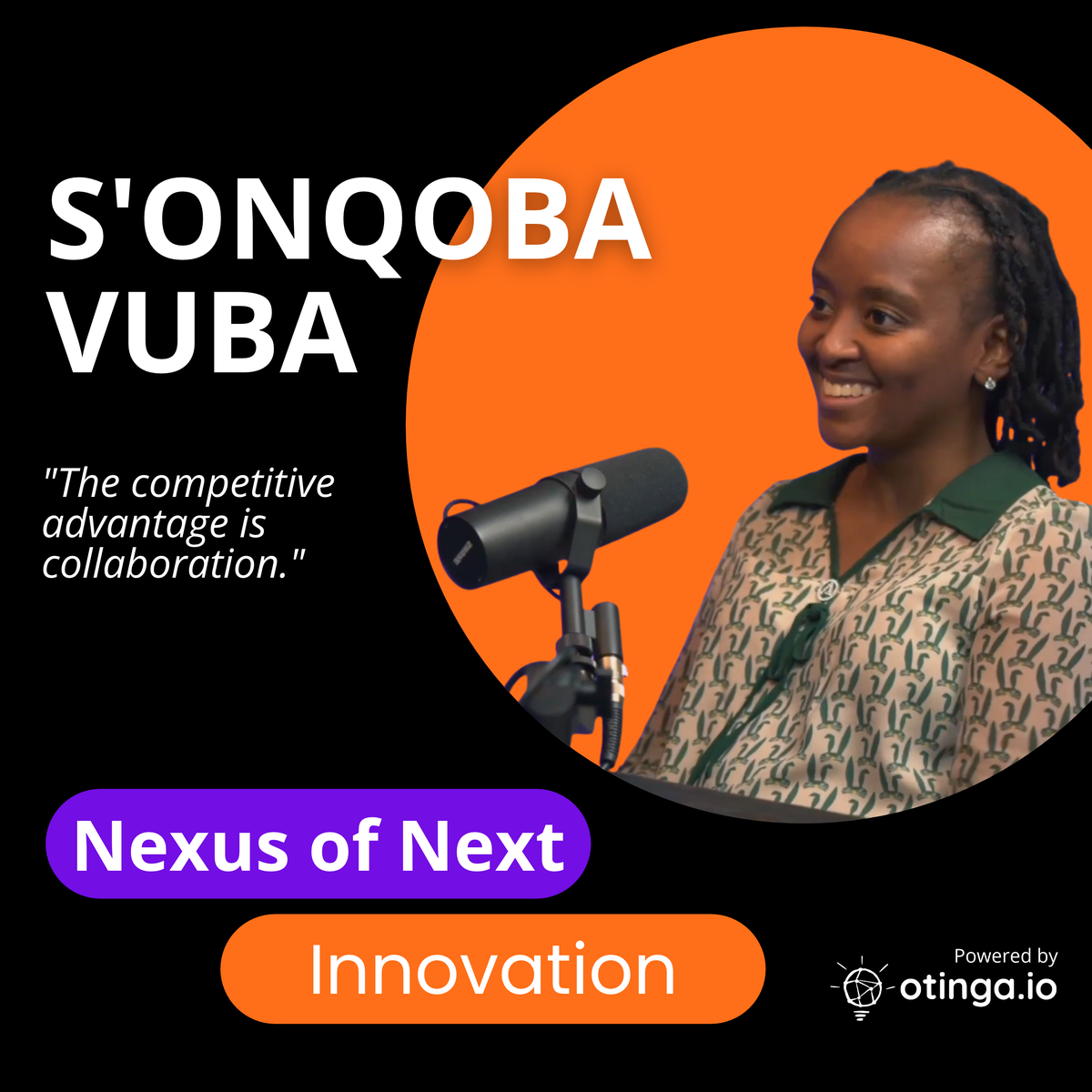
S'onqoba [50:51] Which is so true, so true. And I think what you say about collaboration, I, you know, or like if you did any decent strategy like studies or courses, was always about like what's your competitive advantage, and how do you defend, how defendable is your competitive advantage, and it's like how do you keep what you're doing a secret from your competitors, or you know, your service providers even, because no one must know and that's how you're going to be successful. And I think, yeah, like it's a revision in times, because that kind of content's like not actually accurate anymore. Oftentimes what you're finding is that the competitive advantage is collaboration. The competitive advantage, which is sustainable competitive advantage or defendable competitive advantage, is through partnerships and collaboration. And you're 100% right around kind of inside the enterprise and outside the enterprise, but I'd argue even inside the enterprise, right? So collaboration is how a lot of enterprises work and like succeed. It's because they've taken the IT team to work with the product team to work with the research team to work with the finance team, and that cross collaboration of skills. Um, it's companies that have been able to break down silos so that your, I don't know, your low income segment is doing work with your small business segment, because a lot of low income people are actually entrepreneurs too, and you're actually servicing the same customer. So it's those type of collaborative moves inside the organization, let alone outside the organization, that becomes your competitive advantage and is probably more defendable than if you were going to build everything yourself. So it's just a fundamental, it's the same principles, but a different way to achieve it.
Francois [52:35] Yeah, I quite like that statement that collaboration is your defensible, distinguishing advantage. It's quite interesting because that hasn't been the case for many, many years. And now all of a sudden people start realizing, well, as the world is getting smaller and smaller, once again, it becomes better to make friends and bring people together towards a goal.
53:00
Open innovation and the collaboration you never see
Francois [53:00] I wouldn't be surprised if there's a lot more of these quasi open source or open innovation initiatives in the near future that's really going to push the paradigm a little bit, be that in the AI world or some other technology space. I definitely think that's a space that's still quite ripe.
S'onqoba [53:22] Yeah, I think definitely. I think there's still a lot more to be done in that space. And I think sometimes we don't know because it's not shouted from the rooftop, right? Yeah. I mean, I remember sitting in a session and I can't remember what it was, but it was a conference and someone who worked at Uber, and this was probably about five years ago, someone who worked at Uber and someone who worked at Airbnb had presented at the same conference. And one of the weird things that was an epiphany for me was that those two applications that we just know as Uber or Airbnb, and maybe they're not what they used to be fully back then, but they were really amazing back then. And these guys were presenting around how it was basically 50 to 70% of the technology platform with the different modules that made up Uber, Airbnb were open source pieces of code. So what they had done is literally pulled in different modules in the back based on what was best in class that was out there. They pulled it into a single point focused on building the front end interface and the 10% or 30% that they couldn't find really good modules for, the ones that they wanted to own as proprietary information. And that combination of things put together was what was the proprietary Uber and the proprietary Airbnb. Don't know to what degree that's still true now, but it's a great example of like how sometimes we just don't know. You wouldn't think Uber, Airbnb was open proprietary, you know, open modules like leveraged elsewhere. But, you know, actually what you realize is they were collaborating and that was their competitive advantage. And it was great because then if someone was dealing with the calendar function on Airbnb and that was what that company focused on and you just leveraged the module, that meant someone's waking, sleeping moments were all about calendar functionality, and they would be on top of things and release the latest updates and you would just benefit from it, right? Instead of you trying to be the expert at 10, 11, 20 different things or modules that were making up your application. So I do think that collaboration thing is key, but I also think we must actually realize that we're probably only ever aware of a fraction of the collaborative efforts that happen because of the nature of open source, because of the nature of white labeling things, because of the nature of APIs. It means that we sometimes never truly have an appreciation of how much collaboration is in the platform that I'm interacting with every day that I think is amazing. But those guys are only worried about 10% of the solution.
Francois [56:02] That's so cool. I really like that analogy of the wrapper and what's actually on the inside of the platform. You know, S'onqoba, it's been an absolute pleasure having you on. You're a truly insightful individual with a unique perspective of the world that's not on every corner of every street, which I think is really very, very cool.
56:29
The question she wanted to be asked: when will your work be done?
Francois [56:29] I've got a few questions for you. I'd like to ask you this question, is there one question that I haven't asked you that you think I should have asked you that you'd like to answer right now?
S'onqoba [56:45] Jeez. Interesting. So maybe, yeah, I actually got this question last week and I thought it was a really good question. And someone said to me like, when will you know your work is done? I was like, Jesus, that sounds very final. It is quite final. But it forced me to think, right? And I said, I don't know if I'll ever know my work is done, but when I'll know I can like slow down a bit and it's like, actually, I'm good. I say to the person like it's owning my privilege. It's like I shouldn't be sitting here across from you if I explain that I'm like this young black woman who grew up in a township in the east end of Joburg and got like public education, right?
Francois [57:34] It absolutely does make sense.
S'onqoba [57:36] Who is like raised by a mom selling lipstick to put her through school. Like I am an extremely privileged person, I mean I may not be the most privileged in the room sometimes, but I'm definitely a privileged person, and I said that for me like the guiding light and the guiding factor is I'll know kind of most of my work is done if I can go back into the environment where I grew up or in the places where people who grew up like me are and have seen a shift, whether that shift comes about directly because of my efforts or indirectly through the swells and waves and currents that I'm creating in the work that I do or that we're collectively creating, or like a little like, um, shanty town in Kenya, like you know those type of places, that's when I'll really feel like okay, I can kind of, um, lay off on the accelerator a bit. You know, just a little bit, not completely, just a little bit. Um, but yeah, I thought it was such a good question because I think sometimes we get lost in the big shiny things and stuff and our titles and the boardrooms we're in, but what it made me realize is that for me it's actually all about like that little girl that I was that doesn't have the opportunity to be a woman in tech, that doesn't have the opportunity to be sitting at boardrooms, um, in large corporates in this country, who in a single generation, like if I think about my mom was a cashier at a bank and I was running an innovation program for a bank, working as an exec assistant, right-hand person to the CEO of a bank, in one generation, that just sounds like a movie, right?
Francois [59:14] Yeah.
S'onqoba [59:15] But I need those movies to keep happening and I need to make sure that there's a lot of them. So that would be the one that really caught me off guard last week, but I thought it was a really good question.
Francois [59:24] That's so cool. Yeah. It's the movies that inspires us, right? It's the, it's the movies that shapes the perception of the next generation. So true. And so yeah, it's about creating those movies, to be honest, you know.
59:37
The previous guest's question: what inspires you?
Francois [59:37] Um, cool. So we we normally end end with two two bits, uh, the one bit is I'm gonna ask you a question that the previous guest, okay, uh, of the podcast asked, um, asked or submitted. So the previous guest of the podcast submits a question for the next guest, and and the question is: what inspires you?
S'onqoba [60:01] Sure. Goodness, I mean it's like it changes, but I'm inspired by things that bring hope. So like it could be as simple as seeing kids like, you know, unruined by the world just, you know, enjoying the discovery of something for the first time. Or like I've got a two-year-old son, so like seeing him sometimes dance to music, like it's the first time he's ever heard music, you know, as a moment. Or like you said, like those stories, those movies that inspire us, where you hear someone's personal story and you're just like, you know, like my personal assistant right now joined this organization 10 years ago and she started as a cleaner, and then kind of became an office manager and an administrator. And now she's like a PA to an exec. So like just those, I think there's so many of those stories. I'm inspired by things that bring back hope and keep hope alive. Last night I was watching Chasing the Sun 2, the last episode. Hope, right? With the rugby and the Springboks winning the World Cup. So just I really am inspired by things that just resuscitate and revive hope because I don't think we should ever let go of that.
Francois [61:18] No. Yeah, that's very cool. Profound words. I believe your assistant deserves, say, a movie of her own. She does. She definitely does. I think those unsung heroes are sometimes so inspiring. There's so many. Yeah.
S'onqoba [61:38] We've just got to pause long enough to dig under the surface, but there's so many.
Francois [61:39] Yeah. So what do you think could have gone better today?
S'onqoba [61:44] Jeez. Okay, you asked really interesting questions at the end. Um, sure. I mean the only thing that could have gone better in my opinion, I always say this, is like always feels like a heavy burden kind of being the only other voice in the room. So having more people, the pressure, right? Yeah, yeah. But also when I think of more people in the room, I'm kind of quite specific in what those people look like, right? So I think having like young people in these conversations just makes all of us uncomfortable, and I think that's good because there's such a different perspective of the world. Um, I think that taking voices of people who are hardly ever given the platform or hardly ever heard, so just turns the conversation on its head. We'd get such interesting answers for some of the questions, right? So, um, yeah, I think it, like I said, it's for me always a thing around just like how do we get more voices in the room, but very diverse voices in the room. Yeah, you know, because it's just fundamentally changes it. It's that collaboration thing, is the competitive advantage. Yeah, for me it's always about that. So that's the, yeah, that's the thing that comes to mind first of all for me.
Francois [62:55] Super interesting. And what do you think went really well in your opinion?
S'onqoba [62:59] Jeez, I think like this didn't feel like a dud. It felt like a conversation, you know, sometimes you're like, oh gosh, it feels super rehearsed and stuff. So I think this felt super natural, which is amazing. Um, yeah, because we're talking earlier about how you and I've only interacted on online platforms, it's the first time we meet, so that's just amazing, and you were right, building rapport with a person online, it's actually kind of like a pre-filter for you guys getting along in person. You were so right. So that's something that went really well. That's cool. That's cool. Yeah. So that's it. That's the episode. Thank you so much for jumping on.
Francois [63:38] Thank you. Really cool perspectives.

 Claude
 ChatGPT
 Gemini
