00:00
Introductions
Paul [00:00] I have one of the worst kinds of failures, which is the failure of succeeding through more effort. None of them are generating income. I've stepped away to do all these other things. My main business started to collapse. Campaign that targets that convention centre with a one kilometre radius. You got to look for ways to kill your darlings. If you don't, someone else will. Everything's going to look like charcoal. Why don't we forget about the 1,500? Why don't we focus on the one unit and what that means to one person?
00:31
Welcome - meet Paul van Biljon
Francois [00:31] Welcome everyone to the Nexus of Next podcast, where tech visionaries and innovators share their perspective of what the future of business holds. Today, I am absolutely excited to welcome Paul van Biljon to the studio. Paul is a good friend and a very insightful human being. He is a growth strategist and the founder of HeyPaul.co. He helps businesses identify what actually is blocking their growth before they start spending the money to scale it. He calls his approach Constraint-Led Growth Architecture, which boils down to a simple but uncomfortable truth. Most companies don't have a marketing problem. They have a constraint problem.
Francois [01:31] Paul's also writing a book, Anything But Not Everything. And this one liner, I feel, captures his philosophy very well. Stop scaling your assumptions and start scaling what's actually proven to work. Paul, welcome to the studio.
Paul [01:51] Thanks for having me. That's my new LinkedIn bio right there. Thank you for that. That's going to be transcribed and that's going to be uploaded.
Francois [01:57] Yeah, I think it's a done deal. It's a done deal. Yeah, I usually charge $0.50 per word. Just kidding, just kidding. So, Paul, you know, one of the things that I always find fascinating about having conversations with you is you always leave with a little bit of a nugget at the end of a conversation where you go like, hmm, that was quite interesting.
02:20
Information is useful, inspiration gets it done
Francois [02:20] Yeah. What do you think is some of the things people will hopefully take away from today's episode?
Paul [02:26] I think more than anything, I always believe information is useful, but if there's no inspiration, if there's no energy to implement. So hopefully some inspiration, that would be a great takeaway.
Francois [02:38] Oh, that's awesome. Some inspiration. And I know there's some good stories also on the way. A story about someone called Elizabeth, and how failure is part of our origin stories, and some of the broader lessons we can take away of the future of business and tech. Right? Yeah. So, when we think about your core vision and mission, it's really about scaling the things that's proven to work.
Francois [03:10] Yeah. But there is some gold in between those lines, because when you say scaling something that's proven to work, the thing you're also saying is you've got blind spots that you're unaware of and you need to actually ground what you think and what you say and what you believe in truth. Right?
03:31
Fail fast, and why we're taught to fear failure
Paul [03:31] Yeah. You do test those assumptions. You know, Silicon Valley is obviously famous for fail fast, fail often, fail forward, which is a nice little mantra. But it's something that doesn't translate into other business. We are very scared of failure. We are taught to be scared of failure, right?
Paul [03:49] If you fail an exam, you get punished. There's not a scenario of celebrating failures because you try hard. And so people are by, you know, designed to kind of stay in their lane and kind of do things. And so because of that, we especially as you get older, you become a lot less, you know, comfortable with that failure.
Paul [04:10] And that discomfort is the thing we need more now than ever.
04:14
Dinner parties and keeping up with the Joneses
Francois [04:14] Especially when you're at a dinner party or something like that, and everyone else is following a traditional path. And now there's the Keeping up with the Joneses, if you will. And I think we all, especially when we start that entrepreneurship journey, we attach value to certain things and we make assumptions with our own blind spots of what we think valuable is. What's your thoughts about that?
Paul [04:44] Well, that we is very apt because that we is me. We can take that W and turn it around to make it a me. And we basically have done that way too often. So these are things that I've experienced myself. I have stories that land well, you know, and it's great to go to have people over at your house and to tell them how you just started another new business and you are now a serial entrepreneur. Fancy.
Paul [05:09] And it's always exciting business, it's always these novel, like, businesses, and the people look at you like, wow, this is incredible. Like you know, and then you go look at the numbers, and the numbers tell not such an incredible story. It's like actually quite a scary story. This thing is taking a lot and giving very little if anything.
05:29
A stage, a mayor, a dozen ventures and no income
Paul [05:29] And you have all these businesses I was running and I was telling these people about all these wonderful things that I'm doing and realising none of them are generating income. I had a coffee business that was pivoting to become a coffee subscription business. I had a training academy and I was setting up and getting funding for it, and it was fancy stuff.
Paul [05:48] I got meetings with the mayor around that. I got to speak at an international investors conference around these topics. And it's good, good social media content right there. You know, on the stage with people, next to me is the premier of education. Next to, on this side, is a guy that started a college and got a huge amount of funding.
Paul [06:09] And I'm being on a panel talking about the future of education in this context. And I got, you know, personal introductions to the mayor, all these wonderful things. This was still while I was in a small town, so not quite as fancy, but still it looks great on your social media. There's a meal kit business that I'm part of.
Paul [06:26] There's this business, and there's all kinds of other things that I'm busy doing, some leadership development academy, and it's like 50 different things. Yeah, yeah. But none of them were doing anything meaningful. There were a lot of great ideas and stuff that I was able to get some real traction on. The fact that I could get meetings with mayors.
Paul [06:44] I got the guy that I'm on the panel with, incredible guy that says, hey, we've actually got a huge amount of extra space. The mines donated an old facility they weren't using. They gave us money to renovate it. You're welcome to set up your academy here. So, like, it actually looks very, very promising.
Paul [07:02] But then the main business which is actually generating money for me is not going anywhere.
07:06
Anything, but not everything
Paul [07:06] And so that's kind of why the book came around, that title came around, which is you can do anything, but you can't do everything. You know, you need to find that focus. You need to get things across the line. And yes, you can step away to do something else.
Paul [07:19] But when you step away, what happens? Because I've done that. I've stepped away to do all these other things, and my main business started to collapse. And I had a responsibility to those people there. Absolutely. Make sure that thing runs and it generates business and it generates momentum. So if I want to step away, I need to make sure that thing can run without me.
Paul [07:36] And I didn't take the time to do that. And so that's the reality. You can have all these great ideas and they seem very promising. But do they have a future? Have you projected a future? So like, yes, I got all these offers for all these things, but did I take the time to see where these businesses would actually go and what the resources would take to get there?
Paul [07:56] And do I have the ability to do that? I didn't do that. I didn't test to see if these things actually had a future. It seemed great, but can they actually scale?
08:06
One mattress factory beats 75 ventures
Francois [08:06] Absolutely. And when I think about what you said earlier, it's actually that constraint problem that you should be thinking about, and what are the assumptions that you're trying to scale here. And so like when you tell the story, I think there's loads of people in both corporate as well as in the entrepreneurship realm who resonate with this, where you feel like, yeah, by doing more, regardless of how successful it is, it will be successful in the future, I promise. Yeah. By doing more, it sounds more impressive. So we've got this attachment that doing more is better rather than doing three things that we know work. Yeah. And doing them a lot. Even if that is, I've got a mattress factory, and I make really good mattresses, and people want to buy them.
Francois [09:05] Yeah. It sounds a bit on the boring side of things, but that's way more impressive than having 75 different businesses and ventures that's all running and none of them are moving.
Paul [09:17] And you should definitely sleep on those mattress ideas.
Paul [09:21] You need. And that's the thing is, you need to kind of take the time to literally like sleep on things, to think on things, you know, not to get kind of swept up in the momentum. Because then once you've announced to all your friends at your birthday party or and your social media that you're doing this and you think it's difficult to back away from that, so you want to kind of test the assumptions before you've started in that journey.
Paul [09:39] But the reality is sometimes we don't. Right. And it's really that idea of that constraint. What is a constraint? How is the constraint? Time is a constraint. And if I divide it between too many things, none of them will work. You know, if there's a limited amount of my time and sometimes we overcome that.
09:56
The failure of succeeding through more effort
Paul [09:56] And that's sometimes the biggest failure is not the failure that is obvious where the business fails. It's the thing that, this thing is making progress, but it just takes a little bit more effort. And then next month, a little bit more effort. And those little bits compound to a point where after a few years, if you forward project that, you're going to actually have one of the worst kinds of things, which is the failure of succeeding through more effort.
Francois [10:22] Yeah, the failure of succeeding through more effort. That is a double-edged sword because it still feels like progress. Yes. And we see a lot of businesses getting stuck in that, hey, even big important businesses. This is a common blind spot, if you will.
10:42
What he'd tell his past self
Francois [10:42] So if you could go back to previous Paul or maybe a friend who's running a division at a company talking about all of these very impressive things that they're busy involved in.
Francois [10:56] What would you tell them?
Paul [10:58] I wouldn't use too many words. I'd use a bit more violence, I think, you know.
Francois [11:02] Towards yourself?
Paul [11:04] I'd sort myself out.
Francois [11:05] Yeah.
Paul [11:06] No. So I obviously mean, I'm stoic at heart, so I'm not going to be one of those people who thinks that things could have been different. You know, and I'm not a person who also thinks everything happens for a reason, I believe. But you can't find the reason, you know? So I have learned from that.
Paul [11:23] I'm continuing to learn from these ideas.
11:24
When only the founder can sell
Paul [11:24] But the reality is that we often see this, like one of the most common areas we see in this is sales. A founder can come in and they can kind of sell. And when they try to now move that off to someone else, it's something they feel like, oh, people are so incompetent that the people are not incompetent, either over complicated or you just maybe don't have product market fit. Right. So you've created this scenario where only you can succeed. And that's the danger there, right? You can put a little bit more effort in, but you can't really hand it off. And so if you've got the scenario where that becomes the issue, the constraint, you should find that out sooner than later.
Paul [12:02] So if you can do anything but not everything, finding the thing that's going to have the ability to scale and to have the ability to succeed without having that key man dependency is worth trying to figure out early on, because you can put years on. I think people put years into businesses that will unfortunately never really scale, never really grow, never really give them freedom or joy from that business. It's always going to be too dependent on them. It's always going to be a little bit more effort, a little bit more exercise. And so finding ways to find that information. And that's the question.
Paul [12:36] But how do you do that, right? Most people just do what's familiar or comfortable for them without thinking, well, is this got a future? Is this going to work long term? Not just the business itself, not just the product market fit itself, but my approach to business, and I think taking the time to sleep on that mattress idea, to sleep on those ideas and to think about these things before you go announce it to your social media is probably a wise decision.
13:00
The mirror in the bathroom
Francois [13:00] Yeah. Someone once said to me, a very wise person, and they built a very successful business in South Africa, and they worked with a lot of founders or franchisees on cases. And then the franchisee or the owner of the business would say, well, the people are incompetent. No one's doing anything. Nothing's right. Everything's wrong. And there's this clear sense of contempt and anger almost towards their team. And he said, okay, quick. Get up.
Francois [13:41] Go to the bathroom. There's this desk in the bathroom where there's these bowls, and they put water in it. In front of you there's a mirror. Right. Look at that mirror. The person walks there and they go, and they look at the mirror. He goes like. That's the reason why the people are struggling.
Francois [13:58] And I agree, and I think a lot of the times we refuse to accept that as a leader or as an entrepreneur. The buck starts and stops with us. And unfortunately, those blind spots of ours also scale throughout the business. And so oftentimes we need to catch ourselves in that space. Right. So I'm quite curious when we go down this journey.
14:26
How do you prove what's working?
Francois [14:26] Is it experimentation? Is it pulling data? How do you actually know what is proven to work? How do you prove it?
Paul [14:38] So it's a very broad topic. So I'd rather go quite specific to that, right. So let's say for example, we've got this client that came to us a while ago and they've got an award winning innovative product. It's next level incredible product going to solve a lot of things. They've won multiple awards. They've got investors and grants and all kinds of prizes they've won, and they have got a handful of clients, and now they're wanting to market.
Paul [15:04] And they've already had two other marketing agencies that have worked with them. And they heard me talk about some stuff and they said, hey, let's have an engagement. We spoke about it and I was just mentioning some things. And they said as we were talking, you know, about how we're going to do marketing a little bit different, a bit of a more creative approach, which is always helpful.
Paul [15:21] Like, you can get a lot right with some creative marketing, a lot right with some creative marketing.
15:27
The referral trick for direct outreach
Paul [15:27] And sometimes it's the simplest thing, like it's not a fancy newsletter. Sometimes it's a simple thing of reaching out, direct outreach, and you intentionally reach out to like a slightly more junior person to the person you want to get to.
Paul [15:40] But similar-ish level to the person you want to get to. And you just say, hey, are you the right person to talk to? And they said, no, but you should speak to this person. And then when you speak to that person, you say, hey, by the way, this person referred me to you. Now suddenly they're a lot more receptive.
Paul [15:52] So there's simple ideas like that. But as we were talking through some of these strategies, they realised, well, they're not even sure if they've got product market fit. And, you know, if you don't have product market fit, maybe it's not a scenario of finding better tactics and better measurements and better ways to get your clients.
Paul [16:09] It's actually a scenario of maybe the messaging you're doing is just not appealing to your audience.
16:13
Testing messages around a convention centre
Paul [16:13] And so we ran a bunch of experiments. We found a place where there's a convention, where it is a concentration of the people they want for two days, and it's very cheap. It's a Meta campaign that targets that convention centre with a one kilometre radius.
Paul [16:27] And we were able to show those people a lot of different messages and see which ones resonated the most. So we could test problem solution, pain points, resonance testing to see what works well and quickly realise that actually, none of these are actually really appealing to their client's audience. So those are not really the problem solutions.
16:44
The market loved the problem, not the solution
Paul [16:44] The problems were correct, but not the solutions. And we came back to the drawing board where the thing was you don't have product market fit. It's not a thing about updating your messaging. It's not a thing about updating your marketing. People resonate with the problem, but not with your solution, so that pain point resonance, you are tapping into the right pains.
Paul [17:02] But the solution you're offering, no one really is looking for. And they actually had to go back to the drawing board and to change their product. And that's where we left them, was to go back and change their product. And so they've done some bit of pivoting here and there, and that's what they needed to do.
Paul [17:17] But that data was clearly able to show them, and it was an uncomfortable conversation. And I've been there where I've got this great idea and it makes so much sense in my head. And of course, my friends and my family love it. Of course, all of them will buy it, but the market is like, no, not really, not really what I'm looking for.
Paul [17:34] Right. And so running these experiments can be super inexpensive, super easy to do. And it's worth testing. Are people actually looking for your solution? Because yes, if you're a great salesperson I'm sure you can go sell that to someone. But if you want to step away, if you don't want to do sales for the rest of your life and you want to step away from it or build a sales team, and you still want to be a part of it, but build a sales team, you're going to need to make sure you got a good product market fit.
Francois [18:00] Yeah, that's so true.
18:01
The ultimate sales hack
Paul [18:01] It's the ultimate sales hack.
Francois [18:03] Yeah, the ultimate sales hack is actually building something people want. I think that comes from Y Combinator, if I'm not mistaken. But yeah, I think when you're speaking like this, and I'm putting myself in the shoes of a founder who's got this product or a business leader who's got this initiative, who has been working on this for the last 2 or 3 years.
Francois [18:28] You've got all of these positive signals telling you, yes, absolutely. I mean, even your mom likes this app, right? And she's proud, and they've won awards and they've gotten all of the success, vanity success, but success nonetheless. Yeah. And now you need to confront that uncomfortable truth with a bunch of experiments that may seem a little bit facetious to begin with.
18:59
Kill your darlings
Francois [18:59] That's a tough pill to swallow. How do you look at that pill to swallow, especially when it's your baby, your favourite horse?
Paul [19:09] Yeah. You gotta look for ways to kill your darlings. If you don't, someone else will. If you don't, the market will. You know, you need to. You need to try to, you know, disrupt your own business before someone else does. You need to try to disrupt your own marketing.
Paul [19:23] You need to try and understand what are people actually looking for, and then decide if that's something you want to offer them at that price point. Right. And it's often we can ask ourselves, can I build this product? Can I do this thing? But there's three questions, very important questions that should come before that.
Paul [19:39] And the problem is sometimes we only realise this 2 or 3 years into business and then we don't really want to because we've put a lot of time and effort into that, and we've read studies and books that kind of support our narrative. But the question is, does the data support your narrative? Right? And so you want to find actual data that says, this will or won't, you know, be a good product market fit.
Paul [20:01] This will or won't scale well. And while you do that, it's not always a scenario of I'm going to make a massive pivot.
20:09
Fix the weakest link in the chain
Paul [20:09] I prefer the whole theory of constraints. Right. So we're busy working with, I got the opportunity through a friend of mine in the US to work with one of my favourite authors, and they've got a thing where, like, I love his way of thinking about things, because you get systems like EOS and Traction from, you know, it's a great system, but it's so many different things you need to do for that to work.
Paul [20:32] It gets super complicated. And what they're doing with this specific company they spun up is to say, what is the constraint? What's the weakest link in the chain? And let's fix that link. That is not the weakest. We need that focus because, and the approach works so much better for small businesses because of that.
Paul [20:50] Right. So if you're a small business definitely focus on the constraint.
20:53
Small adjustments, not a jerk of the wheel
Paul [20:53] Focus on iterative improvements. So don't run massive experiments and try to change everything. That's actually not what I'm saying. What I'm saying is make small iterative improvements that are taking you slightly more direction.
Paul [21:06] Don't take that steering wheel and jerk it to the side because then your car is going to roll. You know, you need to make, especially if the thing's a bit bigger, you can't just completely change direction. It's going to cause a disaster. So make small adjustments, small adjustments, and be patient with yourself.
Paul [21:21] Be patient with the process. But find data.
21:23
Vanity success and who actually hands out the awards
Francois [21:23] Yeah, I think that's such an important thing, especially when it comes to these commonly accepted beliefs or unchallenged beliefs, especially when you're in a small business or in a smaller team. I think in a big team it can be a little bit more obvious, but there's this very attractive narrative of we know something others don't.
Francois [21:50] We understand what others don't. And I think that may perpetuate those beliefs that a thing is one way. But that was an assumption, and reality actually points squarely in the other direction. You know, like when we talked about the vanity success of awards for a product, which from an execution standpoint, that's usually awarded by someone who isn't the actual person with the problem.
Francois [22:24] Yes. And so that's probably the reason why that happened, is it was a body or an entity that looked at the execution of building the product. And I think there's value in that. But there's loads of other businesses where, objectively, it looks true that this business is successful. And if they were a software development agency, that would have been exactly what they should have been doing, right?
Francois [22:51] But now if we go and look at other industries where there's objective success, but people don't care about that award enough to go, I want to buy that product. And similarly, no one cares like how many cans of juice you bottle or can. Yeah. They care about how does it make me feel when I drink this juice? Or does it remind me of my childhood, or does it align with my values?
23:25
"Quality and quantity": the horrible slogan
Francois [23:25] And I know you've got this story about a company who's doing some really impressive things when it comes to the numbers of units that they're building. Right. Tell me a little bit more about that.
Paul [23:39] I think we've worked with a number of clients in the construction development. A lot of engineers are phenomenally clever people. Like, way smarter than me, right. And they speak in like jargon that their clients don't understand. They'll work with some people and they'll say, we're going to do this.
Paul [23:58] And from their perspective, they want to deliver a project that is going to be like, their claim to fame is like, we're in this construction industry, and we're going to do things way better than anybody else. Our quality is the best. We're going to do much more quantity. And that was their slogan when we met the specific companies, quality and quantity.
Paul [24:18] I'm like, and I told them straight, I'm like, that's a horrible slogan.
Francois [24:22] Have your cake and eat it too.
Paul [24:23] And they told me the whole story about why that's a thing. And it was a good story, but I'm like, that doesn't resonate with your, that's not going to resonate with your clients at all. Your client doesn't care about whether you can do quality and quantity, maybe quality a little bit, but everyone uses that as, you're not going to stand out.
Paul [24:36] You're not going to differentiate yourself. And if you try using generic and appeal to everyone, you're going to appeal to no one. And so we just, I said, tell me the story. Tell me about the things. I said, yeah, the reason we want to do it is because we got this huge contract. We're going to build 1,500 RDP houses.
Paul [24:50] And for them, it was by far the biggest contract. Since then, they've gone on to do massive things. They've actually become one of the dominant players in their space. And I said, that's all cool, but like, your clients don't care. You know, what are you actually doing? You know, we're building homes, right?
Paul [25:06] Or we're building units. They call it units. I'm like, yeah, but it's not a unit. It's actually like a house, a home someone's going to live in, you know?
25:12
Forget the 1,500 units, focus on one
Paul [25:12] Why don't we forget about the 1,500? Why don't we focus on the one unit and what that means to one person? And I told him, I kind of tossed him this thing, and I told him this story, and I said, that's what your clients are going to care about.
Paul [25:24] They don't care about units. They care about the people that are gonna be receiving these low-cost houses and the difference it's going to make in their lives. That messaging appeals more to your audience. And I put the challenge for them. I said, why don't you find someone that's a beneficiary of one of these units, not units, houses?
Paul [25:39] And let's tell that person's story. And they said, okay, well, I'll do that, but we still need to do the 1,500 units video. So we did a number of videos. And the one is like how many bricks were used, and this and all the stats and the figures, and it's very impressive.
Francois [25:54] And to all the builder friends and construction friends, that's also super impressive, right?
25:59
Elizabeth, and a new slogan: changing lives
Paul [25:59] And then I met the person that I got to tell her story about her unit, her house, her home, and her name was Elizabeth. And I'm getting goosebumps now. And Elizabeth, I didn't expect the story to impact me this much. I just thought, this is a cool idea. This is going to appeal more to your actual clients.
Paul [26:18] And that story has just stuck with me. And Elizabeth tells her story of how this unit has brought her and her family together on one roof for the first time ever. They've been divided, and she tells the story of how she once had to sleep in a public toilet with her grandkids under her arms, scared with every sound that was there, and she was able to tell the story of how this thing is not a unit.
Paul [26:45] It's not even a house. It's a place of safety, a place of community, a place of connection. And as she's telling the story, you get emotional. All the other videos were like, okay, take two, take three. But she just tells her story. And it was just beautiful and impactful. And their slogan fortunately changed from quality and quantity to changing lives.
Paul [27:07] And they've actually changed their name, but their slogan stuck. It's still changing lives. And that's what they do. It's not about that. These people are building, that build houses, that build homes, that build bridges and stuff. It's not about the road and how long it is and how much asphalt was used. It's about you connecting this community with this community.
Paul [27:29] And those are the stories you want to tell. Those are the things you want to bring out. And so messaging and marketing, and that is not about what you did and how many awards you won, if that's what your clients care about. Sure. But ask yourself what do people actually care about? And if you ask yourself those questions once in a while, you'll find a beautiful Elizabeth story.
27:50
People don't buy what you do, they buy why you do it
Francois [27:50] Yeah. It reminds me of Simon Sinek saying people buy why you do, or that people don't buy what you do. They buy why you do it. And I think a lot of the times when we focus on the detail of execution. Yeah. And believe me, it does matter. But when we focus on that only, we sometimes forget to take off the blinkers and look left and right and see in which ecosystem we're operating in.
Francois [28:27] Yeah. And yeah, I think the Elizabeth's story just brings it home in such a way, because a lot of the times when you think about the Kafkaesque factory that people may find themselves in, in a business, be that small or large, we've seen this happen anywhere, right where there's just a cog in a machine.
Francois [28:51] Yeah. But by having that purpose internally, it becomes so much easier to do the work if you understand the why. And then from a customer's perspective, I think the beauty that comes from that sentence that you helped them discover was, for me, at the very least, is that it very succinctly and effectively summarises the why in a way that's accessible to anyone. Be that someone who looks at the business objectively, who's not a client or an interested stakeholder, or it may be a customer.
Francois [29:37] Absolutely. Yeah. That's fascinating. That's fascinating.
29:41
Bringing stories into company culture
Paul [29:41] I'm obsessed with storytelling. Right. It's such an impactful thing. And we've often had pushback on that. Right? We've especially with engineers, but multiple people, like, we, and we tell clients like, don't just bring it into your marketing messages externally, but bring it into your internal marketing, right?
Paul [29:56] Should be part of your culture. If you tell someone our value is to be a place that serves others, like that's a nice value. But if you tell a story about how one of your team once served a customer, like Tony Hsieh's Delivering Happiness book from Zappos, where it talks about how they kind of went out of their way to deliver happiness, and you tell those stories instead of telling your employees about your values.
Paul [30:23] It's a story that sticks. That makes an impact. Right. And so we've created like an internal system when we're onboarding. We don't just capture our values. We have a scenario where we can take our values and turn them into valuables. And we reward our team. Or our team can reward each other for exemplifying our values.
Paul [30:39] But the reason we're doing it isn't just to kind of like tell people like our values we take seriously. We also want to capture those stories. And so once in a while, we get a really cool story. And when a new person is onboarded, they can read some of the stories about how people in the past have existed for years.
Paul [30:54] And you bring a story into a lot of things, I think. I think it's such a powerful thing.
30:58
Turning a client brief into a story
Paul [30:58] Something that one of my team suggested recently, which I love, love, love this idea, she said, why can't they feel like the production team is a bit too detached from understanding the client? They want a better brief, and what it eventually came out to is we don't just want to give them a better brief.
Paul [31:15] Our briefs weren't bad, but there's always room for improvement. But what we want to do is tell a story. So if we've got Sam and he's got a company, Blackbond, and his company is very important to him, we can tell them, okay, this is the company, this is the objectives. This is why they want to succeed. This is their brand colours.
Paul [31:32] This is their brand story. I want to tell my team. I can know Sam has two kids. He has a son and a daughter. His son is 12. And we tell a bit of a story about his son. And this is why this business matters, because there's people in it. And if we then build the website and we tell Sam, hey, by the way, on your About Us page, that image there is inspired by the story you told us about your son.
Paul [31:53] And this is how it ties to that. It's not going to just be a website. It's going to be something meaningful. I'm telling you, he's probably never going to want to take that page down. He might redo his website, but that image. If we can weave story into things, we can weave meaning and connection into things.
Paul [32:11] It's way more powerful.
32:13
Why stories stick when information doesn't
Francois [32:13] It's interesting how stories help us do something that information just cannot. Yeah. And I think that when we talk about the future of business and the future of technology. We had this problem where today we've got, you know, the biggest library in our pockets, easily accessible, and it's all information, but the things that we actually remember is the story.
Paul [32:47] Yeah.
Francois [32:47] And so when I think about that a little bit more, and I'd love to get your perspective on this. Each of us have got our own journey that we follow. Be that the journey of impressing the friends at the dinner party, then realising, oh, that was not actually the greatest idea. We need to change our perspective.
Francois [33:07] That development, that growth, those stories let someone else walk in your shoes or in that person's shoes for a little while. Yeah. And it creates a sense of connection that goes far beyond accessing information about statistics or performance. And I think there's an art form to linking those two together. But I'm curious, what is your perspective around storytelling when it comes to that experiential element?
33:44
Would anyone tattoo your logo?
Paul [33:44] So imagine stories were told so well around your company that someone wanted to tattoo your business logo onto their body. Do you think that would happen?
Francois [33:53] I think at the moment, no, but that is definitely an aspirational, worthy objective.
Paul [34:01] But that happens quite often, actually.
Francois [34:02] It does. Yeah.
Paul [34:04] And the reason is like, let's say Harley-Davidson, you know, and people say, oh, this is a pretty design or pretty logo. I don't say Harley-Davidson's got a story. They say Harley-Davidson understands me and my story. And that's what companies need to do. Right. And we understand this, that the company is not the hero.
34:23
The customer is the hero
Paul [34:23] The story you're telling is not that the company is the hero. It's that the client is the hero. You're the guy to help them realise it. It's a very much Donald Miller StoryBrand, all of those progressions, and that's it. We want to help these companies succeed, you know, and I'm a big believer that the biggest driver of socioeconomic development and just change and like impact in the world is going to be through small businesses, not through large corporations.
Paul [34:48] I think there's some stuff that can happen there. But I think small businesses have got such an opportunity to impact people's lives, to give them a thing where they're connected to the work and the meaning. Not just money, but like meaning through what they do. Right? So and that ties into the messaging, right.
35:04
Pain-point resonance: making customers feel understood
Paul [35:04] Experiments we run and pain point resonance. It's not about you want to tell people about how award winning and wonderful your product is. And I fell into this trap. I still fall into this trap. It's pain point resonance. This is I understand my client and that's what they feel. It's such a simple version of storytelling.
Paul [35:20] It's like, this is my pain. They've got a solution, I feel understood, I feel like they get my story. That's actually what's happening super quickly without someone realising it is you telling a story through a simple, do you have this problem? We have a solution. People feel understood. They feel like you get their story.
Paul [35:38] And that's what it's all about, is running these messaging experiments, testing your assumptions. Are you understanding your customers? Are you understanding what matters to them? Is your messaging conveying that? Are you finding better ways to convey that? And that's such an easy thing to run some experiments on.
Paul [35:53] It's so simple to try and figure out now more than ever.
35:56
AI, the Jevons paradox and the question of purpose
Francois [35:56] Especially today. And I think, like when you're talking about how certain things have become more easy today than they've ever been. Yeah. And I'm specifically thinking about the story you shared about how someone would literally tattoo a company's logo on their body. Yeah, because it's got such strong resonance. One of the things that I'm always curious about is when we now try to progress into this future where the actual work becomes so easy, and it's been done by machines to a certain degree, that it creates massive output and resource. And in the Jevons paradox of, if we build the steam engine, then, you know, we'll just start, we'll do away with most of the horses and then the world will stagnate.
Francois [36:54] But in reality, that just unlocked a massive opportunity and created immense growth. What that did do, though, is it did rob a certain subset of people from purpose?
Paul [37:06] Absolutely.
Francois [37:07] Yeah. So what's your view around the future of business and technology and purpose and storytelling and resonance?
37:17
Fire, raw meat and using AI well
Paul [37:17] So I've got two stories to tell around that, right? Imagine you are living in a cave and you go and get an animal and you basically go ahead and kill that animal. Now you've got to eat it. The raw meat you try. It's not just like sushi. This is tough. Raw meat. Your body, it's going to take a lot of.
Paul [37:37] You're gonna probably get sick from that. It's from time to time. You're going to be out of action from that, and you're going to have to use a lot more energy to digest your food because of all the stuff you need to break down and things you need to fight off. And it's just you're going to have a lot less energy to do things.
Paul [37:53] So now you've got this latest innovation that comes around. Something called fire. Fire is wonderful. You can cook your food. It makes it a lot safer to eat. It gives it some flavour at times, and it also allows you to speed up the thing, because maybe you didn't. You realise these are problems so work around them.
Paul [38:08] I could then, you know, basically make some biltong out of this meat by putting spices in there to remove some of the risk. But now it takes very long to make that. You've got to wait very long before you can eat that food. And so now you've got something that shortens that time, makes it so much easier, so much accessible.
Paul [38:21] But it's also dangerous. You could burn yourself. You can burn someone you love. Like, there's dangers that are real there. But the dangers of not using it are worse, right? So it's not, is this purely good or is this purely bad? It's a scenario of trade-offs. And so the one side is you can use AI, you can use technology, you can use all of these things to accelerate stuff, to do things to make things easier, but use them well, right.
Paul [38:48] So if you are cooking food with fire, if you're not careful, you're going to burn your food. If you use too much fire too quickly, you're gonna burn your food. So you want to do it well. Same as you want to use these things well. You don't want to just produce more AI slop. I'm a big optimist that these are great tools, but they should be used correctly.
Paul [39:07] And they can be used really, really well.
39:09
The printing press and a renaissance of meaning
Paul [39:09] And then the other side is that when we've had stuff like this, like, let's say the printing press that came out, you know, it's very rare to have a book. It's very, very rare to have a book. Now, suddenly, relatively speaking, there's this abundance.
Paul [39:23] And anybody can produce a book and it's way more accessible, way more attainable. You can get it to the masses. It's just such a wonderful thing. And suddenly the value of books goes down.
Paul [39:37] You know, having a book is not that special anymore. And so then what happens is there's a bit of a renaissance where there is this kind of pushback, this correction from humanity to say, well, even though anybody can do it, let's now make sure that we can kind of introduce a bit of a touch, introduce some storytelling, introduce some meaning, because it's not just about producing the product.
Paul [39:59] And if the product will at times outpace meaning, but I believe meaning and storytelling and the renaissance will help to catch that up. I think there will be, with an acceleration, meaning does take some time to catch up. But we've done this before. We'll do it again.
40:15
Protecting your business: focus, story and meaning
Francois [40:15] Yeah. So when I think about how do you protect your business or your organisation from this impending challenge that will eventually be here? Yeah, it sounds like it's just a matter of focusing on what you don't know and what you do know, and then stitching a story and meaning to it that resonates with people.
Paul [40:41] That's it. Our story, our narrative that we tell, which is that we want to create things that help our customers succeed, but in a way that it's also ties to telling their story. Now, because that's our story we're trying to, that legacy we're trying to create, if AI allows us to produce work and produce more messaging experiments instead of doing a handful, we can now do ten times as much thing for the same price.
41:07
What AI gives back: time to be human
Paul [41:07] We can help them succeed. But then what do we do with that freed up time and resource? Now my team can go and form connections and bonds with our clients. I had the opportunity to spend some time with a client. Now she lost three family members in a short time, and I was able to just spend an afternoon with her and just have a discussion with her and just be a human with another human.
Paul [41:25] And I was able to do that because I had some AI doing some work for me. In the meantime, it was a lot easier to kind of just block that time out. So I'm very grateful for that opportunity.
41:35
Purpose as a skill, and the case for good AI content
Francois [41:35] Absolutely. I think when we go down this track of the future where purpose becomes so important, I think it's going to have to be a skill that gets taught. Yeah. Because we create our own purpose to a certain degree, explicitly or implicitly. But one thing that's quite fascinating to me, a lot of people are saying, well, generally AI-generated content is bad.
Francois [42:05] And I would say, I love, love, love AI-generated content. Yeah. If it is done well. Yeah.
42:13
The hinge documentary
Francois [42:13] A great example is a, I'm a documentary nerd, right? Like, that's my thing. If you want to make me super happy, give me a documentary about hinges. Okay. Right. And so one of the challenges that I think people like me have is there's only like seven of us that care enough about hinges that someone would be making a documentary about that. Right?
Paul [42:39] I was obviously a different place in life. My mind was to Hinge, the dating app. So.
Francois [42:44] Okay. Yeah, these are different categories. Frames of reference. Yeah, yeah. But I think it's so beautiful because one of the things that the internet actually unlocked for us from a story perspective is it created these environments where you could meet like-minded people and they eventually had needs catered to them.
Francois [43:04] That was never even practically possible. And so today, one of the things that excites me so much is that I can literally watch an hour-long documentary about hinges, or different types of nuts and bolts, and my wife absolutely thinks it's the boringest thing under the sun. And I'll be like, did you know the Germans have a standard?
Francois [43:28] And everyone adopted the standard? And she'd be like, I love you, but I don't get it.
Francois [43:28] That's right.
Paul [43:38] Yeah, it's definitely like, I mean, I completely agree. Yeah.
43:42
AI slop vs AI done well: why memes still work
Paul [43:42] Like, I was at a dining table, and there was a few designers there and they just said, oh, you can quickly see if someone used AI to generate marketing. And we're like, no, then they're not doing it well. Like, you wouldn't notice.
Paul [43:54] If we did. Right. There's, it's just, of course you can see if someone used AI badly to generate marketing, but if they do it well, like they use it, it's the same as fire, right? If you're gonna just basically throw everything to fire, everything's going to look like charcoal.
Francois [44:09] Absolutely.
Paul [44:09] If you get a frying pan, if you put some oil in there, seasoning, you can make some pretty good meals if you do it well.
Francois [44:15] But I think it's also the problem that most propeller heads focus on. So when you think about this propeller head problem, it is that we focus on the execution of it and we focus on the statistics and the use cases and the volume and all of those details. But at the end of the day, there's a reason why memes and bad GIFs perform well, and it's definitely not because of their creative excellence.
Francois [44:51] And, you know, digital art professionalism. Yeah. It's all impact font, all caps on a poorly edited image. And it works. And I think that's a perfect analogy, in my view, between AI slop versus AI-generated content. I'm perfectly fine with someone producing an image that I can see was generated by AI, but it speaks to me.
Paul [45:25] Exactly.
Francois [45:26] And it tells me a story. And I can see that the person that generated this thing understands me.
Paul [45:33] Yeah. That's it. It's, are we resonating with the audience? Right? And that's more important, right? You can have expensive content shoot. You can get people to come in and shoot like this incredible commercial for your company and spend a lot of money doing that. And you've seen that. Like, you've seen like Adidas spend a lot of money becoming official Olympic sponsor.
Paul [45:56] And then Nike decided to tell a thing to create a campaign. And they've made a movie about it with Mel Gibson. I think his movie's name is What Women Want, if you remember. And in the movie they talk about this Nike campaign where it's a woman running and you can hear her internal narrative. And it's not this like epic elite athlete.
Paul [46:11] It's just this average person running. And Nike kind of said, well, that's the stories you want to hear. We make you feel interested because people see this perfect athlete. It's just unattainable, right? They resonate more with this Nike campaign, and Nike saw way more traction by spending way less money.
Paul [46:27] During the same time Adidas were throwing a lot of money at that, being an Olympic sponsor. Yeah, it's because they understood that it's not their story. It's the customer's story.
46:37
When big companies scale an assumption
Francois [46:37] Yeah. And it's a perfect example of how even a big company can make that exact mistake of scaling something that isn't necessarily worth scaling. And it's actually an assumption at the end of the day, right?
Paul [46:52] I mean, that's what happened to Nokia. They made a very, very good assumption, traditionally speaking, around what their future looks like. And one of the assumptions was that we are going to invest, like the next evolution of phones is to have your navigation in there. And they invested a lot. I think the company's name was Navtech that they bought. They had live traffic sensors in some of the major roads around the world, tens of thousands of employees. And then there was a small little company from Israel that basically got all of that information from people's phones. Right. So you could basically have the data provided to them. And if they saw you stopped, they would realise, okay, there's a traffic jam. And Nokia just said, there's no way people will allow that use of their data to do this.
Paul [47:33] This is not the future. We're not even a threat. That was exactly the disruptive thing in Nokia. I think the CEO was crying and he said we did nothing wrong because they did things traditionally like it was supposed to work, but they didn't test their assumptions. And you see a lot of these guys that they make an assumption that their customers won't do that, right.
Paul [47:51] Like the same as Kodak that made an assumption around digital cameras and things like that. And by the time they did start testing assumptions and trying to change, it was too late.
Francois [48:01] Too late.
Paul [48:02] Yeah. So yeah, we need to test our assumptions. And it's easier than ever.
48:08
Wrap-up and where to find Paul
Francois [48:08] Paul, what an interesting conversation, starting off with a little bit of insight into you and your view on failure and success, and talking about stories and how that actually can shape us in the future, and closing it out with what we feel about AI slop at the end of the day and the assumptions that come with it.
Francois [48:32] But, Paul, it's been an absolute pleasure. Where can people find you?
Paul [48:36] You're more than welcome to find me on Instagram or LinkedIn. I'm sure we'll pop the links in there. Follow through, through those channels. There's also the HeyPaul website. And maybe to end with one last story.
Francois [48:47] Absolutely.
48:48
The business card people share on social media
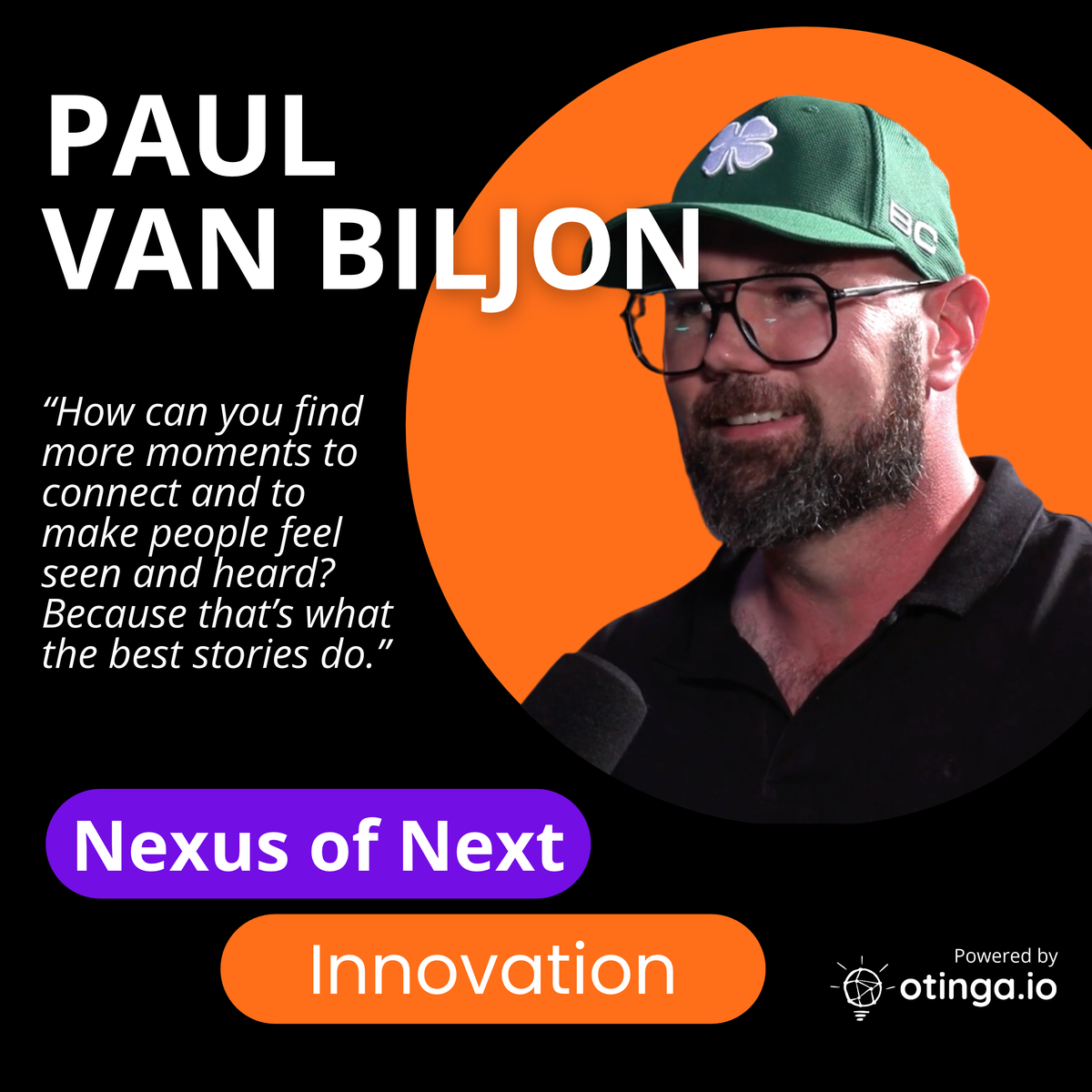
Paul [48:48] We spoke about getting people to tattoo your logo on somebody. I haven't got there yet. What I have got is for people to share photos of my business card with their social media. Okay, you know how I did that? Because I didn't make the business card about me. So the front of my business card's got my details on, back of it says, my favourite thing about you is, and then I would write my favourite thing about them. I don't share the front of my business card, but the back, at least my website's at the bottom there. It's because I took something as simple as exchanging a business card, and I made an opportunity to connect with someone and to tell their story. And so I think that's what I want to leave people with is how can you find more moments to connect and to make people feel seen and heard, because that's what the best stories do.
Paul [49:29] That's what simple pain resonance messaging does. It makes people feel seen and heard. And I encourage everyone to do more of that.
Francois [49:35] What a wholesome ending. Paul, thank you so much for your time and for sharing some of your experience and most importantly, your stories. And for the listeners, thank you for spending the time. You've made it to the end. We see you, we hear you. And you probably know someone who may also benefit from hearing some of the things that's been shared here with Paul.
Francois [50:00] Please feel free to share it with them. And if you're not subscribed, consider subscribing. And please go and have a look at Paul's LinkedIn, his Instagram. And who knows, maybe the paths cross there. Paul, thank you.
Paul [50:14] Thank you. And please, please reach out. I'd love to hear some of your stories.
Francois [50:14] Fantastic.

 Claude
 ChatGPT
 Gemini

