00:00
Introductions
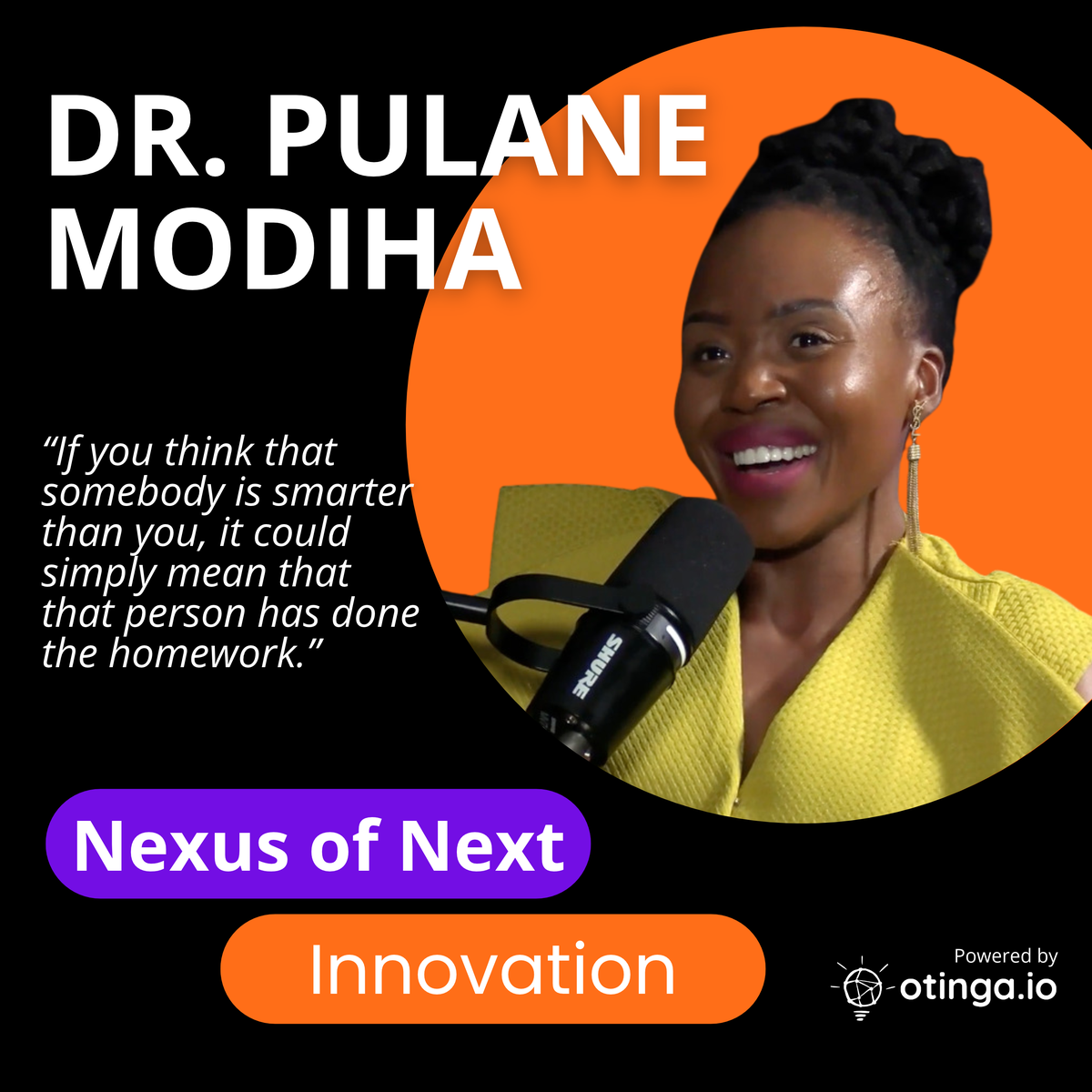
Pulane [00:00] The mistake leaders make is not allowing people to think that they are capable. I lecture people that come from different backgrounds, engineers, medical doctors. They will still feel like they have not achieved enough. They still think they are not enough. I could walk 15 kilometres at age five. It could simply mean that that person has done the homework. If you are coming with something that is obvious, I feel like you're wasting my time. I came second from the position point of view, not from the grades point of view. But here's a story. My family wanted me to repeat. A woman will come with a great idea. You call it innovation now. You will tell your husband and then if your husband buys into it, then your husband will tell the world and then own it.
00:51
Welcome - meet Dr Pulane Modiha
Francois [00:51] Welcome everyone to the Nexus of Next podcast. Today my guest is Dr Pulane Modiha. Dr P has won multiple awards and most recently she's won the Mail & Guardian Power of Women award. She's a chief operating officer in banking, a business school lecturer and the author of a book called From Boundaries to Brilliance.
Francois [01:20] Not only that, she's also a host of her own podcast, Brilliance in Action. Today we get into three things: her mother's remarkable journey, turning imposter syndrome and gendered expectations into a superpower, and why she calls innovation simply a solution.
Francois [01:45] Dr Pulane, a pleasure having you here with us today.
Pulane [01:48] Thank you so much, Francois and your team. And thank you for having me. It's such a humbling moment for me to be with you and your awesome team. The reason I say this is because I also think you are brilliant as a person, as a human being, and of course, as a leader. So I am looking forward to the conversation.
02:10
Meticulousness, and the role model behind it
Francois [02:10] You know, one of the things that I always take away, and thank you for the compliment, one of the things I always take away from our interactions is a slight bit more further thinking, and a question about meticulousness. You're someone that I really admire when it comes to how methodical you are.
Francois [02:30] And we were speaking earlier about being an author while being a senior executive, while being a lecturer, while being a podcast host. You can only be all of those things if you're meticulous, right? And so that's something I truly admire about you. But these things always start with a story and sometimes starts with role models, right?
Francois [02:53] Who's been that one role model in your life that you'd say has shaped you into the woman you are today?
03:01
"Busy life is energy"
Pulane [03:01] Yeah, sure. So you're speaking about, or you're touching on the conversation we had earlier around how do I do everything that I'm doing? First of all, it's because I'm very passionate about everything that I do. If something is not speaking to me or I'm not passionate about, trust me, it will show. So I'll be bad at it.
Pulane [03:20] That's number one. But number two, I think busy life for me, I've coined a certain quote of mine. I say busy life is energy. So when I'm busy, I become very energized and I love being busy. And then back to your question, I think the person that is my role model, first of all, is my mum.
Pulane [03:43] The reason being, I even probably inherited this energy from her because growing up as a child, she has always been there and she has always been busy.
03:52
Her mother, who never looked down on her work
Pulane [03:52] So my mum was a domestic worker. Can you believe it? I know she was that kind of domestic worker. First of all, growing up, seeing her as a domestic worker, I've always known that she is different for two things.
Pulane [04:07] She took her work very seriously, and for her, being a domestic worker did not mean that she is probably in a job that is, you know, a low, she never looked down on her work. So when she worked, she would put effort. She will be meticulous. She will be brilliant in what she does. Right?
04:28
Cleaning in high heels
Pulane [04:28] Number two, she was the kind of a woman who took herself a little serious.
Pulane [04:33] I know people say, ah, I don't take myself serious. No, my mum took herself serious. My mum will wake up in the morning, put on, at the time, they didn't have makeup, but they had pawns, just to make sure that her face is not shiny, and she will clean in high heels. Because, yes, yes, that's my mum. And she never really wore those aprons because she's not a messy person.
Pulane [04:57] She really never messed herself up much. So she didn't need that. Yes, and she was cleaning with her belt. I think you know me, I love belt. Even now I will wear a jacket and I'll belt it up and people will be like, why are you having a belt? So I used to admire my mum with her belt and high heels. And that's why I love high heels.
Pulane [05:16] And you can imagine as a domestic worker you have to run kitchen, bathroom, all.
Pulane [05:20] Of the. Things. Exactly. Yeah. So me, it's only office, really. And I guess
Pulane [05:25] places that are well-levelled so I can rock my high heel and my belt any day.
05:30
How self-perception shapes your future
Francois [05:30] I think it's fascinating how that self-perception at the end of the day results in a completely different future for yourself, right?
Pulane [05:40] Absolutely.
Francois [05:41] And I think, like a lot of people here, listening to the episode, would also think about that moment when you were little and you decided, okay, this is how I'm going to treat myself, this is how I'm going to show up. And it's so inspiring to see you implicitly learning that, because I don't think there was a moment where she taught you, this is how you should see yourself.
Francois [06:03] Okay, let's draw a box. This is you. It was something that she showed you almost.
Pulane [06:08] Oh, people call it lifestyle or I call it lifestyle. For me, it was a way of living, really, as a woman.
06:14
Raised by strong women
Pulane [06:14] One part of my story is I was raised mostly by women because my dad, whew, did he run away or did he decide not to be part of our lives? I don't care. I don't know. But my dad was not present when I was growing up.
Pulane [06:30] My granddad did play a part, but whew, my mum, my grandmother, they were such strong women. They filled the void. I really never felt like my dad was not part of me, because I don't know. I mean, you grow up in a household of people that are so loving and are there for you. And even though by society's standards, you think that you are poor, but you don't even see poverty.
Pulane [06:59] If they say today we are eating pap and cabbage, we are eating pap and cabbage. Who cares about poverty?
Pulane [07:07] You know, we don't need meat. And it was fine.
07:09
A household of workers, and an A student
Pulane [07:09] So I was raised in a household full of love, but a household of workers, like proper workers. My grandmother and my mum believed in work as working hard. And they worked hard. And I think they modelled that. And even me, when it comes to schooling, I just worked very hard and excelled in, early on in my primary schooling.
Pulane [07:37] I've always been, and I'm not bragging. It's not a brag. It's a reality, and it's my journey. It's my true story. I've always been an A student, and for me, it has always been, if you can achieve A, what are you doing?
07:51
She came second - and her family wanted her to repeat
Pulane [07:51] And let me tell you a fascinating story. And you are probably young, probably won't relate.
Pulane [07:57] But back in the days, when you go to high school, when you are in 7th, the school that I studied at, if you came number one, they will promote you. So you skip grade nine, which is 7th, and you go to grade 10, instead of eight. I came second. Oh, wow. I know. I came second from the position point of view, not from the grades point of view.
Pulane [08:22] The grades were still good. We were still A, but there was a young gentleman who is actually a good friend of mine. He's an engineer now, who came first. Oh, gosh, I do not understand. I could never beat that guy. He'll get 100% for maths and I'll get 99. But here's the story. My family wanted me to repeat 76.
Francois [08:44] Wow.
Pulane [08:45] They did not understand. Why did I come second?
Francois [08:47] That is crazy.
Pulane [08:49] Yeah. Looking back, I see that it was crazy. And my grandmother was like, no, it's okay. I think, you know, I can do it at seven. It's fine. But it was not fine.
Francois [09:01] So the grades were. You're wearing heels while working at school. That is so cool. Yeah. And I think that's also an interesting story because it shaped the person you are today in the meticulousness that you do everything.
09:17
Lessons in female leadership from home
Francois [09:17] When you think back to your childhood and you think about some of the other implicit lessons your mum taught you.
Francois [09:26] What would be one of those lessons around female leadership, potentially, that was inspiring for you?
09:33
A farm childhood with no gendered roles
Pulane [09:33] So I think, because, like I said, I was raised by females mostly. Leadership was embedded and they took charge. I mean, I grew up in a farm, like literally farm, and I used to walk to school.
09:49
Starting school at five, 15km away
Pulane [09:49] And here's the fascinating thing. When I was five, because my mum was a domestic worker, there was no one to actually look after me because other kids will be at school.
Pulane [10:00] And I started schooling at five, age five, and the school was like 15 kilometres away. So I was expected to actually walk to school then. No, there was nothing. I mean, everyone in the farm walks, so there wasn't really anything big about it. I think the only thing I would say, I was immature. IQ-wise, I think I was fine, but I think I learned the way my grandmother and my mum realised that I'm not ready for school because I'll cry.
Pulane [10:31] And tell the teacher that I miss my mum, and they decided that, you know, I should try again the following year when I was at ten seven. But to your question, leadership was there. So in the farm, you have cattle, you have sheep, you have whatever, any farm work that was needed, especially what looked like male-dominated type of a chore.
Pulane [11:00] Now, my mum and my grandmother will do those. So we didn't have much of a gendered roles to say this one is specifically for women. The other one is for men. I mean, even myself. I used to go to school when I come back from school, my sister and I, we needed to go get cattle from grazing and into the kraal for my grandmother.
Pulane [11:23] My granddad. The following day to milk them and stuff. So we were doing all that. So leadership was assumed and like I said, there was no because I'm a girl, I can't do this. I had to do what I had to do.
Francois [11:37] I like that because I think we shape a
Francois [11:40] very clear picture of what the world looks like when we're young, and when we think about the role models and examples. There wasn't even a question, really, like, what do you mean? There's a gender separation here, there, or everywhere? Yeah, it's just not something that happens. And so.
Pulane [12:02] I think it's something
Pulane [12:04] That is taught or socialized, because with that said, my mum was more active in terms of obviously doing everything. My grandmother, as an example, worked as a domestic worker in Jo'burg, but she went back to Free State to be a housewife. Yeah.
Pulane [12:23] Yeah. But still. And my grandmother was physically, health-wise, stronger than my granddad. And you ask yourself, why
Pulane [12:33] did she have to look after us when my granddad, you know, do all these things? So it was also those questions that I had that I actually used to have conversations with her to say, you are so smart. You are so strong. Why are you not doing this? Why? And yeah, but she really was taking care of all of us at home.
Pulane [12:54] And I like to think that actually, she was taking care of my grandmother's wisdom and everything,
13:01
Great ideas that someone else owned
Pulane [13:01] But I think at the time, a woman would come with a great idea. You call it innovation now. We'll talk to that and you will tell your husband. And then if your husband buys into it, then your husband will tell the world and then own it as if
Francois [13:16] It was theirs. Yeah.
13:18
Leadership as care in a world of machines
Francois [13:18] And I think that's such an important thing, because when we think about leadership today, especially in a time like today as well, where the world is constantly changing, things are picking up speed perpetually. And so when we think about leadership in that world, it is really about applying care to the humans that you're responsible for, especially when machines become more and more and more prevalent everywhere else.
Francois [13:48] Right. Yeah. It becomes a human problem. And it's important to remain human. Yeah. Something I always find fascinating about people who sometimes struggle emotionally earlier on in life is that that's kind of them being put into the fire to be forged and changed. And so what I find is a lot of people who've had those challenges early on in their life.
Francois [14:16] They learn to adapt and grow and develop the same skills that today is incredibly useful. For me, for example, that was a particularly challenging thing as well when I was young, is just regulating and managing emotions. But today I would say that's my superpower when it comes to leadership.
14:38
The only woman at the executive table
Francois [14:38] And I think the same is true for you, because if I think about being a female, sometimes the only female in an executive team in a sector, finance is not a sector for softies. Right. And so now you need to step into that space and hold your own ground and be both a tough and kind leader. I think that's a challenging role to take on, but I think you've got the right role model early on in your life.
Francois [15:05] With a little bit of fair challenges along the way to make that journey worth it. Right.
15:11
Resilience is moulded early
Pulane [15:11] In fact, on that, I like what you said around being moulded early on. I mean, we talk about things like resilience, right? It's a nice word. Everybody's talking about it. But as you mentioned, that even yourself. For most of us, that resilience was actually moulded very early on in our lives. I mean, to be honest with you, I've got a 12-year-old now.
Pulane [15:35] I don't think he will agree with me, even if I ask him to walk two kilometres to school. To think that I could walk 15 kilometres at age five, for me, means I was already resilient, right? So, to your comment around being in the industry that I am in, I love it to be. And I'll probably never change. They say never say never, right?
Pulane [15:59] But I love it. And when you look at the portfolios that I have found myself in, I've chosen. It's actually tough portfolios because I enjoy challenges. I don't like soft.
16:13
"You're wasting my time" - high care, high expectations
Pulane [16:13] I enjoy things that allows me to think hard and solve. If you are coming with something that is obvious, I feel like you're wasting my time. Not in a bad way. But you are wasting my time. But also what I have learned. Or maybe my superpower right there is that nurturing component has never left me.
Pulane [16:37] As I said, I grew up in a family that is full of love. The family that is full of happiness. The people that I mean, the family that respect people. And you have like crazy empathy. So I might be hard on the results and say, look, we need to land this project or we need to improve whatever that we are working on.
Pulane [16:58] But at the end of the day, I still see you as a human being.
Francois [17:02] High care with high expectations.
17:05
The robots are coming, and why the human element stays
Pulane [17:05] Exactly. Yeah. And now the robots are coming. You spoke about the robots. The robots are coming. It's fine. They can come. They're machines. But these human beings are still human beings with emotions. Absolutely. And everything that goes with it.
Francois [17:15] Yeah, yeah. I think it's fascinating how this world is changing in that realm. But I think the future is a lot brighter than most people would care to acknowledge.
Pulane [17:24] But. So maybe before you go to the next question, I saw a video of a lady walking a
Pulane [17:31] dog robot. I think it was in China or Singapore. It came into my algorithm, whatever screens on Instagram. And I don't know what will be your thinking, but it felt so unnatural. Like, how do you replace a dog? Maybe it's okay. Look, I'm not judging here, but for me it felt so unnatural. If it was me, I still want to give love to a dog and walk the dog to the, you know, to the park and do all those interesting things with something that has emotions.
Pulane [18:07] I think that's why I believe that as much as AI is here, robotics, I fully support that. But we should not think that whatever is happening is going to replace the human element completely.
Francois [18:22] You don't know why she's actually walking with a dog. Maybe the reason why is because she wants to be looked at, right? And so then walking the
Francois [18:31] Robot dog is a really good idea, right? You never know.
Pulane [18:35] It's true. I mean, people have got different motives, of course, but I'm just saying that. And actually, I like what you say because oftentimes we see
Pulane [18:44] people behaving in a certain way. We are quick to jump into conclusions. And I think it's one thing that the older me is, with kids, of course, I am more observant of the people that might have different, even different work ethics. So even if I want the best out of everybody, including my kids, I'll be telling them that, guys, if I could get A's in the public school.
Pulane [19:09] I mean, you're in private school. You don't have a choice.
Francois [19:12] Yeah, there's no choice. Just be brilliant.
Pulane [19:13] And be better. The infrastructure is there.
Pulane [19:16] So you're empowered.
19:17
Reading by candlelight and borrowing books
Pulane [19:17] I mean, I used to read using candlelight. When I was in university, my first year, I didn't have money for books. I used to borrow books from my friends. And I would read and tell them I'll summarise a book for you. So I think that's why it's easy for me to read a book, summarise, and give it to somebody, because that was pretty much part of my university life.
Francois [19:38] And your origin story. Yeah.
19:39
Thank you, challenge
Francois [19:39] I think when we talk about
Francois [19:41] the world of challenge and the world of difficulty, both of them may be the exact same thing. It's the perception that you have of it that differs. And so what I think is an important thing to take away here is when you say, give me capability
Francois [20:01] Or give me patience or give me intelligence. You won't just get those things. What you will get is you'll get opportunities to develop capability.
Francois [20:14] Opportunities
Francois [20:15] to be patient. And I always think when I look at some of the challenges that I face, and I'm certain you do the same, and I go, sure, okay, that's tough. And then I go like, well, thank you, challenge. Thank you. Because tomorrow I will know how to handle you and then I'll be one wiser.
Pulane [20:37] Become wiser, of course.
Francois [20:37] Absolutely.
20:38
The underdog mentality and "do I belong here?"
Francois [20:38] So when we think about your story in the way that you've managed to become someone who a lot of people look up to and a lot of people who look towards for advice, guidance, mentorship and support, it's also easy from your own perspective to have to deal with, okay, do I actually belong here?
Francois [21:02] And the narrative that we always use, especially someone who's hungry, who works hard, who grows, who adopts technology, who makes paradigm shifting projects at work. That's almost always an underdog mentality, right? That's, we're not resting on any laurels here. That's great. That's pretty.
Francois [21:23] Put it around your neck. Let's go. There's another mission to accomplish. And so I think it's always interesting to me how the underdog mentality can be your strongest asset, but also cause a little bit of a challenge when you ask that question. Well, do I actually belong here? Right. What's your view around imposter syndrome and gendered roles in the senior executive world, especially in finance?
Pulane [21:50] Yeah.
21:51
Imposter syndrome is real
Pulane [21:51] So, look, imposter syndrome is real, right? And it doesn't matter how much we achieve, somehow we carry it with us. I will be in the room here, I might be thinking, oh my goodness. Francois is way smarter than me. Listen to how he articulate himself. Oh my God, if I have to compare, his podcast seems to be better than mine.
Pulane [22:13] So it's those kind of, in my humble opinion.
Pulane [22:17] Yes. And also, most of where imposter syndrome is coming from is some limitations that we place within ourselves. And I like what you said earlier around you will not have known probably how strong and wiser you are if you don't take the challenge on. Right.
22:37
Why her podcast is called Brilliance in Action
Pulane [22:37] So I do believe and that is why my actually podcast is Brilliance in Action, because I feature stories of the people that have chosen to act.
Francois [22:47] So action is so important.
Pulane [22:49] Action is so important. So if you have an idea in your head and you don't act on it, it just lives in your head and that's it. It dies there. Right.
22:58
Accomplished executives who still feel not enough
Pulane [22:58] And I think what I find fascinating, as you said, I lecture part time in business schools, and I'm talking about now people that I think, in my humble opinion, are so well
Pulane [23:09] accomplished. They are so smart. Like, this is business school, so I lecture people that come from different backgrounds, engineers, medical doctors.
Francois [23:20] And so. With both pinkies in the
Francois [23:21] Air.
Pulane [23:24] But they will still feel like they have not achieved enough. They still think they are not enough. So there is a module called personal development that I lecture. I love that module with all my heart, more than anything else that I lecture, because it starts with you.
23:40
Check in with yourself first: find the root cause
Pulane [23:40] So you need to check in with yourself first before you even go to a therapy, or before you come to me as your mentor. What is causing imposter syndrome?
Pulane [23:53] If it's because as a woman, you were the only one on the table and maybe men were talking over you, blah blah blah. So now you are even scared to voice out your opinions because you can realize that, you know. So I think for me I always, and funnily enough, I used to be in risk before in my life. They love to say what is the root cause?
Pulane [24:18] We love root cause analysis because whatever that you see is a risk manifesting, as an example, it's a symptom. But something went wrong that costs whatever that costs. So you need to go back into being honest with yourself. And, to our earlier point, we come from different backgrounds, and those backgrounds might be the cause of how we're showing up, the way we're showing up.
Pulane [24:45] And you may find people like me, I don't have. I think my threshold for imposter syndrome is very low now because I'm very aware of the circumstances that make me feel like I'm inadequate, but most importantly.
25:00
Excited by a challenge
Pulane [25:00] Because I had an interesting upbringing whereby I needed to fight all the time for everything that I have. And my husband will tell you that the funny part is I don't mind fighting. When I say fighting, I'm not saying physical and whatever, but I don't mind taking a challenge.
Francois [25:23] Negotiating.
Pulane [25:24] And. Negotiating and going at it and trying to solve the problem. I actually get excited by that.
Francois [25:31] It's like.
Francois [25:32] Fuel for.
Francois [25:33] You.
Pulane [25:33] It is a fuel, even now.
25:35
Smarter usually means they did the homework
Pulane [25:35] And I think when you look at what the world we live in now, the world is volatile, is ambiguous. It's crazy. And then you look at AI and now it's interesting solutions and blah, blah, blah. But a lot of us, I don't care whether you have studied IT or not, our world is changing, right? And we are all learning many things.
Pulane [25:58] Every day there's something new. So if you think that somebody is smarter than you, it could simply mean that that person has done the homework. That person has learned something new and you have not. So it does not necessarily mean that you are not smart. You don't belong. You don't do whatever. It just means that probably don't watch too much TV.
Pulane [26:19] And be on Instagram. Enlighten yourself about the way the world is going so that you can add value into the conversations or into the solutions that the world needs.
26:31
Curious and solutions-driven
Pulane [26:31] So if you look at what is making me win because I do believe that I'm winning, right? Even at work is I love research. I love research.
Francois [26:44] That's your superpower.
Pulane [26:46] I just, I'm very curious. I'm a very curious individual, so I want to know what is happening out there. But most importantly, I'm very solutions driven. So if something is
Pulane [26:59] broken, I would like to know how do we fix it as opposed to accept, no, it's broken.
Francois [27:07] This is how it's always been.
Pulane [27:09] This is how it has always been within the society. Ah, the society is broken.
Francois [27:12] What do you mean? What do you mean? What do you mean?
Pulane [27:15] You know, and if it's broken, who broke it? So let's go into. Let's unpack it further.
Francois [27:20] It's the root cause. Like, what.
Pulane [27:21] Is the root cause? Because I think we take a lot of things at face value. And I love people. The more I speak to people, the more I realize that people are not broken. They just need to. And again, even when talking about the fix, the fix is within reach.
Francois [27:38] For all of us.
Pulane [27:39] For all of us. The fix is within reach. And we will talk later about my book.
27:45
Brilliance is not for the chosen few
Pulane [27:45] But my book is on that premise to say brilliance is not for the chosen few or the clever ones. Anyone can be brilliant. Anyone can be brilliant. But if you believe that you can be brilliant, what do you do? You need to start acting.
28:02
Pushing through the boundary
Francois [28:02] Yeah. It's about believing first. You know, one of the things that always fascinates me about you is that unwillingness to accept a problem and just be. This is unacceptable. And we will find a way. But then in that same breath. And that may be a boundary that people perceive, right? And then you'll say, well, that's great.
Francois [28:24] I don't care about that boundary. We will push through that boundary.
Francois [28:28] And do that in a way where people are actually standing behind you. And, I mean, I've worked with your team before. I know it's like a literal force of nature, you know, to move forward. And I think it's fascinating to see that happening where, yes, there's a boundary. Sure. Great. Yeah. And that's why the title of your book, From Boundaries to Brilliance, is so cool.
Francois [28:53] Tell us a little bit more about that in a minute or two.
28:56
The mistake leaders make with their teams
Pulane [28:56] I think before I go into the book, I love working with you too because you're very solution driven. And when we work with you to your observation, even my team now, my team believe that they can bring solutions because the mistake leaders make is not allowing people to think that they are capable.
Pulane [29:15] That is dangerous because if you create an environment whereby people think all solutions should come from you, then it's a problem.
Francois [29:27] Learned helplessness.
Francois [29:28] Effectively. Yes.
Francois [29:29] The elephant pulling on the thin string you know.
Francois [29:31] Yeah.
29:32
One problem, three solutions
Pulane [29:32] So my team is actually I tell them if you come to me with one problem, at least suggest three solutions, and you will be amazed as to the creative brains that goes into that.
29:48
From Boundaries to Brilliance: the book
Pulane [29:48] But so my book From Boundaries to Brilliance. As I said, so I'll read this snippet here. It says most people believe success belongs to the exceptionally gifted.
Pulane [30:00] But the truth is different. And when you look at my book, I feature as an example, the first CEO of restaurant Mary Vilakazi,
Pulane [30:11] I feature Mike take. He's the CEO of Charity Holdings. I mean, they're doing mining now and the water is doing amazing work. Hema Vallabh, who's a female engineer and is also
Pulane [30:26] extending our multiplying impact, with assisting women to actually get into business. Dr Paul Leroux, he owns Cape Town Fertility Clinic, the medical doctor by background. Telefani Banks. Young entrepreneur.
Francois [30:46] The funny is also, you.
Pulane [30:47] Know, Telefani.
Francois [30:47] Of course. You know, some guy, you.
Pulane [30:49] Know.
Francois [30:50] And.
Pulane [30:50] Then Dr Judith Lamine. I mean, the reason why I'm mentioning these people, when you look at their resume and when you look at them now, they are so polished.
Pulane [31:00] You will think that their life has always been so simple. But when you read the book and they share their stories of brilliance, you realise that you know what they are normal human beings, like all of us. They've met challenges, they've met barriers along the journey. But you look at them now and they are winning.
Francois [31:21] I mean, if
Francois [31:23] You look at what they have achieved and the impact that they've made.
Francois [31:26] Absolutely right.
Pulane [31:27] So I think this book is exactly for that to say believe in yourself because the brilliance in within.
31:35
Why she mentors for free
Pulane [31:35] But also importantly as you said I do a lot of mentorship and I love it. I believe that if I can share at least a piece of information that I know that can help someone to improve their life or their lives or multiply impact, I will have won in life.
Pulane [31:56] It's not even so much about
Pulane [31:58] money or anything like that, because I don't actually charge.
Francois [32:02] For so much cost. Yeah, yeah.
Pulane [32:04] No, I don't charge, I don't, yeah, but I want to multiply impact. But I'm a busy human being. And I think the more people know about you, the more people want more of your time. And I realise that
Pulane [32:20] certain people, or most people that come to me are on mentorship. They've got the same problem.
Pulane [32:27] It's the same movie, different sound, music, different scene.
Pulane [32:33] But same.
32:34
A self-help book that challenges you
Pulane [32:34] So I was like, you know what? Let me rather write a book that it's like I say, it's a self-help, but it challenges you. It asks you the questions that I would have asked you if you came to me. First of all, to say, Francois, what is your boundary? Do you even know?
Pulane [32:49] Because sometimes
Pulane [32:50] We are quick to say, oh, I'm so stuck.
Pulane [32:53] Stuck way.
Francois [32:55] How? Yeah.
Pulane [32:56] You know, so I wrote this book for the people, and I always say, I'm probably gonna write a second book soon. Okay? Not soon as in this year.
Francois [33:05] Maybe next week. Wednesday.
Pulane [33:07] I would love to. I might as well as December is coming. What am I going to do with myself when everybody's
Francois [33:13] At the beach?
Pulane [33:14] I might as well. Right? Right.
33:15
Share your brilliance: solutions over negativity
Pulane [33:15] But I'm saying we write this book for people, not for ourselves. And I do believe that as we
Pulane [33:24] attain our own brilliance, the best thing that we can do, especially as leaders, is really to share. And someone will probably motivated. Someone who will probably take a guide from your leaf and they will run with it. But ultimately, I really want to see people winning. There is a lot happening in our country and actually in the world.
Pulane [33:47] It's crazy. There's a lot happening, and probably there's a lot more that's to come. So I think we need to make sure that mentally we are fit. So when you look at social media, when you look at the things that we read, most of the time we are really consuming so much negativity. France is burning and Italy and, you know, so for me is can you just yeah, create positivity and get more people to think solutions than challenges.
34:22
Thank you, and where to find Dr P
Francois [34:22] That is so wholesome. You know, this is the thing that inspires me. Dr P, thank you so much for spending the time with us today. Once again, if you didn't catch that during the episode, Dr P's podcast, Brilliance in Action.
Francois [34:37] With Dr P with Dr P. Yeah.
Francois [34:41] And From Boundaries to Brilliance, your new book. A pleasure spending time with you today. And yeah, thank you so much. Some inspiring words. And I'm excited to see what's next. Maybe we'll have you on again for your next book. Next week. Wednesday.
Francois [35:02] No pressure. Yeah, I think it's great. I always enjoy these conversations. Thank you so much. And if you're still listening. Thank you very much for spending time with us today. It's a pleasure having you here with us. If you know of anyone that may be interested in the topics that we discuss at the Nexus of Next, please consider sharing the podcast with them and consider subscribing.
Francois [35:26] Have a great day.

 Claude
 ChatGPT
 Gemini

