00:00
Welcome & introduction
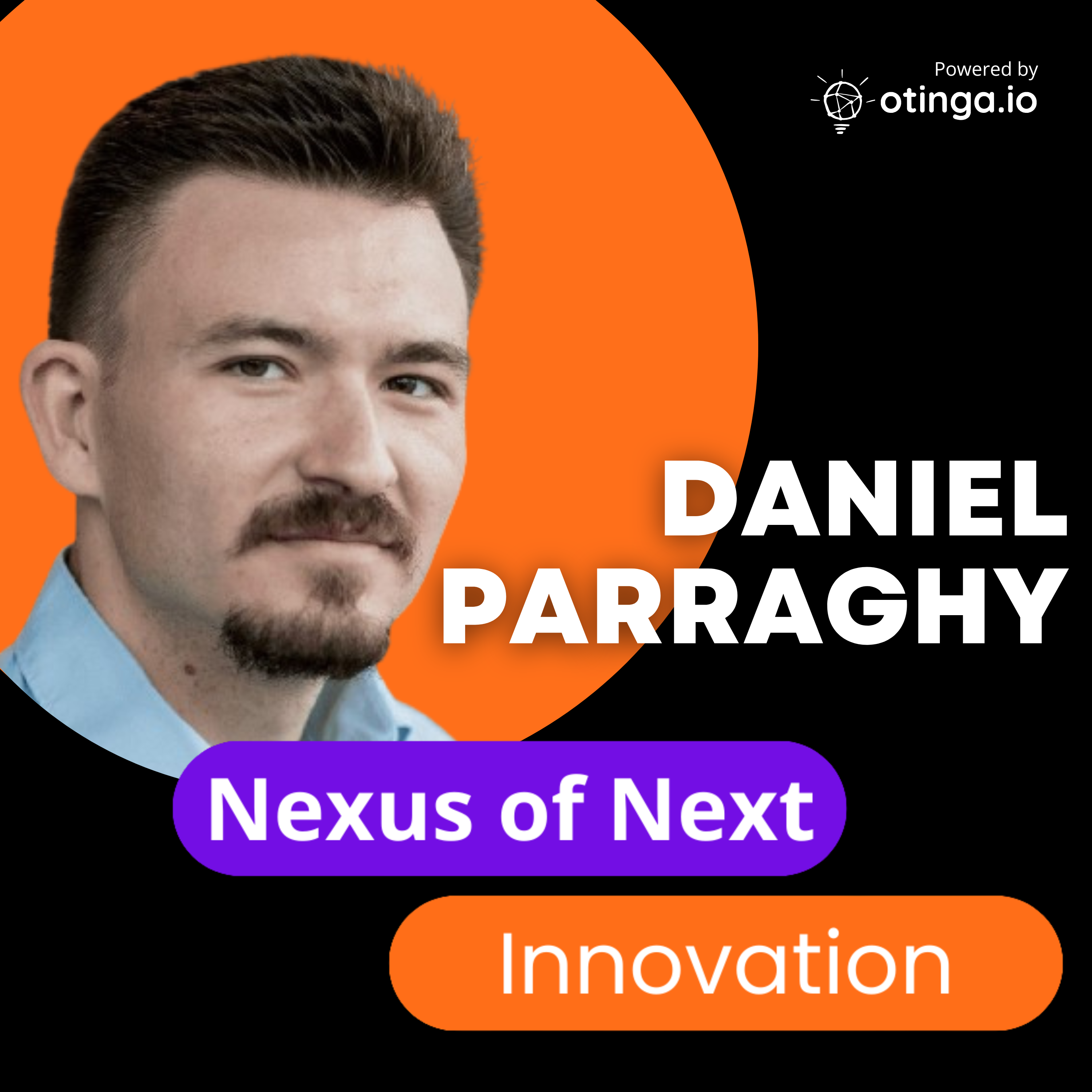
Francois [00:00] Welcome everyone to the Nexus of Next Innovation podcast. And today I have the absolute pleasure of having Daniel Parraghy here with me today as he, Daniel is a applied systems and organisational scientist. He develops holistic strategies and really helps businesses navigate those challenging and tumultuous waters when it comes to changing market environments. Just standard business problems that's difficult to solve. He serves on multiple boards and has helped businesses from all over the world. Um, he's been at the forefront of holistic strategy development, and he uses systems thinking and system dynamics to transform organisational challenges into Opportunities. In this episode, we'll be diving into Daniel's journey from coding in the area of flash all the way through to large scale business transformations. Daniel, it's such a pleasure to have you here with us, and thank you very much for joining us.
01:16
Daniel's background and early life as a coder
Daniel [01:16] It's a pleasure. Thanks, Francois.
Francois [01:19] So, so, Daniel, um, something that that I think is so interesting about you is that you discovered early on in your life that you were having something that was perceived to be a challenge personally and eventually became your biggest superpower to help you spot patterns and see things from a completely different angle, helping you to innovate, redesign and revolutionise how organise how organisations operate. I'd love to hear a little bit more about your journey with neurodivergent as well.
02:03
Discovering neurodivergence at 33 and what it unlocked
Daniel [02:03] I learned just last year when I became 33, just before my 34th birthday, to be honest, that I'm neurodivergent. Until then, it was just I sensed something was off, but I didn't know what. And it it was like during my childhood, I was curious about things I always wanted to know how does it work? And once I knew how it works, I was able to either improve it or use it to my advantage, or just get out of its way not to get harmed. So it was a like like with flash. It was. Everyone was playing these games and I just was interested in how they work. So that's how I started with ActionScript and. It was a journey. I mean, in school, nobody could, like, trap me into you have to do this or that.
Francois [03:22] Mhm.
Daniel [03:24] Once I got out of school I did whatever I wanted.
Francois [03:29] It's a good thing you've got a passion for business because I think that's your unique superpower, you know. Um, it sounds like you dabbled in systems thinking before you even knew what systems thinking was. And today, it's probably one of the things that helps you solve incredible, incredibly difficult and complicated business problems. I'm curious. Um, you were about to tell me a little bit more about what you think innovation is, and I'm super curious to hear your view about what innovation is in business today.
04:05
What innovation actually is (and what it isn't)
Daniel [04:05] Um, well, we first have to, like, make the difference between what people understand when we say innovation. Many think about innovation in terms of that eureka moment, like Apple falling on your head, and now you're Newton coming up with gravity. And it's not like that. Basically, innovation is a by-product of habits, activities, processes and even just like tinkering, absorbing information and then going for a walk and let your subconscious bounce around things and come up with New ways of how to how you could approach stuff like taking things which are around like a stick, a long stick and a sharp knife, and figuring out if I get that sharp stone onto that stick, I could throw it, maybe catch a deer.
Francois [05:20] Sounds like it's resources. Leveraging resources and using that in a way to get a better result than you were getting before.
Daniel [05:30] Well, it's no secret that most of the innovations which are produced, what research develops, isn't even used, just like ten, 20 or 30 years later. If if at all. I mean, some stuff is just somewhere in the R&D department or somewhere at the university, and it never becomes a spin off.
Francois [05:57] Hmm. I find, like sometimes it's just too early or it's it's just not. The timing was maybe a little bit off or something like that. I mean, if we if we look at, like, even this, uh, this was a brilliant idea in a box in a basement for a very long time before it became something popular that everyone uses today.
Daniel [06:21] That's true. Think about smartphones. The first smartphone wasn't invented by Apple. So it was invented in the 1990s. 93 or 94. I forgot the company, which it was, but I think it was Microsoft, maybe, or something like that. And it was Technology wasn't ripe, but they tried to come up with it already. But once we had the internet and a little bit more processing power. Now that's where the magic happened. You know, you need a certain amount of. Technological advancements so that it can culminate in the next stage.
Francois [07:19] Mhm. It's almost like a build up. It kind of builds up and then it ever launches onto the next stage. I'm curious like how have you seen that manifest in business. Like when an organisation is facing a challenge and then they kind of build up this almost like an innovation avalanche in a way. How do you see that happen in a positive way?
07:46
Blockbuster, Netflix and the anatomy of organisational blindness
Daniel [07:46] Take for example, Blockbuster and Netflix. Blockbuster had a brick and mortar store with thousands of stores, which was investment heavy. So you need a lot of investments and loans from banks or from investors to create or expand the branch network and Netflix. Back at the time, it was pre, pre-internet, just the internet was like starting to exist when Netflix was still like sending out copies. Of videos, it was like a subscription service. You subscribed and you received a certain number of videos every single month or week, and they couldn't compete. But what they could was like trying to figure out how to use that new thing, which was the internet. And by doing that, they just, in small scale started to do things which for a blockbuster, it made no sense. Why would we want to remove the brick and mortar stores? We invested so much into it. That's the loss aversion. That's the human side of decision making. So when you have incentives in place in a huge organisation, they can effectively stop your people from exploring things which in the long term replaces the organisation as it is.
Francois [09:36] It's almost like a blindness that gets created a like a a there's a term they use called cognitive blindness, with a moonwalking bear across the across the basketball court. When they ask people to count the number of basketball pauses. And I feel like, uh, the those biases associated with like, heavy investment or, uh, fear of loss or the sunk cost fallacy coming into play kind of creates those blind spots where there's like a blinker on at the moment. And even if it even if it slaps you in the face, um, you're not gonna respond to it in the appropriate way. I know that, uh, Netflix wanted to sell to blockbuster at some point, and blockbuster didn't, uh, didn't actually take them up. And today, I think blockbuster would have been very happy in being sold to Netflix.
10:38
Elon Musk, Volkswagen and playing the wrong game
Daniel [10:37] I mean.
Daniel [10:38] Take for a moment, I think it was 15 when or. 2016 when Elon Musk was on stage having a being on a panel with 2 or 3 other people talking about the future of mobility. And everyone in the audience was like chuckling about what he was saying. They were laughing about his predictions, and he said that in 10 or 15 years, all of you will be out of business. And it's not because of his arrogance. And he is, but it's because there is a simple fact that when you have a huge business model which relies on no deviation from X or whatever product you have, because that's driving your revenues and everyone is measured To like drive this one forward. Take, for example, Volkswagen. All of their profits. Most of it stemmed from es ese. And instead of doubling down now finally on their, um, electric mobility and electric cars, they start to discuss how to like, do both. Yes, of course you still need ES because people want to buy them, but you can't win in the future when your electric car isn't what the what people want to buy in 5 or 10 years. Mhm.
Francois [12:27] I see is internal combustion.
Daniel [12:29] How Volkswagen could do both is if they stop producing electric cars within their existing model and create an Ethos Wagon brand and do it separately, completely outside of the existing order, because they won't change the structures of the existing company.
Francois [12:58] How have you seen organisations manage to create the space for innovation from a leadership perspective? Because that that is a problem that every single, well-established industrialised business face is. They face the challenge of having something that they're really good at doing. And the sunk cost fallacy, there is a focus. All of that is there. But when the market starts changing, how do you see businesses creating that space for people to start thinking Differently, while the industrialised process is still operating efficiently because it won't always operate efficiently, right? Like there will be new emerging threats. It might be electric vehicles, it might be AI, it might be something else.
13:52
How paradigm shifts work: the five forces
Daniel [13:52] So now we are going into paradigm shifts. What you're talking about when the market is changing and it doesn't change overnight. So um, if I remember correctly, you read the second edition of my newsletter in which I dissected the five forces that go into, um, which go into changing a paradigm from what it is today into what it will be in the future. And when organisations try to leverage or double down on their strengths, like what you mentioned or what, for example, Volkswagen is again trying to do or considering to do, then they are effectively sub optimising their whole organisation and it will accelerate their downfall. Because they take their strength and push it to that certain limit where it stops being a strength. It's like almost a Achilles heel.
Francois [15:06] It's like over optimisation of a strength becomes or overdependence and over leverage of an existing strength creates blind spots and vulnerabilities in a business that isn't immediately apparent, but then becomes apparent when that double down, or that heavy investment and heavy leverage of that single strength Uh, starts faltering. Uh, and then it's too late.
Daniel [15:37] Um, talking about about basketball. Now imagine you're playing basketball. You have your team and there is another team, and you don't know when. But somewhere along the line of playing, you know that the game's rules will change. Now you keep ignoring that the rules changed and you still play the same old game.
Francois [16:05] Mhm.
Daniel [16:06] Can you.
Francois [16:07] Win? You're trying to play by the old rules but there's new rules now. Yeah.
Daniel [16:14] How do you want to win a game that is already playing based on new rules. When you still playing the old game. You can't.
Francois [16:26] Well you can try. You're just not going to have a good time, I guess.
Daniel [16:30] So no, it will be frustrating because you will go through the stages of the five stages of grief and you will first deny that something changed. Then it will anger you because, well, why? Why am I not allowed to do this or that? Or why do I have to pass on the ball to the other team? Now, I didn't do anything wrong because you're still playing the old game, but in the rules of the new game, what you did was wrong. Yeah it will.
Francois [17:07] And that denial.
Daniel [17:08] The point where you will be depressed because the other team will keep scoring and you won't be able to even get anywhere close to just do one score.
Francois [17:22] So it's almost like keeping your eyes open for when the rules starts changing, and seeing which signals it is that you should be looking out for. I'm curious how. How do you how do you spot those signals? And how do you overcome those blind spots in an organisation in your view?
17:43
The three organisational models and why design determines destiny
Daniel [17:43] It depends on what organisation we are talking about because there is not one one size that fits all. So you have different types of organisations and depending on what view of our existence and the assumptions which went into designing that organisation, it can be a mechanistic, a biological or the social, cultural or socio economic view. Each of them has a unique set of assumptions that go into the design and makeup of how that organisation is designed and will be functioning. Depending on there. Each of these models has their strengths, but also limitations and trade offs and unintended consequences. And they only work in certain environments. So you have to know, am I playing now really basketball because I'm standing on a football field? Don't try to play basketball on the football field. Very simple.
Francois [18:53] Yeah, you're gonna get hit and you're gonna probably make your way to the ground very quickly. If I could stretch that analogy as far as it goes, you know, you know, something that's quite interesting is that certain organisations are more adaptive to change than others. And in a lot of cases, it's due to the organisational design. And I really enjoyed having a look at your last newsletter where you talked about like how you've got these mechanistic hierarchies and how you can then transition that into decentralised intelligence in a in a very methodical way. Help you just understand that premise a little bit more.
Daniel [19:40] Well, you can't transform it, but you can like take the organisation as it is. If it's a mechanistic model, which means it is top down, rigid structure, no feedback to what I say. I don't care about your brain. I just need your two hands to live with. Um, a quote which is attributed to Henry Ford. But there is no proof that he ever said it. But it just like, symbolises the industrial era in which we don't care about the people. They are just another part in the machinery that produces something which we need to sell.
Francois [20:23] Mhm.
Daniel [20:24] Back then the challenge was how can we produce for the masses? Products or whatever we need to sell if it's food or whatever? Mass production was key. How can we achieve it? And he broke down every single task into just one motion. That was simple regardless of someone's education and background. They were able to fulfil that one motion. So imagine a person doing for 10 or 12 or 14 hours a day, just that one mindless motion.
Francois [21:10] Yeah. I don't envy that at all.
Daniel [21:13] Yes. So that's one of the consequences that comes along with that view. And how to organise labour and work.
Francois [21:25] But it's almost reductionist in nature, isn't it, because it basically reduces people down to mechanical functions. And I think there's way more potential in people than, you know, being able to screw on a cap or do something like that. And unfortunately, mechanical, mechanistic organisations, yes, it's knowledge work, but those mechanistic organisations are effectively doing the same in forcing people who can think for themselves and have potential to still screw on a cap on an assembly line, preferably.
Daniel [22:01] Yes. But we have to understand that the context in which we in which this model like emerged, it was a lot of people have been starting to being laid off through the invention of the tractor. Yes. When you don't need any more 90 people working on a field from a hundred, but only ten. What do you do with those people? They started migrating into the cities and that created issues, but at the same time, a huge potential.
Francois [22:39] An opportunity. Yeah.
Daniel [22:41] So when labour is cheaper than machinery, you just take labour. We don't need their brains. We need their hands.
Francois [22:54] Of course. Yeah.
Daniel [22:55] And it created wealth for people. I mean, look at Chicago. It was prospering. People had well-paying jobs. Of course they did. Nonsense. Taking apart. Putting it there or whatever. One motion. The whole day. 5 or 6 days a week, but it created wealth. During its height. Ford was selling more cars or producing more cars than all of his competitors combined.
Francois [23:39] Hmm. That's like the definition you were saying?
Daniel [23:45] Yes. So there is power in this model. Now, the question is, how do you improve it in ways in which the human isn't just reduced anymore to like that mindless motion, fulfilling whatever you want to call it.
Francois [24:08] Autonomous. Yeah.
Daniel [24:11] And you receive feedback from the front because that's the Achilles heel of that model. You need external intervention to improve it. It is not created for adaptation.
Francois [24:26] Yeah, it's created for exploitation and, uh, doing one thing incredibly, incredibly well. It's almost like the Asics of the of the CPU world or the processor world. It's good with that one thing.
Daniel [24:44] The system has only one purpose.
Francois [24:47] Mhm.
Daniel [24:48] Fulfil whatever purpose the owner of the company or the organisation has. Or the owners. If it's more than one.
Francois [24:57] The leader. Yeah. I'm curious.
Daniel [25:01] Or whatever. Fulfil that one purpose.
Francois [25:05] Mhm. I'm curious what your thoughts on how um both creating an environment where people can break out of that reductionist position like that mindless assembly line type of work, even though it's knowledge workers like how that could accelerate a business forward. And then on the other side, how just creating decent feedback loops, uh, that the that people can use to surface high quality ideas and high quality opportunities to the level at which it actually can, can be taken action upon.
Daniel [25:50] Well, what I learned over the years that people struggle with imagining how an organisation looks like. So the best way to start with is to map everything, not just how it's build up in two dimensions, but put it in a perspective of three dimensions.
Francois [26:14] Or a graph even. Yeah.
Daniel [26:16] Yes. Like illustrate it and then add to it everything. How is the data flowing with data I mean information. Top to bottom. Bottom to the top. Who is communicating with whom? Who is reporting to whom? How long does it take for that information to be seen, to be processed, to be answered to? Yeah.
Francois [26:44] I think that's a very valid point at time because that impacts responsivity to change probably the most is just the time that it takes.
Daniel [26:53] So you will see how often people ask for more information, how long it takes to make a decision. And then you will start to be able to see okay, wait a second. Why does it take a long time for information A to go through the whole cycle to the person who needs it. And then you can also like ask yourself these types of information or these decisions. Do they have to be made this high on the hierarchy? Or can I like delegated to the lower levels. Because these are not impacting the organisation on the on the long term. They are contained to like software or machinery or whatever the type of business is you're dealing with. And it's an evolutionary improvement of of the software, or maybe the UX or user interface of, of the, of whatever product you have. So instead of pushing that to senior or executives, they shouldn't waste their time with it.
Francois [28:15] I found that organisation seems to have those two patterns, and either the decisions are being made at a two higher level of the organisation, and so the leadership then wastes their time in making decisions that could have been made at a lower level. And then on the other side, you've got this challenge where, um, there's all of these incentive based filters within an organisation as part of the hierarchy, where let's say there's an event that happens on like n minus five layers from, from the most senior leadership. Um, and so now for that information, let's say it's meaningful information for that information to get to the top. You're not only talking about the time delay and whether or not there even exists a channel for that information to make its way up there. You also have to deal with the filters in between where the filter might be someone that is incentivised to do X, but this piece of information is as shining a spotlight on Y. And so those those are higher. Hierarchical filters also restricts communication in the organisation. And so there might be something incredibly valuable happening. But it's impossible for senior leadership leadership to know and allocate resources to it.
Daniel [29:42] Now we are talking already about another model in view. Because these layers and the decision making process which you described is attributable to the biological view. And with that I mean every living organisation or organism has one brain. And when you model an organisation with a centralised brain which means the power over people and power to decide is centralised with within each layer on one person or one function. Then you're effectively creating mini dictators, because the only way to get ahead is by even just the slightest, um, by being more competitive and behaving in ways which is anti-social. To just get to that limited position above. Let's say you have 20 people on one layer, but only five people one layer above.
Francois [30:55] Yeah.
Daniel [30:55] So when there is one spot, you have to push away 19 people to get your seat up there.
Francois [31:03] Yeah. It's the it's the slicing the pie versus growing the pie. A zero sum game problem.
Daniel [31:10] Someone needs to instantly just just buy the build up of this system. I mean, for us humans, it's good that our heart or our lungs to the command of keep pumping or keep breathing, that they are not like, nah, nah, dude, I want to have a five minute break. I need a sick.
Francois [31:32] That would be a tough day.
Daniel [31:34] Yes. So it's good that our organs and cells, they they have to comply with what our brain is dictating. But in an organisation when you have all these layers, they are always every sub layer is has to follow the rules set by the next superior layer.
Francois [32:00] Hmm. And they might not be the same organisation.
Daniel [32:04] The closer you get, the smaller it is. The the deviation. With regards to the rule set by one layer above.
Francois [32:15] It's almost like comparing. And I think you also mentioned it in your newsletter. Like comparing certain organs to like functionally specific organisational units or business units within a larger business.
Daniel [32:32] Um, some are survival critical and others can be spared, which is why we often see in certain organisations that, um, when, for example, HR isn't considered to be one of the core functions that from overnight, they just decide that 90% of these people can go.
Francois [32:56] Yeah, unfortunately, those are usually decisions that have a very, very long, uh, lagging, uh, impact on the business because that's usually like people's cycles and, uh, health and wellness and culture all have very, very long, uh, or late lagging indicators to decisions and have, uh, loads of leading indicators, but they are usually very loosely correlated to the actual results. And so it's kind of a very challenging thing. And I think business I think the reason why and this is my hypothesis and I'd love to get your perspective on it, is let's say you take a mechanistic perspective on an organisation. Um, because of the reductionist nature, you're effectively reducing people to the function that they fulfil and by association reducing the value that they can potentially contribute to the function that they full and.
Daniel [34:03] Because that moment doesn't matter anymore. It doesn't see them as a human.
Francois [34:09] You don't see them as a human. And so I.
Daniel [34:12] Think many parts in the organisation that produces something. Mhm.
Francois [34:17] Yeah that's true.
Daniel [34:18] And you won't be surprised. But a lot of founders who I've met um, who created an organisation um below a hundred people, they all had like some sort of basic mechanistic view in their organisation. When I looked at it.
Francois [34:43] Um, I think it has to be the to a certain degree.
Daniel [34:47] When you split it, when you have, for example, the same kind of founder from a university in a innovation hub or in an innovation ecosystem. And they have advisors they started rising through the scaling phase to use the slowness and the Alfred slowness and organisational model, which is the divisional structure which creates then many dictators.
Francois [35:14] Yeah. And I feel like that's that effectively becomes one of the biggest challenges for organisations to be responsive in a rapidly changing market. Right. Because if you're installing, um, these types of mini, um, mini dictators with their organisational control mechanisms and the broken incentive structures that comes with it, then when you have to deal with those five stages of grief or grief, in a way everyone started playing football, but they're still playing basketball. Um, because of that structure, it becomes very, very difficult to quickly reorganise the internal components of the business and then impossible. Yeah. And that's why we also see like all of these large businesses are constantly going through some form of flux where there is some form of organisational restructure and it's like super complicated to manage. Um, and almost always results in loads of lost opportunity and lost lost productivity. And so my question to you again is what are your thoughts around, uh, more decentralised organisations. That's um, that's more flat in a hierarchical hierarchical structure. Um, and how you see the differences between these organisations operate within that space.
36:49
Decentralisation, flat structures and why Agile hits a wall at 150 people
Daniel [36:49] Well, we have no real 100% decentralised Asians. Every organisation which we see out there has either taken the mechanistic view or the biological view and just broken it down to flatten it out. But a real sociocultural or a socioeconomic view means that it's completely flat. It is not based on control. And. It evolves around communication, collaboration, and shared values. It is a trust based organisation. There is not one person who can, based on their title, tell anyone on or control or even has the need to control anyone. There are other reasons behind these organisations how they form, how they function because we humans we are not enough. When humans collaborate, we are not paws of a machine and we are not cells that hairs that have to. Like follow the rules set by the brain. We all have an own brain. So which means it requires a very different approach to lead such an organisation and how to govern it. This is why we don't have yet a real, um, flat and decentralised organisation, because we don't have a governance model. How at the top, because we still have economic responsibilities towards our investors, towards the government.
Francois [38:56] Shareholders, all of that.
Daniel [38:57] Yeah. Yes. So there is responsibility and which means we need governance. How can we create a governance structure which will allow us to blindly leave control invisible. Because we can trust each other. Mhm. It is a known problem for executives and board members that we know less than 4 to 7% of the critical information which frontline employees know.
Francois [39:29] Mhm. And it's and it's a tough one that because uh it's, it's not due to lack of interest. It is just due to lack of organisational design and information architecture. At the end of the day that, that causes this, this type of challenge. And so it's almost up to the leader to sometimes take take a book out of one or a leaf out of one of those books, of those reality TV shows where the boss goes down to the floor and becomes a low level employee. But it's, it's it's a almost a a force function on gaining access to information on the ground.
Daniel [40:11] I would need to like, um, stop the recording for two minutes. Can you give me that? I'm having a call, which I need to pick up.
Francois [40:22] Yeah.
Daniel [40:24] So, um, where were we? Um.
Francois [40:28] So we're talking about how, um, you have centralised and decentralised organisations and.
Daniel [40:36] Some. More centralised and some more semi decentralised.
Francois [40:40] Decentralised?
Daniel [40:41] It's not. We have no fully decentralised systems organisations and Some would claim that we already have a model. It's called Scrum and Agile, but the problem is that it's working as long as it's very small. We can't scale it beyond 150 people because or better said, even if you just like take um, agile release trains, then maximum is 450 people. That's as far as we can scale. Agile, decentralised or somewhat decentralised. The moment we.
Francois [41:31] Go.
Daniel [41:33] Into more scale it above 450 people. You already hit the wall and you have to cram it somehow, either into a centralised system, most of them below a PMO. Then it's already worthless because you will be spinning around in circles until the PMO decides what to do, or even just answers your email, or you have the divisional structure, and then you already have someone else dictating to you what to do.
Francois [42:15] Um, yeah. That's true. It's interesting how that lines up with Dunbar's number, right? Like how 150 people, we were kind of programmed to be, uh, more or less within that space from a tribal perspective and and how these flat systems work in that way. It's also also quite interesting how, um, a decentralised organisation can temporarily exist. and this is the bit that I kind of have become quite curious about, because if you think about a lot of the structures within organisations, they are usually very, very incentive based. And so as a result, there is a very, very clear incentive structure. And the control structure is actually a function of the incentive structure. It's not the other way around the the control structure is there to ensure that the incentives are met. And so I'm always being curious about like how you can create these temporary moments within an organisation where you can be decentralised and you see it happen sometimes with like brainstorming or in, um, team building events, for example, or in in agile they've got this practice called program increment planning or pi planning where you see that decentralised structure play out a little bit and how that actually works. And, and one thing that I've seen it as well is in.
44:01
Communication complexity, trust and how humans naturally self-organise
Daniel [44:02] Like.
Francois [44:03] Only on small scale. Yeah, I found, interestingly enough, like we we see that internal innovation hackathons, uh, struggle to be valuable, um, or easily valuable above 150 people. If we exceed 150% mark, we need to spend, like, almost double the amount of effort in using software and incentive structures to control the, the, the process. So like effectively creating like a software defined organisation almost temporarily.
Daniel [44:41] Now the problem which you describe is as basically that? How can I explain it? So when when you take a machine or a biological system, then you have either the hardware, the machinery which has its, um, motions that control it. So in whatever way it's set in motion, that's the direction in which it will move. For the biological system, you have the genetics, the genetic code, either of the plant or whatever organism it is, which gives it a prime, how to reproduce, what to do, how adaptive it is. And it only always works in certain environments for us humans when we collaborate. We are the nodes within the system and our information, which we, through collaboration and communication, share with each other. That's our software. Now you can do the math how many communication channels you need or that exist for the 150 people.
Francois [46:04] Mhm.
Daniel [46:07] It's a lot already with ten people. You are at 96 communication channels.
Francois [46:15] Yeah. It's it's that, it's, it's the challenge of the number of communication channels. Uh is equal to n squared. Right.
Daniel [46:27] Well um somewhat I have the, the formula for it. I don't know, it. Um, I was grabbed but it's n Something like n times n minus um, one or something like that. I'm not sure I should check it up somewhere. I have the ref for it.
Francois [46:56] I'm checking. I'm checking quickly now. I think it's, um. Uh, it's, uh, it's the connections is, uh, n times n minus one over two.
Daniel [47:10] Uh, yes.
Francois [47:11] Well, that's what they say. Uh, uh, for, for, uh, multimodal peer to peer network. But but I think you're onto something there because the complexity of communication is too high. Yeah.
Daniel [47:22] Which which is important that for us humans, this information serves only one purpose. When we trust each other and we communicate and collaborate with each other, We form a shared image. Of what we want or how we see our existence. How we want to proceed through through conflicts which we receive alignment in a decentralised network. Conflict is good. In any competition.
Francois [48:05] That's good. Yeah.
Daniel [48:07] In any other setting, conflict between peers is undesirable. In a decentralised network, it is desirable because you will get closer to alignment.
Francois [48:22] I think it's also because of the incentive. Right. Like if, uh, if, if this conflict in a decentralised network that is optimised to deliver optimised for an incentive structure, It is a positive sum game because the conflict will resolve to to hit closer to the desired incentive for the collective. But if it is a hierarchical model, a conflict is a negative sum game or a zero sum game, or in some cases negative sum actually. Um, purely because for there to be a winner, there needs to be a loser. And in most cases for there to be one winner, there needs to be 19 losers. And not to mention the actual impact of that conflict to exist. So that's a very interesting observation, Daniel. Very, very interesting.
Daniel [49:20] So imagine, um, when you take like 100 people, they don't know each other. You throw them somewhere in the wilderness. There is no structure, Nothing, just a hundred people and they have to figure out how to survive. There is no incentives. There is only one need. We need to collaborate to survive.
Francois [49:50] Hmm. So which is the human superpower, right?
Daniel [49:53] Yes. It is the result of our genetics. We are not the strongest and not the fittest, but the most adaptive species.
Francois [50:05] Hmm. And be collaborative. Yeah.
Daniel [50:09] We adapt to our environment through not just communication, but also through collaboration, which is only possible when we trust each other and we trust each other when we have one shared goal which we want to achieve. So in the setting of the hundred people, the survival ensuring that we survive is the shared image.
Francois [50:42] Mhm.
Daniel [50:43] Now then the question becomes how. And then this means they will have to communicate with each other. Discussions are needed. Influence happens. Trust is formed. And then people can effectively trust each other. That Martin will do this stuff. Rebecca will do that stuff. And take care of this. And Francis Wall will do that.
Francois [51:18] Mhm.
Daniel [51:18] They don't have to control each other because you you have your strengths. You know what you're good at. And you go after certain things and you leave. What. you're not good at to other people.
Francois [51:35] Mhm.
Daniel [51:36] And by delivering you even strengthen the bond because you contributed in a positive way to the society survival.
Francois [51:48] I feel like humans are almost hardwired to, um, work in cross-functional teams where you've got a different strengths and playing to each of those strengths be that hunting, gathering, um, creating shelter or whatever it is. Um, all of those create a almost a product rather than a sum of all of the, of all of the, um, individual contributions.
52:24
Business model innovation vs. product innovation
Daniel [52:24] This is when innovation happens because you take what you have, what is already there, and you try to put it together in new ways with which you solve a problem radically different. In business, this means that you need to find a way. And I don't talk about product innovation now, but a business model innovation or even more radical, which completely revolutionises or completely destroys certain industries and replaces it, that you find a way to produce whatever you want to do below the operating costs of your competitor profitably.
Francois [53:20] Hang on. Say that again. So you try and reproduce.
Daniel [53:25] Below the offering. Imagine making books costs you, per book $10 operationally, so your fixed costs are ten. Your variable costs are five. Somewhere between 3 and 5, and then your profits are somewhere between 5 and 7.
Francois [53:48] Hmm.
Daniel [53:49] Now, when you're a newcomer and you have someone like that with these costs, you need to find a way to have your fixed and your variable costs and your profit below ten. So when that happens, the incumbent even can lower his prices to $10 and accept that for a certain period they will lose on the variable costs, but you will be still making a profit while paying all your costs. They can't compete.
Francois [54:30] Yeah. Your model is sustainable. Mhm. I think I think that is actually such a nice segue into uh, the both the challenges and the tremendous potential of the world of AI augmented automation. And the reason why I'm bringing this up is because we are starting to see more and more and more emergent businesses that are taking a very, very heavy automated view on, um, on producing goods and services, uh, leveraging generative AI
55:13
AI, automation and the new cost-model reality
Francois [55:14] that effectively drives their cost point, uh, both fixed and variable, far below that of their competitors. And so they can sustainably outcompete on price, which was historically completely impossible. And that, I think, is catching a lot of businesses at the moment, trying still to play basketball while football is just come around the corner.
Daniel [55:47] Well, I would frame it differently. Imagine you're still playing basketball while having your like, let's say Air Jordans, but they have a new version of Air Jordans with which you don't have to jump yourself, but you can effectively jump enhanced.
Francois [56:09] Mhm.
Daniel [56:09] And instead of having only your hands now you have like high tech gloves and it doesn't matter from where you shoot your shot it.
Francois [56:22] Is going to make.
Daniel [56:24] With this loss. Now. There is a certain deviation for shots from a real person. But with those gloves zero. Every shot is perfect. How can you compete with someone like that? It's impossible.
Francois [56:46] Yeah. And and then, uh, you might have to have a whole team that you're competing with that person with, and that might be only one person or two people.
Daniel [57:03] It's like trying to keep two dogs in a bathtub while washing them.
Francois [57:17] And it's not the type of dogs that enjoys Water.
Daniel [57:21] It's it's.
Francois [57:22] It's it's not.
Daniel [57:23] That. It's not a Labrador.
Francois [57:26] So what I'm hearing, Daniel, is that I'm trying to face off against a AI enabled or highly automated competitor. Is like keeping two dogs that hate water into the same bath.
57:46
How to think about AI adoption without destroying your organisation
Daniel [57:45] Yes.
Daniel [57:46] But we have to be cautious here, because when you take your organisation, because this is what currently many organisations do, they just throw AI at whatever problem they have.
Francois [57:58] Oh yeah. Yeah yeah, yeah. And that's not the way to do it.
Daniel [58:02] Which is nonsense. The first thing which I would do is go to the external and see how has the market shifted, how will it evolve? How do I have to adjust my structures to within this changing Environment. How can I deliver what I want in one year? Three years? In this you have also contingency planning. You have various protocols. How to behave. In what situation? You have ghost scenarios which if that happens, it could destroy your organisation. How do you want to handle these? They are unlikely by default, but when they happen, Start-Up comes around and. You become obsolete. What do you do then?
Francois [58:59] And I think in today's world where we're seeing more and more businesses get created. When we think about it, statistically the more businesses are created, the higher the probability is of a black swan event. Right. And if Nassim Taleb has taught us anything, it is that a non-zero statistical probability is a non-zero statistical probability. It can happen.
59:30
Black swan events and why the probability is never truly zero
Daniel [59:30] And if you take, eventually the. Question is when.
Francois [59:35] Exactly. And yeah. And the more businesses enter the market and the easier it becomes for people to start businesses and especially businesses, that's got a model that could potentially threaten your business model. The higher the likelihood that those negative eventualities will materialise.
Daniel [59:58] Well, in with this regards, I have to the listeners or those watching, I have one very negative new news for them. Um, if their organisation is focussed only on product innovation. On getting the next, next feature for the next iteration, they'll start searching for a new job.
60:31
The five forces of change and why differentiation is the only exit
Francois [60:26] Hmm. Yeah.
Daniel [60:31] Because those organisations are already exposed to the first force that's driving change, which is called imitation.
Francois [60:43] Mhm.
Daniel [60:43] Every successful strategy, every competitive edge is the result of differentiation. When you don't differentiate yourself and you're already replicating features. Then you're already on the losing side.
Francois [61:01] Mhm. Yeah. You need to have a new, a new way of doing things. Uh I would, I would argue that innovation is the only form of sustainable, uh, differentiation. Like there isn't another sustainable form of differentiation out there.
Daniel [61:21] Well, in its essence, the moment when someone starts copying you. You have to find a new way to change the rule of the games again.
Francois [61:35] Hmm. Hmm. Re-engineering value or creating more value, or making it difficult.
Daniel [61:44] For your competitor to change into. What's on the market. What can I do? Um. Plug and play. Throw stuff at each other and see what what what sticks. What can I do? And how can I put it together to fulfil a need on the market below the the fixed operational costs of my competitors?
Francois [62:08] Hmm.
Daniel [62:09] Profitably.
Francois [62:12] You're talking about throwing things out there, and I can't help but think about how the evolutionary approach really plays such a strong role in the world of innovation, and how centralised and mechanistic organisations struggle with an evolutionary or iterative improvement. Whereas a decentralised organisations can't help but be evolutionary, improving and iteratively improving organisations.
Daniel [62:52] We have to be cautious here again. We don't have decentralised organisations.
Francois [62:57] None of them we have. Um.
Daniel [63:02] Even if you have like a company with 50 employees, 30 or 50 employees and they are running, um, some form of scaled Agile. You are already having a founder who takes control.
Francois [63:21] Who sets incentives? Who sets and has the final call.
Daniel [63:27] You're right. That's already a biological view which is semi-autonomous, semi decentralised, but not decentralised.
Francois [63:40] So it's almost like a loss minimisation function where you're trying just to minimise the delta between full decentralised organisation and where you're at.
Daniel [63:57] To some form. Yes, but it's the assumptions that go into it. Everything. Whatever you look at has certain assumptions about what is true, how things should be done. What is right and wrong, or even just how do I want to have it? What do I prefer? And based on these assumptions, things are built and created and some of them are not true. But they are assumptions and people never question them.
Francois [64:37] Yeah that's true.
Daniel [64:39] There are companies requiring full auto. What are the assumptions that they think that's viable? They believe people who are controlled in the office will produce what we want, because they think, I have to control you, because if I don't control you, you don't Work.
Francois [65:09] Mhm. Yeah.
Daniel [65:13] They also assume more times in the office where your controlled equals more work gets done.
Francois [65:24] I think it could be true for certain job functions where the work is potentially very uh not pleasant at all.
Daniel [65:39] And I think the. Factory.
Francois [65:41] Like in a factory or some form of work where the work is just not pleasant at all. But that that, in my mind, is the work that should be automated because.
Daniel [65:53] No one wants to do that. Unloading a delivery from, you know, unloading a truck or.
Francois [66:02] Actually talking or.
Daniel [66:03] Handling stuff in in logistics.
Francois [66:08] In a. Kind of it's more it's more things like data capture or.
Daniel [66:15] For that I don't need people anymore.
Francois [66:17] That's my point, right? But this still happens today is organisations are still paying people to do that type of thing. And I think, um, that is where that control mandate really comes from. And my view is just that that shouldn't exist. People shouldn't be doing these types of jobs.
Daniel [66:36] No, it's not the the task which is setting the design. The design exists before the task comes around.
Francois [66:46] That's also true.
Daniel [66:48] And design is the result of what do I want? You have preferences. You have limitations. You have trade offs, you have long term goals of the organisation. And then you take the resources and then your References. Some people just believe being in the office makes people more productive.
Francois [67:12] Yeah.
Daniel [67:13] And then you have people who prove them wrong. But despite the overwhelming evidence. People resist because we have biases. We we are, um, subject to fallacies. And we don't want to hear information that contradicts what we believe.
Francois [67:41] Yeah.
Daniel [67:43] Because it would shatter everything. What we what we what we created in our life, what we optimise ourselves for.
Francois [67:52] Mhm. I think it's a self-confidence or a self-reinforcing belief to be honest because the organisations that mandates work from or return to the office is organisations who already have a predisposition to the same control. A requirement that watching people work has. And so the organisations that are reporting on this is also the organisations that has the structure where you will see the net benefit in getting people to return back to the office, whereas organisations that are natively designed not to be, uh, office bound, those organisations don't see that same return on investment. In fact, I can tell you out of experience that, um, a lot of the remote native organisations that I've been involved with have seen a productivity decline when people go to the office. Ironically.
Daniel [69:09] Um, yes. Because you get. So much less done in an office setting. Um, it's still one of the celebrated settings that you have these open spaces, but these are designed for open communication. The problem is the set up minimises your ability to focus.
Francois [69:34] Yeah. And minimises your ability to unsubscribe from the, uh, from the open communication. Right.
Daniel [69:40] Like, temporarily. I think open communication is super valuable. You hear them? It's impossible to flee. Which is why, um, I know a few companies here in Switzerland. They started purchasing, um, noise cancelling. Headphones for their employees. So those who like want to detach, they can just go somewhere and cancel the noise out and and work focussed.
Francois [70:10] But genius.
Daniel [70:13] That's nonsense. Spending money on rent plus then plus that.
Francois [70:19] Yeah, I think that, uh, it's probably some smart manager out there that. Or some organisational unit there that decided that, uh, I think that it's not maybe companywide. It's a, it's a Band-Aid company.
Daniel [70:35] I know that it was the intern that people wondered why he gets so much done, and they realised that he was sitting in a corner with headphones on, and one of the managers approached him for, why do you wear headphones in here? So he took off the headphones, answered that with all the noise I can't work and you need to have this here done until 4 p.m. and I need to focus.
Francois [71:08] Yeah. Yeah, that's quite an interesting.
Daniel [71:12] He was asking how much of the how many people of the teams have the same issue that they can't focus because there's so much noise in the office.
Francois [71:19] And everyone raises their head?
Daniel [71:22] The managers told the owner.
Francois [71:24] That.
71:31
Deep work, focus and how Daniel structures his most productive hours
Daniel [71:26] We can't focus. We have a hard time to focus.
Francois [71:31] Yeah, I think I think it's also a matter of just a good example in the in the remote, in the remote office space, which is also quite interesting, is that. I found that interruptions, digital interruptions serve to create the same type of problem. And so What we've implemented is effectively like for the first four hours of the day. Like no one is online and available like at all, because you get more done in that four hours than the than the entire day. If it is a day that's got meetings and interruptions, but for four hours you're pretty much just you and your deep work. And I mean, that's, uh. What's that? That's. That's that's 5 to 8 Pomodoro cycles. If you're into the Pomodoro world, which is a lot it's a lot of cycles depending on what your Pomodoro looks like.
Daniel [72:44] But yeah. I frame it differently. Even if you're four hours look like, um, one hour of, um, Mean war with one of your colleagues and going to get like, coffees 2 or 3 times and trying to figure out which, um, which playlist to listen to, and maybe watching a cat or a dog video on YouTube. You still have one hour of deep focussed work. Then within that one hour you get more done than in the seven other hours.
Francois [73:26] Oh yeah, oh yeah.
Daniel [73:29] I think mathematically it's provable.
Francois [73:33] Um. I found that one 90 minute focus session is oftentimes more valuable than an entire two days, or in some cases when you, when you're serving, uh, a calendar of interruptions on the like by, um, Daniel.
Daniel [73:53] I stay within 30 to 45 minutes.
Francois [73:58] Oh, yeah.
Daniel [73:59] And make them stand up, lift a few weights.
Francois [74:03] And.
Daniel [74:03] Then go back out. Get my heart pumping and then get back with a fresh hit.
Francois [74:10] I do. I don't know if you know the term burpees, by any chance. Do you know the term burpees? Yeah. So that's my, uh, my my desk interruption or my break? Interruption is I do a few burpees, um, every now and again.
Daniel [74:24] Get you awake very quickly. I personally don't recommend them because they are detrimental for your lower back.
Francois [74:33] Okay.
Daniel [74:34] Interesting. So if you want to speed things up, just do like 50 squats and then five minutes of mountain climbers.
Francois [74:45] Um. Yeah, that would do it as well. Yeah.
Daniel [74:49] And then you need a shower and then you can get get back.
Francois [74:55] Yeah.
Daniel [74:55] That's true.
Francois [74:56] I've got this thing of a mile run, like every afternoon when my concentration starts dipping, I do a mile run. And look, I'm not a runner at all, but, uh, the nootropic effect of just going for a run is absolutely mind boggling. Like how much more you're able to focus and, like, how much higher the quality of focus is. So yeah, just like quickly go run a mile and then you come back and you're like, you need to take a shower, you take your shower, but then you come back and you can like, uh, write a piece of content or do something very meaningful. But then you'll, um, I would really like to thank you for sharing some of your wisdom with us today. Um, it's been absolutely, uh, eye opening in a lot of cases just listening to how you think about organisational design, how you think about the different architectures, the advantages and disadvantages of each, and how organisations can structure themselves and use some tools to really innovate. So thank you very much for joining me on the podcast. And, um, spending some time with us.
Daniel [76:09] Was my pleasure. I hope that, um, some of it will be of the benefit of your future.
Francois [76:17] Oh, for sure. For sure, for sure. And so. So, Daniel, what we do, um, with every single podcast episode, is we have a blind question, and this question is a question that the previous guest gets to ask the next guest. And so I'm going to quickly go and open up the question that a person has left for you. And, um, and I'd love to get your perspective on, on on that. So let's quickly have a look here.
76:56
The blind question: if you could do only one thing to grow a business?
Francois [77:00] So, so the question is. If you could do anything but only one thing to help a business grow, what would that be generically?
Daniel [77:19] It's not an easy one.
Francois [77:22] No.
Daniel [77:23] Because in essence, everything is constant, uh, context driven. But the major issue within organisations is governments governance and decision making. And once you improve the decision making process for an executive or. Management. Then you can improve the government governance and with it the organisation itself. And they can find ways to grow. So it's basically improving the ability and the process of how decisions are made.
Francois [78:12] Wow. There's some great perspective here. Taking a very, very, very difficult question and answering it so eloquently. Daniel. So thank you so much. It's been an absolute pleasure. And so I'll be I'll be grabbing your question for the next guest in a few moments. And that is it.

 Claude
 ChatGPT
 Gemini
